
The year is new. Who are we, now?


An empty watch box is full of possibilities. A full watch box is a clear sign that we need an empty one. From box to box we advance, pushed by desire and pulled by chance. We become collectors and, in that process, we build a personal style. In an admittedly theoretical exercise, we sought to isolate some of the most recurring profiles, like someone choosing the instruments for a musical composition.
"Everything in a Point" is the title of a short story by Italo Calvino that begins with a dizzying idea: the entire universe concentrated in a single point. The narrator, Mr. Qfwfq, describes his journey from that initial instant—the Big Bang—to the present, always with the certainty of an eventual return to the primordial point. It could be said that it is a story about the greatest collection of all time: the collection of everything.
Why can't the entire collection of existing watches be considered a single collection?
First, because they don't belong to the same owner. Second, because they aren't grouped together. And finally, because they don't follow any particular criterion. The criterion is perhaps the most important element in distinguishing between a collection and a simple accumulation of objects.
He is the one who establishes the parameters for comparison. Any characteristic capable of distinguishing one watch from another can become a criterion for collection.
The criteria can be organized in multiple ways, and it is precisely this organization — the selection, the hierarchy, the insistence — that defines the profile of each collector.
We could say:
Show me your watch collection and I'll tell you who you are.
Observing a collection is always an exercise in self-knowledge, in which evident traits of the collector's personality emerge. Just as in a book all the characters are, ultimately, creations of the writer, in a collection all the watches result from personal choices and, therefore, reflect who chose them.
All that remains is the dream. More than what we are, a collection reveals what we would like to be. Divers, pilots, and office explorers know this well. Collections function as mirrors where we recognize strengths and try to compensate for weaknesses. The most meticulous, those passionate about timekeeping, understand this particularly clearly.
When reality proves monotonous, complications offer a way out.
When the world seems too ugly, design can be a refuge.
When the past seems superior to the present, vintage emerges as the answer.
When romantic relationships become strained, commitment to a brand can serve as a form of compensation.
When economic life is frightening or exciting, an investment-oriented collection can bring security or thrill.
None of this is absolute. Human complexity rarely fits into rigid categories. As if chance weren't enough, throughout the collector's life the criteria change, and with them the collection itself transforms. We all know how we started; no one knows how it will end. Often, the pull of chance proves stronger than the push of desire.
The following exercise deliberately departs from the concrete reality of each individual. It should be understood as a set of mirrors in which we can find a faithful reflection, an imperfect one, or even no reflection at all.
Narcissus

Among the various versions of the Narcissus myth, one of the most suggestive recounts that Tiresias prophesied, on the day of his birth, that the young man would have a long life as long as he never contemplated his own image.
Narcissus grew up to be extraordinarily beautiful, arousing the love of several nymphs, including Echo. The disdain with which he treated them led some to seek revenge from the gods. Nemesis then condemned him to fall in love with his own reflection in Echo's pool. Imprisoned by this contemplation, Narcissus withered away. After his death, he was transformed into the flower that still bears his name today.
Like Narcissus, this collector adopts beauty as the central criterion.
Their watches reflect the beauty they possess — or the beauty they would like to possess.
It is not uncommon to find him contemplating his own watch for a long time, almost like Narcissus before the still water. He is perhaps the collector most anchored in the present, since aesthetic criteria have gained increasing prominence. What is beautiful varies with the context: in vintage watches, the marks of time add character; in new watches, the pursuit is immaculate perfection.
Just like the collector himself, his watches must always be impeccably presented, with straps and bracelets chosen with meticulous attention to detail. Narcissus recognizes himself in watches that visually please him, and when he wears them, he feels captivated by their beauty. To compliment his watch is equivalent to complimenting his appearance.
The Meticulous

For the Meticulous One, a clock resembles an infinite matryoshka doll: each layer removed reveals another, ready to be explored. And if there's one thing he appreciates, it's light, because darkness fuels ignorance, one of the main ingredients of fear. It is in this interplay between light and shadow that the Meticulous One is born.
Feeling is unfortunately an effective way to extinguish the light. An intense feeling often leads us to close our eyes to reality.
The meticulous person prefers to reduce the intensity of feelings in order to increase control.
Mastering the details thus becomes a way of illuminating the unknown, and watches offer an inexhaustible source of these details.
It can be in terms of functionality or appearance. The former is controlled through chronometry analysis. A precise watch conveys security; the power reserve indicates how long we can rely on it. Combining both data points allows us to track variations throughout the entire winding cycle. In terms of appearance, the details multiply: the finish of the hands, the texture of the dial, the inclination of the lugs.
The meticulous observer looks at a clock as one approaches an Impressionist painting too closely, analyzing each brushstroke to avoid the overall emotional impact. Even so, most people sometimes find the courage to step back, look away from the details, and feel.
The Investigator

In every watch there is a world to explore.
Those who enjoy crime novels will easily recognize this profile. Each piece in the collection is equivalent to a crime scene ready to be analyzed. The investigation requires calm, patience, and time. For these collectors, delving into the past of their watches is an effective way to rest from the present.
The present is tiring because of its urgency; the future is unsettling because of its unpredictability. The past, on the other hand, presents itself as stable and, therefore, reassuring. In new watches, one investigates the brand's history and the variations that led to the current model. In vintage watches, the field is almost limitless: maintenance marks, dedications, customizations, contrasts, evidence of provenance.
The investigation naturally extends to research in books, magazines, archives, and antiquarian bookstores. Once the process is complete, the need arises to share the results. Publishing, discussing, and disseminating information in forums, blogs, or social networks allows us to spark interest in the history and provide criteria for future collectors.
The Keeper of Memories

Agostinho da Silva advised:
"Don't make plans for life, because you might ruin the plans life has for you."
If the future resists tidying up, then the past remains to be organized. There is a memory for every clock and a clock for every memory. That is the motto of the Memory Keeper.
Watches function like vaults capable of containing triumphs, births, journeys, encounters, and farewells. Their case resembles a photo album. Commercial value, design, or complications matter little. What is essential is that the watch is alive, functioning, a sign that the associated memory also remains active.
The past is not as static as it seems. Descriptions change with time, influenced by subsequent experiences. Precision fades; the feeling remains. The Keeper of Memories preserves above all this feeling. Wearing a watch associated with a victory can brighten a difficult day. Wearing the watch of someone who has passed away brings us closer to that absent presence. Imprisoning time is impossible, but the gesture brings serenity.
The Gadgets
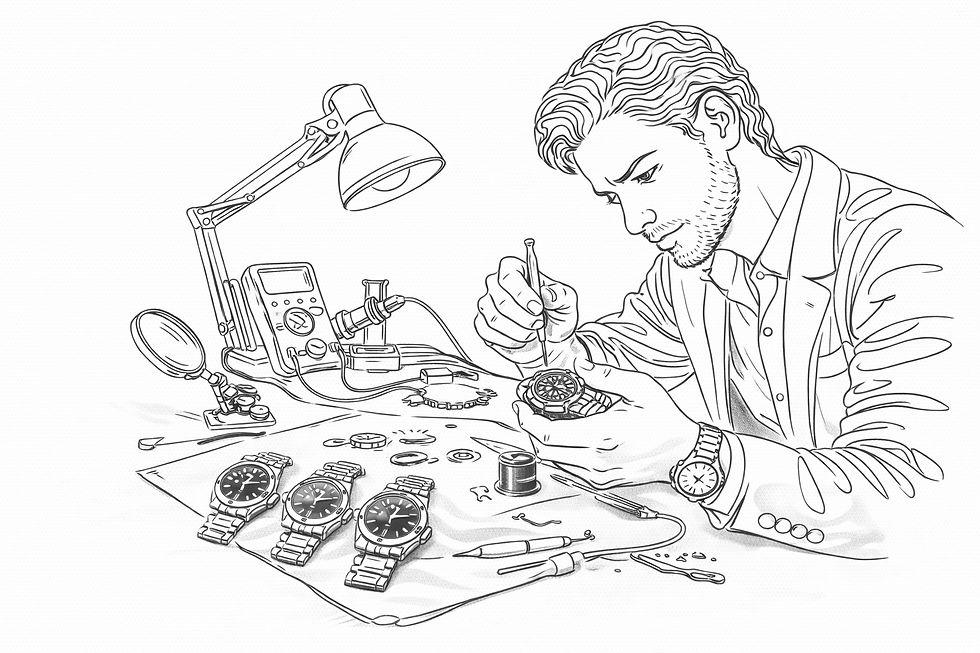
If it's possible to complicate things, why simplify them?
Simplicity, though beautiful and serene, proves boring to Gadgeteers. Clocks displaying hours, minutes, and seconds unsettle him. Life is too short for what is simple.
This collector seeks constant movement. Watches should conceal talents, tricks, and surprises. They should provoke astonishment. Anything static inspires distrust. His case is a veritable amusement park for horological complications.
Engenhocas recognizes that time accelerates or slows down depending on the context. Enthusiasm is the only antidote to slowness. Understanding how a complication works is pure joy in the form of brass and steel. Calmness only arises after complete understanding, similar to that of a mountaineer at the summit. The future represents invention; the past, discovery. The aesthetic aspect matters only as a consequence of the technical process.
The Investor

Buying and selling watches allows one to become familiar with many models. The investor appreciates this knowledge, even if it is only superficially technical. The moment of acquisition is the pinnacle of the experience. They know that, if necessary, they can quickly convert the collection into cash without significant losses.
Security is paramount. Presenting a purchase as an investment neutralizes the guilt associated with luxury. Each watch represents a step on an economic trajectory. The collection becomes a succession of proofs of financial success.
Like a farmer, an investor plants watches and harvests euros. It depends on the environment, the context, and human behavior. The quartz crisis illustrates this instability well. The best defense lies in keen perception and good timing. In the end, you know you control money better than you control watches themselves.
The Committed One

Maintaining a romantic relationship is complex. The committed person finds more stability in a relationship with their chosen brand than in other romantic relationships.
Watching the sunset or having dinner by candlelight with a watch on his wrist is enough for him.
Loyalty requires effort. It's not always easy to remain loyal to a single brand, but some manage it with distinction. Curiosity about other brands is minimal. This relationship is not strange, as the brand offers belonging, community, and predictability. Encounters between followers reinforce this bond.
Betrayals are not tolerated. Abrupt changes in strategy can be felt as emotional ruptures. Loyalty refers to principles, not exclusivity. The Committed One constantly seeks new followers for their brand, strengthening it. They are, among all, the most gregarious of collectors.
We invite you to start 2026 by reflecting on your collecting style. Do you identify with one or more of these profiles? Your opinion is welcome, even if shared anonymously.
Advertising


Comments