
8 October
The day in brief
On 7 October H. Moser & Cie. presented three watches with 30-second retrograde seconds: the Pioneer Skeleton, Streamliner and Endeavour Retrograde Seconds, all in steel and all 40 mm.
On the same day, Jacob & Co. brought back its first minute repeater, the Palatial Flying Tourbillon Minute Repeater, now with the new JCCM04 calibre and a silent centrifugal governor. China's Peacock is taking pre-orders for the Tai Chi Curved Guilloché, a triple-axis tourbillon whose cage measures 8 mm and weighs 0.436 g. In Hong Kong, Phillips revealed the first highlights of its 21–22 November auction, led by a group of rare Patek Philippe watches.
H. Moser & Cie. takes retrograde seconds to three collections

H. Moser & Cie. announced three takes on the same complication on 7 October: the Pioneer Skeleton Retrograde Seconds (reference 3251-1200), the Streamliner Retrograde Seconds (6252-1200) and the Endeavour Retrograde Seconds (1252-1200). They follow the first Pioneer Retrograde Seconds and share a 40 mm steel case.
In all three, the seconds hand sweeps an arc for 30 seconds and returns instantly to zero. The mechanism is on show on the dial side. A double snail cam stays in permanent contact with a finger; as the hand advances, a hairspring placed under its axis stores energy. At the end of each cycle the cam releases that energy all at once and the hand jumps back. A rack, visible beneath the retrograde seconds bridge, positions the hand on its track and keeps the jump under control.
A two-tone disc beneath the cam shows whether the watch is in the first or second half of the minute. That matters: a hand that only covers 30 seconds cannot tell you, on its own, which half-minute you are in.
The solution has a mechanical cost. A retrograde hand of this kind jumps 2,880 times a day, and every jump uses energy and loads the components. Hence the importance of a return guided by the rack rather than left to the spring alone.
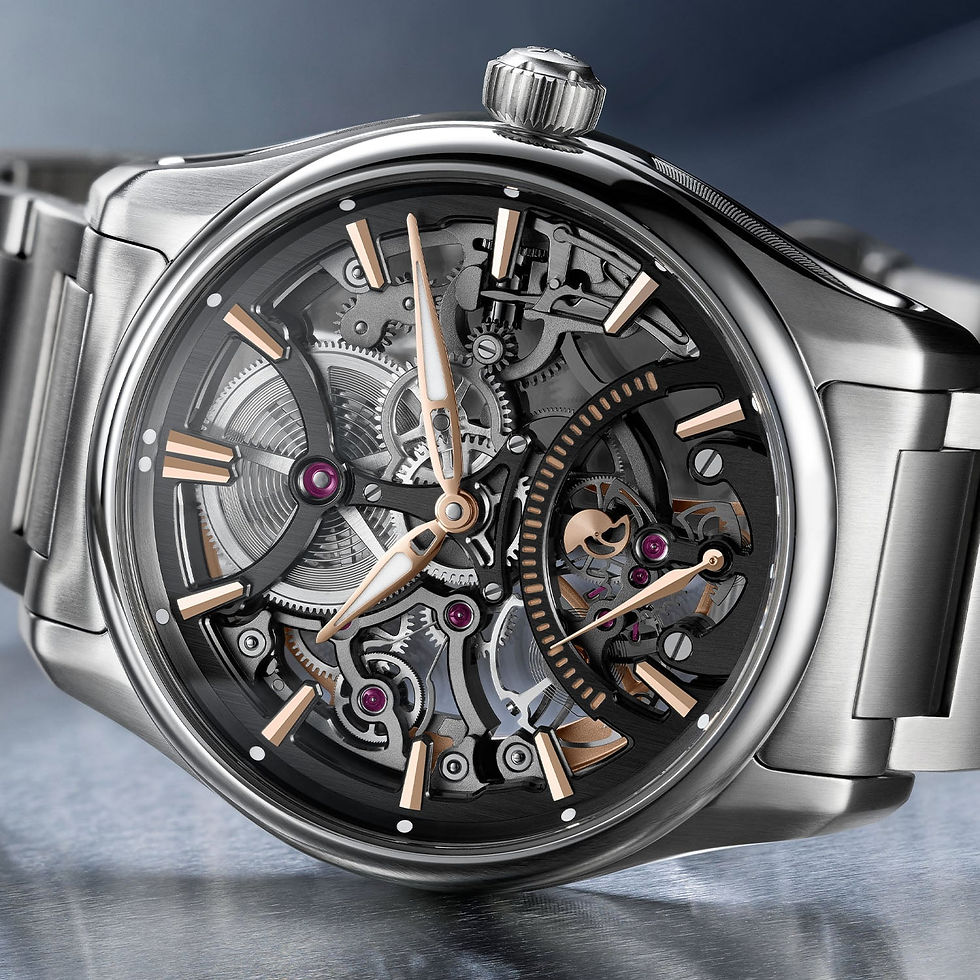
The Pioneer Skeleton uses the self-winding HMC 251 calibre, fully skeletonised, with anthracite-finished bridges, 29 jewels and an engraved, skeletonised oscillating weight. The case is 12 mm thick with the crystal and water-resistant to 12 ATM. It comes on a steel bracelet with a second strap in khaki rubber.
The Streamliner and the Endeavour get the HMC 252, with 31 jewels and partially skeletonised bridges, fitted with a retrograde module developed by Agenhor. The former has a Midnight Blue fumé dial, an integrated steel bracelet, a 12.1 mm case and 12 ATM of water resistance. The latter has a Blackor fumé dial, an 11.2 mm case, 3 ATM and a nubuck alligator strap.
Both calibres measure 32 mm across and 5.5 mm high, beat at 21,600 vibrations per hour, and have hacking seconds, a Straumann hairspring and a minimum power reserve of three days.
According to the brand, prices before tax are CHF 35,000 for the Pioneer Skeleton, CHF 29,900 for the Streamliner and CHF 27,900 for the Endeavour.
Find out more on the brand's website.
Jacob & Co. returns to its first minute repeater

On 7 October Jacob & Co. presented a new edition of the Palatial Flying Tourbillon Minute Repeater, the watch with which the brand first ventured into chiming complications in 2014. There are 12 pieces, one for each year since the original, in the year the house marks its 40th anniversary. The price is USD 390,000.
The new hand-wound JCCM04 calibre succeeds the JCBM03. It has 308 components and 29 jewels, runs at 3 Hz and offers 90 hours of power reserve. It pairs a minute repeater with a one-minute flying tourbillon at 6 o'clock, whose cage has been redesigned.
The repeater is armed by a slide set into the caseband, which supplies the energy for the sequence. Once the slide is released, the watch strikes the hours on a low note, the quarters on alternating high and low notes and the remaining minutes on a high note. Stepped cams, known as snails, hold the information for hours, quarters and minutes; racks read their position and set the number of strikes.
Two hammers strike two cathedral gongs. Longer than conventional gongs, they extend around the movement to increase resonance and lengthen the sound. They are formed, hardened, tuned and fitted by hand, with the final adjustment made by ear.
The most significant technical change is in the centrifugal governor, which controls the cadence of the strikes. According to the brand, it has been engineered to run silently, removing the mechanical noise that interferes with the sound of the gongs. It is a sensitive point in any repeater: the governor's hum is heard between strikes, exactly when there should be silence.
The case measures 43 mm across and 12.3 mm thick. The sapphire back shows the gongs, the hammers and the movement finishing, with Côtes de Genève and hand-polished angles. On the dial, a rose gold G clef at 9 o'clock and skeletonised hands shaped like a metronome complete the musical reference.
Find out more on the brand's website.
Peacock shrinks the triple-axis tourbillon

Peacock, the Chinese manufacture from Liaoning, is taking pre-orders for the Tai Chi Curved Guilloché Triple-Axis Tourbillon, reported by Monochrome on 7 October. The brand presents it as the world's smallest and lightest triple-axis tourbillon, a claim that is its own.
The spherical titanium cage measures 8 mm in diameter, weighs 0.436 g and has 81 components. The three axes complete a rotation in 60, 15 and 50 seconds.
In a classic tourbillon, the regulating organ rotates in a single plane to average out rate deviations in the vertical positions. With two more axes, the balance passes through every orientation, at the cost of more moving mass and more friction. Reducing the size and weight of the cage is the way to limit that energy consumption.
The hand-wound PAX9616 calibre has 37 jewels, beats at 21,600 vibrations per hour and offers a 48-hour power reserve. There are no hands: hours and minutes are shown by two concentric titanium discs, with a white diamond for the hours at 12 and a black diamond for the minutes at 6.
The convex dial is hand-guilloché with 40 V-shaped grooves and divided into two halves, yin and yang. The lugless 18k white gold case measures 43.5 mm in diameter by 14.95 mm thick and is water-resistant to 50 metres.
The edition is limited to 70 pieces, a nod to the brand's 70th anniversary, and costs USD 61,999. Pre-ordering requires a 30% deposit and delivery is expected on 30 June 2027.
Find out more on the brand's website.
Phillips brings a rare group of Patek Philippe watches to Hong Kong

On 6 October Phillips, in association with Bacs & Russo, released the first highlights of The Hong Kong Watch Auction: XXIII, scheduled for 21 and 22 November. According to the auction house, it carries the highest pre-sale estimate of any watch auction it has held in Hong Kong.
The top lot is a first-series Patek Philippe reference 2499 in yellow gold, made in 1952, with a Wenger case and absent from the market for 37 years. The estimate is HK$12 million to HK$24 million (US$1.5 million to US$3 million). The same range applies to a platinum 3990P-011 with diamond-set bezel and indexes and a salmon dial, from around 2006: of the 17 known examples of reference 3990, it is the only one identified in this configuration.
Next comes a pink gold 1518 from 1951, estimated at HK$8 million to HK$16 million. Reference 1518 was the first serially produced perpetual calendar chronograph, and Phillips believes about 58 were made in pink gold. There is also a Sky Moon Tourbillon 5002P from around 2008, with 12 complications and still sealed, estimated in excess of HK$8 million.
Beyond Patek Philippe, highlights include a yellow gold Rolex Daytona 6239 with a "John Player Special" dial, from around 1969, estimated at HK$3.9 million to HK$7.9 million, and a unique white gold Cartier Crash from the brand's special order programme.
Estimates do not include the buyer's premium. Before the sale, the lots travel to New York (14–16 October), Singapore, Hong Kong, Taipei and Geneva (4–8 November).
Find out more on the auction house's website.
Worth watching
H. Moser & Cie.'s retrograde hand and Jacob & Co.'s silent governor have one thing in common: in both cases the engineering effort goes into managing energy released in an instant, whether the jump of a hand every 30 seconds or a sequence of strikes on demand. Peacock's proposal shows, for its part, that Chinese high complication is now measured in fractions of a gram, even if the records announced remain brand claims.
The TimeForArt auction, on 5 December in New York, keeps revealing unique pieces. On 7 October Gerald Charles announced the Maestro GC39 Mitoraj, a 42 mm titanium Grand Maestro jumping hour with a brass miniature of Igor Mitoraj's sculpture "Luci di Nara" set on a guilloché dial. On the same day, Perrelet presented a 42 mm Lab Peripheral whose dial and peripheral oscillating weight were decorated with coloured stripes by Chris Alexander, The Dial Artist. Jaquet Droz makes its debut at the auction with a champlevé enamel dial designed by Fiona Djukanovic, a student at the Académie de Meuron. Proceeds go to the Swiss Institute.
Coming up: the GPHG travelling exhibition reaches Bangkok from 15 to 18 October, opened by the President of the Swiss Confederation, Guy Parmelin; the 19 prizes will be awarded on 7 November in Geneva. In Mexico City, SIAR holds its 20th edition from 20 to 22 October with 50 brands, according to WorldTempus. And Bell & Ross has a new BR-03 Green Radar Ceramic, limited to 999 pieces, in which three discs carrying aircraft replace the hands, according to Monochrome.


Comments