
At Krayon, everything begins at the tip of a pencil


Anywhere Métiers d'Art Azur, 2022 @ Krayon
Krayon has slowly been earning its place, in its own right, among the most interesting houses to have emerged this century. Its recent performance at the Grand Prix d'Horlogerie de Genève is a good excuse to take a closer look at who Krayon is and where it comes from.
Rémi Maillat is the designer, watchmaking engineer and founder of Krayon. A friendly, unassuming and seemingly shy character, Maillat has the enviable ability to turn the most complex mathematical calculations into fascinating horological creations. And since all his pieces literally begin with a sketch drawn with the tip of his pencil, the name “Krayon” (a word for chalk or pencil in French) came about naturally and spontaneously.

Everywhere, 2017 @ Krayon
In June 2017, Maillat presented his first creation, which he called “Everywhere”, followed by a variant of this model made at a client's request. The “Everywhere Horizon” went on to receive the Best Horological Innovation prize awarded by the jury of the Grand Prix d'Horlogerie de Genève at its 2018 edition.
Anywhere, 2020 @ Krayon
In 2020 came the “Anywhere”, a creation its maker describes as true to the concept of the art of singular timekeeping and as a synthesis of mathematics, watchmaking and poetry with a genuine philosophical dimension.

Anywhere Métiers d'Art Only Watch, 2021 @ Krayon
The following year Krayon took part for the first time in the Only Watch auction, with the “Anywhere Métiers d’Art”, a unique piece decorated with a magnificent sunset by Claude Monet, which ended up selling for four times its initial estimate.

Anywhere Métiers d'Art Azur, 2022 @ Krayon
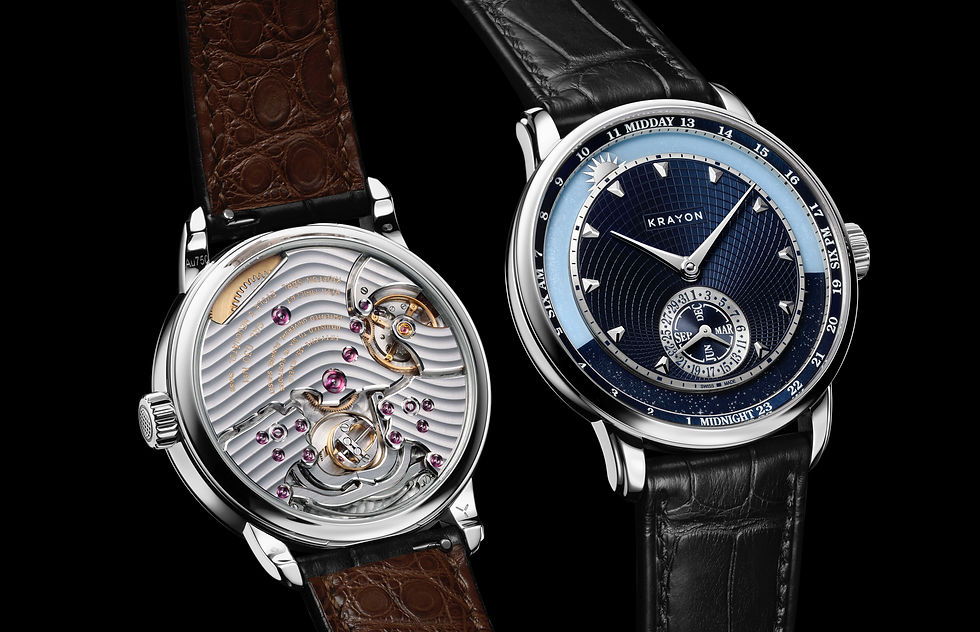
In 2022 the brand returned with a new creation, the “Anywhere Métiers d'Art Azur”, limited to just 15 pieces, which won the prize in the “Calendar and Astronomy” category at this year's Grand Prix d'Horlogerie de Genève.
Those who follow everything surrounding watches and watchmaking most closely usually hold models with date functions or astronomical indications in special regard, not only because of the level of complexity needed to make them, but also because these indications are directly related to the observations made by the first civilisations of distant ages. For those who grasp the true scale of this achievement, a watch with a date gives us direct access to the cosmos, a connection made all the more rewarding by its symbolism and by the fact that it is genuinely rooted in the science of watchmaking.
The calendar is, then, a mechanical solution to an astronomical problem. From ancient Egypt to Rome by way of Ancient Greece, from astronomers to mathematicians, not forgetting the inescapable men of God, the history of the calendar has always centred on the question of how to fit the lunar and solar calendars into a table of whole numbers.

Anywhere Métiers d'Art Azur, 2022 @ Krayon
Wherever it may be on the globe, the Métiers d'Art Azur shows the hours and minutes by means of two hands at the centre of a dial that appears to be suspended. The dial is surrounded by an annular zone around which a small sun travels in perpetual motion, indicating the time over 24 hours.
The ring-shaped indication is divided into two parts: a day sector (sky blue) and a night sector (midnight blue), whose respective extents are constantly moving, their positions indicating the times of sunrise and sunset.

Calibre C030 of the Anywhere Métiers d'Art Azur, 2022 @ Krayon
To integrate this geographical element, Krayon developed an innovative mechanical positioning system. Through this mechanism, the relative position of the two sapphire discs is determined not only by their reference position but also by the calendar. To this end, the Anywhere Métiers d'Art Azur displays the date and month on a subdial at 6 o'clock. It is a dual calendar in which every month lasts 31 days. In other words, the system requires five adjustments a year, made quickly and easily via the crown in both directions.
The movement
The Krayon Anywhere Métiers d'Art Azur is fitted with Calibre C030, developed and entirely assembled in Neuchâtel, Switzerland, by Rémi Maillat himself. The calibre is a direct descendant of the one created for the Anywhere built for the 2021 Only Watch charity auction.

The apparent simplicity, width and thickness relative to its complexity (just 5 mm) of this hand-wound movement (432 components, 86-hour power reserve) belie a surprising ability to define a geographical and temporal space tailored to the user. Following a principle dear to Rémi Maillat, the happy owner can set the watch to a city or place of their choice, together with the corresponding sunrise and sunset indication.
And if we were to dive into the features and crafts that decorate this Krayon Anywhere Métiers d'Art Azur, we would certainly have room for a good few more pages (or screens). But we leave that exercise in our readers' hands. Just visit Krayon's page here.


Comments