

I.W.C. | 1899 | Silver

Series: GREAT BRANDS
By: Sílvio Pereira
- Lépine-type pocket watch. Dated 1899
- Functions: hours, minutes, seconds
- Serial number: 215779
- Manufacture: International Watch, Cº.
- Country - Switzerland
- Calibre: three-quarter plate format. No number
- Movement protection: silver dust cover.
- Escapement type: Swiss lever
- Balance: bimetallic, temperature-compensated, with Breguet hairspring
- Power reserve: 36 hours
- Frequency: 18,000 vph
- Jewels: 13
- Case material: silver - 0.900
- Dial: enamel with small hairline cracks
- Small seconds: at 6 o'clock
- Case diameter: 52.9mm
- Thickness: 17.10mm
- Weight: 113.27g
- The mainspring is wound via the crown at 12 o'clock.
- Hands: Breguet type. Set via the crown. Pin to release the stem.
- Numerals: Arabic for the hours. Indexes for the minutes. Seconds: Arabic at 10-second intervals and indexes for the rest.
- Crystal: in excellent condition.
- Caseback number: 232877
Overall assessment - A watch from one of the most important brands in world watchmaking, in an excellent state of preservation. It works perfectly.
Other pieces in the collection
I.W.C. |1939 | Steel
HISTORY OF I.W.C. (International Watch Cº.)

How it all began
For IWC, it all began in 1868 with the American engineer and watchmaker Florentine Ariosto Jones, who decided to leave the USA and travel to Switzerland in search of new and better business opportunities. Essentially, he wanted to avoid the cost of labour in his home country and use more affordable labour in Switzerland. Shortly afterwards, he founded the International Watch in Schaffhausen, where he harnessed the power of the waters of the Rhine to drive his machines. With its American roots, IWC became a household name in the Swiss watch industry.
Brand history
Florentine Ariosto Jones was a man with a plan. Jones was born in New Hampshire in 1841 and fought in the American Civil War. After the war, he began working at E. Howard & Co, a Boston-based watch and clock maker. He started his career there, but he had a more ambitious plan for the future.
The plan was to find a location in Switzerland to set up a factory and begin producing watches. He brought modern machinery from across the ocean and trained highly skilled Swiss workers to operate it. The idea, at first, was to produce high-quality movements and watch parts for the American market at a very competitive price. This was mainly due to the lower cost of labour in Switzerland. He first looked for the right location in the French-speaking Swiss cantons, but could not find one that suited his needs perfectly.

IWC factory in Schaffhausen
The early days of the IWC brand
When Jones met Johann Heinrich Moser – a watchmaker and manufacturer from Schaffhausen, in eastern Switzerland – everything fell into place. Moser, a pioneer in the industry, had just established a hydraulic power station driven by the waters of the Rhine. This facility supplied cheap energy, and Jones saw the opportunity and decided to set up the base of operations of the International Watch Company (IWC) near this hydraulic power station on the banks of the river.
A good reputation does not mean lower taxes

Group of pocket watches with the Jones calibre
Jones quickly built a standing, both for himself and for IWC, with the introduction of the advanced “Jones calibre” for pocket watches. Unfortunately, a good reputation on its own was not enough. His plan to export to the USA did not generate enough revenue, mainly because of the high US import duties. As a result, the company went bankrupt, making its creditor, the Schaffhausener Handelsbank, its new owner. In 1874, the bank turned IWC into a public limited company, which would not last long either. In 1880 the company went bankrupt once again. It was at that point that Johannes Rauschenbach bought the company and successfully steered IWC into calmer waters. It was also the time when the “Probus Scafusia” philosophy was introduced. The Latin phrase stands for the proven excellence of the company's Schaffhausen product.

IWC Schaffhausen Probus Scafusia seal
The many names behind the IWC brand
There have certainly been a number of significant changes throughout the history of the IWC brand. Many generations of Rauschenbachs led the family business. The last member of the Rauschenbach family in charge of the company was Hans Ernst Homberger. Owing to the quartz crisis, rising gold prices and a weak dollar, he was forced to sell IWC to the German company VDO Adolf Schindling AG in 1978. Both Jaeger-LeCoultre and Lange Uhren GmbH were, at certain points in their histories, owned by VDO.
Later, in 1991, VDO merged with the multinational Mannesmann. The telecommunications giant Vodafone bought Mannesmann in 2000. Shortly afterwards, Vodafone sold IWC and other watch brands to the Swiss watch conglomerate Richemont. Under Richemont's wing, IWC began a second, far more dynamic life.

Tribute to Pallweber Edition 150 Years Ref. IW505002
The material side of IWC
The spirit of innovation has always been an important element at IWC and, in 1885, it was this spirit that led to the creation of revolutionary pocket watches with a digital display. These watches were an invention of Mr Pallweber and were produced by IWC. Today, these peculiar IWC pocket watches with enamel dials have become rare and highly sought-after collector's items.

Porsche Design 1980 Titan Chronograph
Another highlight in the history of the IWC brand is the world's first wristwatch made entirely of titanium. Designed by FA Porsche and produced in 1980 by IWC.
The IWC Pilot's watch

Mark XI
Let us begin our look at the IWC collection with its Pilot's Watches. IWC's aviation story begins in 1936, when the brand launched its first wristwatch designed especially for pilots. It is a watch fitted with an antimagnetic inner case to keep the movement safe from disruptive magnetic fields. The large “Beobachtungsuhr”, which we know today as the Big Pilot's Watch, first appeared in 1940. The much smaller Mark XI was launched in 1948. A watch that loyally served the English pilots of the RAF for more than 30 years. Long enough to secure its cult status. All of IWC's classic aviation watches are, first and foremost, technical timekeeping instruments for the pilots who wear them. Their ultra-legible black-and-white dials underline this fact. The Mark XII is another excellent example of its austere, functional aesthetic.
Modern Pilots

Doppelchronograph reference IW3713
Modern Pilot's watches are some of the most popular IWC models. The Big Pilot's Watch is probably number one on the list. It is one of the best-known and most admired IWC models today. The reinterpretation of the classic “Beobachtungsuhr”, reference 5002, was launched in 2002. Other desirable and highly sought-after watches are the Fliegerchronograph and the Doppelchronograph from the 1990s and 2000s. For lovers of XXL watches, the Heritage Big Pilot's Watch (48 mm) and the Heritage Big Pilot's Watch (55 mm) are the most exciting.

IWC Big Pilot’s Watch 43 TOP GUN Ceramic
Truly bold and colourful are the Top Gun models that first came onto the market in 2006. More flamboyant than ever, these watches target a new audience that wants more than just black-and-white functionality.

The Big Pilot Ref. IW501015
In the current collection, the standouts are the slim Big Pilot's Watch 43, as well as the green Big Pilot's Watch IW501015 and the complicated Big Pilot Perpetual Calendar.
Technology first for the Ingenieur

Ingenieur advertisement
The antimagnetic inner case that debuted in the brand's aviation watches was also put to good use in IWC's Ingenieur line. This highly technical watch was launched in 1955. But it was the renowned designer Gérald Genta who made the watch famous. His 1970s creation called the “Ingenieur SL” has a classic Genta look that has much in common with his other famous creations. The Ingenieur SL has a flat, porthole-like bezel with five recesses drilled around it, in true Genta style. It also has an integrated metal bracelet.

Ingenieur Ref. 3227
The Ingenieur 3227 (produced from 2005 to 2009) was the first of IWC's new line of Ingenieur watches, with a design loosely based on the Ingenieur SL model of the 1970s. The Ingenieur Reference 3239 introduced in 2013 was part of a collection that also kept this rather appealing Genta design. Unfortunately, IWC discontinued that particular collection of Ingenieurs.

Ingenieur Automatic Carbon
The current Ingenieur family goes back to the original, slightly rounder design of the 1950s. One might think that the Ingenieur would be the watch chosen for the Mercedes AMG Petronas Formula 1 team sponsored by IWC, but Lewis Hamilton and Valtteri Bottas promote the brand's Pilot's watches, thus ruling out the team's choice.
Making waves with the IWC Aquatimer

Aquatimer
A watchmaker is not a true manufacture without a dive watch. Perhaps that is why IWC introduced its Aquatimer in 1967. Although more likely it was commercial reasons that motivated the brand's decision, but never mind. Which is the most famous IWC dive watch? The Deep One? Probably. The Deep Two? Also interesting. Or the Deep Three? At 48.3 mm, probably the largest IWC of all time. But somehow it would not be fair to label any of these three models as “IWC's most famous dive watch”.

Porsche Design IWC Ocean 2000 calibre 3500
Another good candidate for the title could be IWC's 1982 titanium Porsche Design Ocean 2000 calibre IW35000. More modern, but still interesting, are the Aquatimer models with calibre IW323101 from the 2008 Vintage Collection, which is strongly influenced by the design of the original 1960s watch. There are also the Aquatimer Chronograph Edition “Galapagos Islands” (Ref. IW379504) and the Aquatimer Chronograph Edition “Expedition Charles Darwin” (Ref. IW379503). The conclusion we reach is that IWC is simply not a brand known for its dive watches. That is just an opinion; some prove quite interesting in their own right, but none of them is as iconic of the brand as its Pilot's watches.
Innovation and inventions in true Da Vinci style

Da Vinci. Perpetual calendar and chronograph calibre 3750
The source of inspiration for the original Da Vinci model in 1985 was a sketch by Leonardo Da Vinci. The Renaissance genius drew a circular bastion based on concentric fortification rings, with water-filled moats between the rings. All versions of the Da Vinci – both the original and the most recent – follow this unmistakable design. The concentric rings create an elegant dial layout and house a range of complications in all the models of the Da Vinci line.

Da Vinci. Perpetual calendar and chronograph calibre IW392101
The Da Vinci is the most luxurious and opulent collection made by IWC. Historically, the Perpetual Calendar is the most iconic model of the Da Vinci collection. Master watchmaker Kurt Klaus invented and built a perpetual calendar mechanism designed to sit on top of a chronograph movement. The Da Vinci Perpetual Calendar Reference 3750 was the world's first movement mechanically programmed for the next 500 years and adjustable simply by turning the crown. A mechanical marvel in a case distinctly in the style of the 1980s.
The gentleman of Portofino

Portofino
Now we come to the Italian-inspired segment of the IWC brand's history. The name Portofino is linked to a famous town on the Italian Riviera coast, which became famous for its jet-set visitors. The name brings to mind crystal-clear Mediterranean waters, colourful old houses and “sprezzatura”: the studied nonchalance that characterises elegant and envied Italian men. Inspired by this concept, IWC produced a series of watches under the name. The watches in the Portofino collection show IWC's more formal side.
The IWC Portugieser — ahead of its time
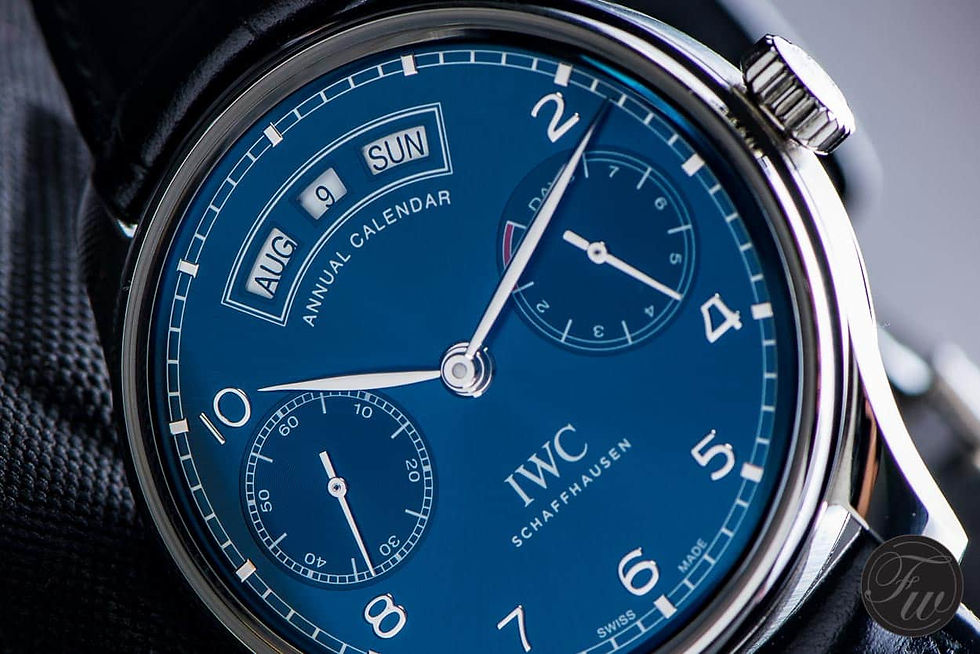
IWC Portugieser annual calendar
The name derives from the two Portuguese businessmen, Rodrigues and Teixeira, who visited IWC's headquarters in Schaffhausen and proposed the development of a large stainless-steel wristwatch with a movement that could match the precision of a marine chronometer. To achieve perfect legibility and the highest precision, the only way to bring their vision to life was to place a pocket-watch movement inside a wristwatch case. With a diameter of 43 mm, the first Portugieser was considered enormous compared with the popular wristwatches of 1939. At that time, a watch was generally not much larger than 33 mm, and the Portugieser looked nothing like the Art-Deco-style watches of the period either.
In 1993, IWC introduced a new limited-edition Portugieser. This model marked the starting point of the modern Portugieser collection. Together with the Pilot's watches, the Portugieser is one of IWC's main collections. The Portugieser Automatic - with its 7-day power reserve, applied Arabic numerals and leaf-shaped hands - is definitely the backbone of the collection. The Portugieser Perpetual Calendar and the Portugieser Annual Calendar show IWC's complicated side in an elegant way.
Moving forward with movements

IL Destriero Scafusia
On the movement side, IWC was never a leader in terms of innovation, unlike other Swiss haute horlogerie manufacturers. But after the 1985 Da Vinci Perpetual Calendar, things began to change at the Schaffhausen factory. The “Grande Complication”, the even more complicated “Il Destriero Scafusia” and the “Doppelchronograph”, with a module designed by Habring, from the 1990s onwards, were shining examples of the brand's movement expertise.

IWC Calibre 5000
It was not until 2000 that IWC launched its in-house automatic Calibre 5000. A movement entirely designed, manufactured and assembled at the IWC manufacture. Using IWC's proprietary Pellaton system, this 8-day automatic movement marks the birth of the Schaffhausen-based brand as a movement manufacturer.
The heaviest IWC weighs 4.4kg and is made of paper

Book IWC Schaffhausen — Engineering Time since 1868
Four kilos and four hundred grams, 536 pages and more than 500 photos and illustrations. “IWC Schaffhausen — Engineering Time since 1868” tells the story of IWC in an unorthodox way. That is because IWC asked the cartoonist Enki Bilal and the best-selling spiritual author Paulo Coelho to contribute. Bilal illustrates Paulo Coelho's six tales corresponding to the different product families, thus creating a book within a book.
Manfred Fritz was IWC's choice to lead this important project. Fritz is not only the former editor-in-chief of the German newspaper Rhein-Neckar-Zeitung, but also the author of the 1991 book “Die Grande Complication von IWC”. Another must-read for fans of the brand who want to read more about the history of IWC. The book is not an encyclopaedia of the brand, but an accessible journalistic history complemented by literature and art. “IWC Schaffhausen. Engineering Time since 1868” is available in German, French and English and can be bought online. At around € 170, this is not only the heaviest IWC of all time, it is also the most affordable!


Comments