
Listening to a watch: what the timing machine tells us

A mechanical watch can be heard: with every tick, the escapement makes a small sound. The timing machine turns that sound into numbers — how much the watch gains or loses per day, how far the balance swings, whether the tick and the tock are evenly spaced. This is how a watchmaker assesses a movement without taking it apart.
A microphone and a reference clock
In essence, a timing machine is a sensitive microphone connected to a very precise internal clock. The watch is held in a stand with the microphone, which picks up the impacts of the escapement; the machine compares the rhythm of those sounds with its reference and displays the result as numbers and a graph.
The measurement is made without opening the watch. That is why it serves both the watchmaker, to decide whether a movement needs servicing, and manufacturers, to check watches before they go on sale.

The four numbers
Once the machine picks up the ticking, four values appear on the screen:
Rate (seconds per day): how much the watch gains or loses in 24 hours.
Amplitude (degrees): how far the balance turns in each oscillation.
Beat error (milliseconds): the time difference between the tick and the tock.
Frequency (vibrations per hour): the rhythm of the movement; modern machines detect it automatically.
How amplitude is measured
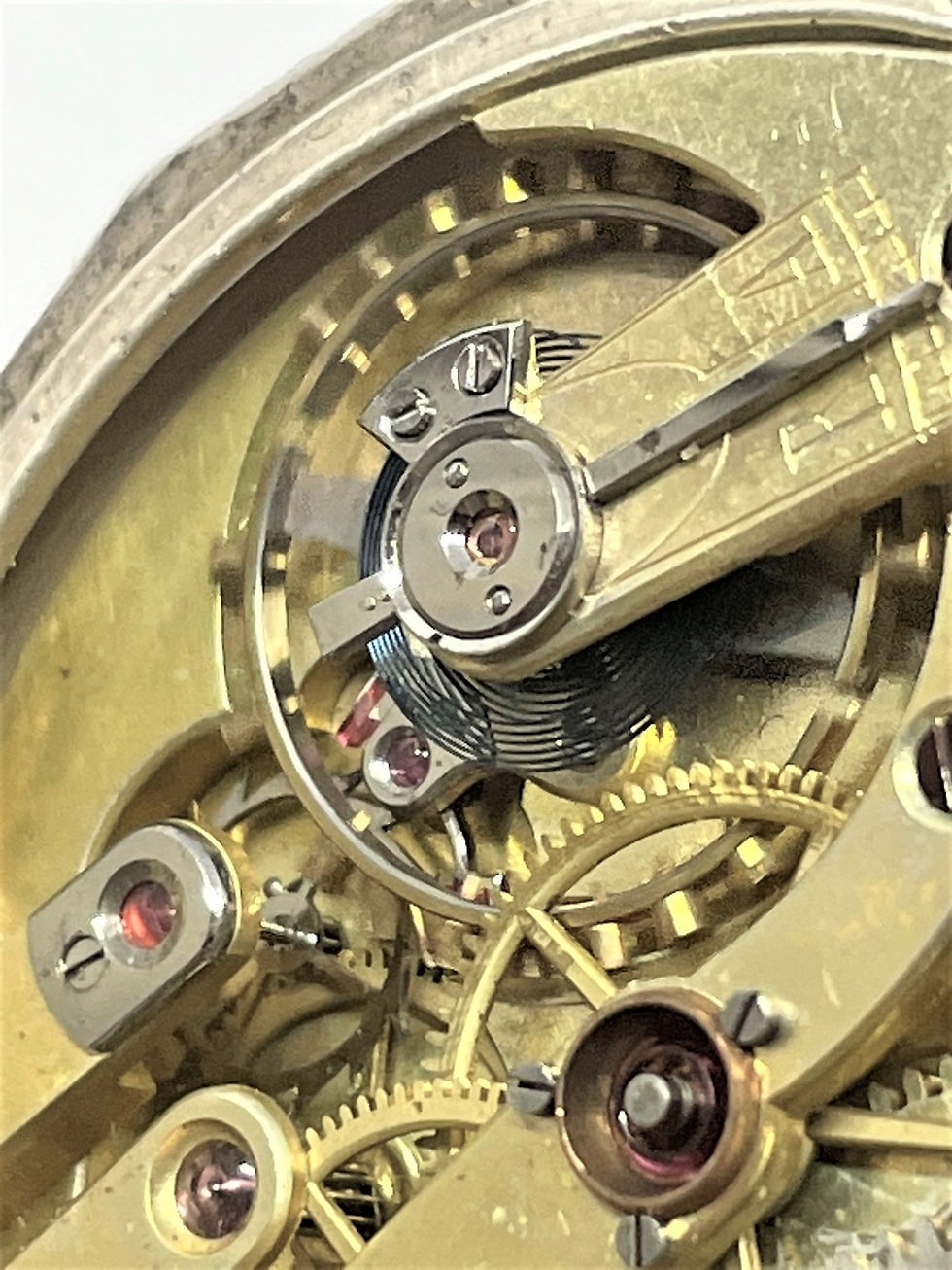
Amplitude cannot be heard directly: it is calculated. Each beat is made up of several sound pulses, and the machine measures the time between the first and the third. In that interval, the balance travels through a fixed angle, set by the design of the movement: the lift angle. The greater the amplitude, the faster the balance crosses that angle and the shorter the time between the two sounds.
That is why the lift angle must be entered into the machine, and a wrong value gives a wrong amplitude. Each calibre has its own. For the ETA 6497, the movement used in the IPR's classes, ETA's technical sheet for the 6497-2 version gives 44° and a frequency of 21,600 vibrations per hour.
Amplitude also depends on the state of wind: it is greater with a fully wound barrel than after several hours of running. To interpret it, you need to know what is normal for that movement.
Reading the trace
Below the numbers, the machine plots dots, one for each tick, forming two lines: one for the tick and one for the tock. If the lines are flat, the watch is on time; if they rise, it is gaining; if they fall, it is losing. With no beat error, the two lines overlap; when there is an error, they move apart, and the larger the error, the wider the gap.
Flat line, watch on time. Rising line, gaining. Two lines apart, tick and tock out of step.
Why measure in several positions
In everyday life a watch changes position: on the wrist, lying on a table, in a drawer. And the balance does not behave the same way in all of them: amplitude can be lower with the watch vertical than horizontal.
That is why COSC chronometer tests, defined by the ISO 3159 standard, measure movements in five positions and at three temperatures (8, 23 and 38 °C), over about 15 days. To be certified, a movement must keep an average daily rate between −4 and +6 seconds, and the difference between horizontal and vertical positions must stay within −6 to +8 seconds.
On professional machines, the change of position can be automatic. Witschi makes a microphone that measures on its own in ten positions, and production systems that measure ten or twenty watches at once.
And for a vintage watch, what is normal?
There is no single value: it depends on the calibre, its age and its condition. But there are benchmarks that watchmakers and collectors use to assess a vintage watch on the timing machine, fully wound:
Amplitude: between 270° and 310° is very good; between 250° and 270°, acceptable. Below 200°, the watch needs servicing.
Rate: up to ±7 seconds per day is excellent; up to ±20 seconds, acceptable.
Beat error: ideally 0.0 ms. Above 0.4 ms, the watch may be poorly regulated; above 0.8 ms, there may be a problem with the balance.
Some difference between positions is normal, especially in a vintage watch that has loosened up over many years of use. And some calibres never reach the values of today's movements: a freshly serviced Seiko 6139, for example, should reach at least 220° of amplitude and, with work done well, around 260°.
From numbers to diagnosis
Reading the machine is making a diagnosis. A watch that suddenly starts gaining a lot may be magnetised: the coils of the hairspring stick together, the hairspring becomes effectively shorter, the balance oscillates faster and the watch can gain several minutes a day. After demagnetising, it is measured again: if the rate is back to normal, the problem is solved.
The machine also helps identify faults in the escapement or the gear train, and it is the watchmaker's reference during regulation: the watch is adjusted and the result is checked on the screen straight away. At the end of a service, it shows whether the work was done well.
The IPR runs watchmaking courses and workshops for individuals and companies. Find out more at institutoportuguesderelojoaria.pt.
Sources


Comments