
The 18th Century, the Century of the Great Watchmakers (Part 1)

By: Sílvio Pereira
Markwick, Markham, Perigal | 1720 | Silver Dial | Triple Case | Brass
Brass plates, fusée movement, verge escapement with Tompion regulator, cock with a “D”-shaped foot. Silver dial. Tulip pillars
Continuing my series on the history of watchmaking, which began with 3 articles on the 17th century that I published earlier, and prompted by the presentation of the watch above, dated 1720, which is part of the collection, I decided to look a little further into the history of watchmaking in the 18th century, considered the century of the great watchmakers.
In this first part I will cover the history of the watchmakers, or historical facts linked to watchmaking, from the beginning of the century up to George Graham.
This research will result in a series of articles on the horological history, and more, of that century, which I will be publishing over the coming months.
Happy reading!
18th Century (part one)

During the 18th century, English and French watchmakers continued to produce a large number of watches, with steadily improving quality and precision. The distinct styles of watches developed by each of these countries were refined until the end of the century, when exchanges between them increased, giving rise to a more uniform style of large, flat watches.

From left to right: tulip, Egyptian, square baluster, round baluster
Both countries went through a change of style in their pillars, moving away from the tulip and Egyptian styles towards square balusters. At the end of the 18th century this style became shorter, thinner and rounded, partly owing to the effort to produce thinner, flatter watches. The use of pillars became obsolete as new movement layouts adopted separate bridges, doing away with one of the plates. This system was invented by the French watchmaker Jean-Antoine Lépine and perfected by Abraham-Louis Breguet.
Although they had specialised in producing cheaper copies of French and English watches since the end of the 17th century, Swiss watchmakers began to enter the trade in rough movements (ébauches), exporting them above all to France. Later, centres producing high-quality watches were developed, aimed mainly at the Ottoman and Chinese markets. A few notable watchmakers stood out, most of them associated with Jacques-Frédéric Houriet.

In England, watches kept the single-footed cock, but the “D” shape, so fashionable at the end of the 17th century, was kept only until about 1710. From then on, the foot became narrower and the diameter of the cock itself was reduced. An exception were the few large, important watches built around John Harrison’s “H4” and the chronometers of Thomas Mudge, which had cocks with two feet because of their large size, recalling the Dutch style. The English kept their system of winding from the back on all watches, but added a dust cap that protected the mechanism from dust once the cylinder escapement was introduced. Silver and gold as dial materials were replaced by enamelled copper. One of the most important English contributions to accurate timekeeping in the early 18th century was made by George Graham, who perfected the cylinder escapement and used it from 1725/6. Thanks to his improvements, watches began to be made thinner and smaller.
Cases remained fairly plain, with occasional engraving, such as a coat of arms, at the beginning of the century. This changed around 1740, when quite elaborate gold and silver cases with refined workmanship appeared. The English preferred their pair-case system, while the French continued to house their movements in a single consular case (1).

From left to right: Mould used to make the refined repoussé decoration on case backs. Two examples of English watches with gold "repoussé" cases. Ashmolean Museum, Oxford
During the 1750s, Thomas Mudge developed the lever escapement and, at the same time, the longitude problem was tackled by several watchmakers, inspiring John Harrison to develop one of the most famous timepieces in history: the “H4”. Other watchmakers simplified Harrison’s concepts, creating 'Chronometer' watches, the most accurate pocket watches of their time. John Arnold and Thomas Earnshaw began perfecting temperature-compensated balances in the construction of marine chronometers, some of which accompanied the most important geographical expeditions of the 18th century.
Andrew Dunlop, London, No. 505, ca. 1705


Andrew Dunlop, a talented watchmaker recorded between 1701 and 1732, is known for his impressive creations in gilt brass. A notable example is this watch with a verge fusée movement and Tompion regulator, adorned with a slightly angled “D”-shaped cock foot. This magnificent watch features tulip pillars (2) as part of its design, although the movement is not working, and the dial and hands are missing.
Dunlop became famous for making the turret clock for Hawkley House, Blackwater, in 1716, demonstrating his mastery in creating impressive clocks. He was also known as a skilled maker of longcase clocks(3). Dunlop shared his knowledge with a number of apprentices, including Conyers Dunlop, who began working as his apprentice in 1725.
Unification of Great Britain 1707:

The political union that joined the kingdoms of England and Scotland took place in 1707, during the reign of Queen Anne. It was then that the Acts of Union ratified the Treaty of Union of 1706 and merged the parliaments of the two nations, forming the Kingdom of Great Britain, which covered the whole island. Before that, a personal union had existed between the two countries since the Union of the Crowns of 1603 under James VI of Scotland and I of England.nstruc

t the refined decoration of the backs
As queen regnant, Anne’s coat of arms before the union (picture on the left) were the royal arms of the Stuarts, in use since 1603: quarters I and IV grand quarterly, azure three fleurs-de-lis or (for France) and three lions passant guardant (for England); II, a lion rampant within a flory tressure (for Scotland); III, azure, a harp or (for Ireland). In 1702 Anne adopted the motto semper eadem (always the same), the same motto used by Queen Elizabeth I. The Acts of Union declared that: “the ensigns armorial of the said United Kingdom shall be such as Her Majesty shall appoint”.
In 1707 the union was expressed heraldically by placing the arms of England and Scotland side by side in the same quarter, where previously they had been in different quarters. The new arms (picture on the right) were: quarters I and IV, three golden lions passant guardant (for England) impaled with a lion rampant within a double “tressure flory-counter-flory Gules” (for Scotland); II, azure, three fleurs-de-lis (for France); III, azure, a harp or (for Ireland). For Scotland, a separate form of the arms was used on seals until the Act of Union.of the
Robert Simkins, London, 1707/1714*

s cases

This is an exquisite gilt brass watch with a verge fusée movement (dial plate 42.2 mm, 15.3 mm high between the plates) and Tompion regulator. The design features a “D”-shaped cock foot with the royal arms and Egyptian pillars (decorative elements reflecting the influence of ancient Egyptian architecture), which add a touch of elegance to the whole. Originally the watch had a meticulously crafted silvered “champlevé” dial. Later, however, it was replaced by a white enamelled copper dial, which is almost perfect in its immaculate appearance. The cock is notably engraved with the British royal arms and bears the motto of the Order of the Garter, “ONY SOIT QUI MAL Y PENSE” (shame on him who thinks evil of it). The motto “SEMPER EADEM” (always the same), skilfully engraved, can also be seen. At the base of the cock stands out an engraved profile portrait of Queen Anne, adding a touch of majesty and historical heritage.
The cock shows the arms of Queen Anne after the unification of England and Scotland into the Kingdom of Great Britain. However, owing to the small size of the cock, it is not possible to show all the details of the central quarters of the arms. This piece was probably made as a commemorative item for the union in 1707, or for Queen Anne after her death in 1714.
There are older commemorative watches bearing the royal arms, such as those made in memory of William III in 1702. These watches usually show the English arms and do not normally include portraits at the base of the cock. Although there is an example in the British Museum that was made to celebrate the coronation of Queen Anne on 8 March 1702, the piece described here is clearly later than that period.
It is unlikely that this movement, like other similar ones, was a royal commission, since the quality of manufacture does not meet the standards normally required. Moreover, most royal commissions usually included the signature or initials of the patron, as well as a dedication.
Example from a private collection, Lille
*Robert Simkins, apprentice of John Beeckmann, was dismissed from the watchmaking firm where he worked on 02/05/1709. He was apprenticed to 4 watchmakers between 1711 and 1721.
Queen Anne 6.2.1665 – 1.8.1714

Anne ascended the throne of England, Scotland and Ireland on 8 March 1702, becoming queen of those three kingdoms. It is important to note, however, that Scotland already had its own monarch, King James VIII, who lived in exile in France. The union between England and Scotland came about through the Acts of Union, which consolidated the two kingdoms into a single sovereign state known as Great Britain.
After the union of the two kingdoms, Anne continued to reign as queen of Great Britain and Ireland until her death in 1714.
Anne was born during the reign of her uncle Charles II, who had no legitimate children to succeed him. Her father, James, was next in line to the throne, but his Catholicism was unpopular in England. On Charles’s instructions, Anne was raised as a Protestant. Three years after Charles’s accession, James was deposed in the “Glorious Revolution” of 1688. His Protestant son-in-law and nephew, William III, became monarch together with his wife, Mary II, Anne’s elder sister.
Although the sisters were close, disagreements arose soon after Mary’s accession over finances, status and the choice of Anne’s companions, which drove them apart. William and Mary had no children, and after Mary’s death in 1694 William continued as sole monarch until he was succeeded by Anne after his death in 1702.
As queen, Anne favoured the moderate Tory politicians, who were more likely to share her Anglican religious views, over their opponents, the Whigs. During the War of the Spanish Succession the Whigs grew stronger and held several important government posts. In 1710, however, Anne dismissed many of them. This action weakened the Whigs and consolidated the power of the moderate Tories in government. Anne’s close friendship with Sarah Churchill, Duchess of Marlborough, deteriorated because of political differences.
Anne was plagued by a series of health problems throughout her life. From her thirties onwards her physical condition deteriorated progressively, resulting in difficulty walking and significant weight gain. Sadly, despite seventeen pregnancies, none of her children survived her, and she became the last monarch of the House of Stuart.
Under the terms of the Act of Settlement of 1701, Anne was succeeded by her second cousin, George I of the House of Hanover, who was descended from the Stuarts through his maternal grandmother, Elizabeth, daughter of James VI. In July 1714 Parliament passed the Longitude Act and established the Board of Longitude.
On 1 August 1714, sadly, Queen Anne died. She was buried beside her husband and children in the Henry VII Chapel, in the south aisle of Westminster Abbey. The funeral took place on 24 August.
Thomas Tompion 1639 – 1713

Thomas Tompion was a renowned English clock and watchmaker of the 17th and 18th centuries, known for the excellence of his design and the high quality of his materials. To this day he is regarded as the “Father of English watchmaking”.
Tompion employed highly skilled watchmakers, many of whom were French and Dutch Huguenots, such as Daniel and Nicholas Delander, Henry Callot and Charles Molyns, the last possibly related to the Windmills family.
The skill of watchmakers of Huguenot origin was essential in meeting Tompion’s demands for high-quality workmanship, on which he built his unrivalled reputation.
Tompion was one of the early members of the Clockmaker’s Company of London, which he joined in 1671 and of which he became master in 1704, and he was one of the few watchmakers to become a Fellow of the Royal Society. His contribution to English watchmaking is still recognised today.
In fact, Tompion’s workshop made about 5,500 watches, according to historical records. There is no precise information on the exact number of watches made by Tompion personally, but it is estimated that he made approximately 650 watches during his career.
It is worth noting that in Tompion’s time watchmaking was a very complex and time-consuming process, requiring great skill and precision. So even if he did not personally make every watch in his workshop, his contribution to the quality and reputation of English watch production was invaluable.
In fact, the law limiting the number of apprentices a master could have at the same time did not apply to members of the Clockmaker’s Company, of which Tompion was one of the founding members. He therefore did not need to get round the law in order to have several apprentices at once. It is true, however, that Tompion had such a high reputation and was so respected in his field that he was able to attract some of the best apprentices available, including George Allett, Edward Banger, Henry Callowe (Callot), Robert Creed, Daniel Delander, Richard Emes, Ambrose Gardner, Obadiah Gardner, William Graham (nephew of George Graham), George Harrison, Whitestone Littlemore, Jeremiah Martin, Charles Molins (Molyns), William Mourlay, Charles Murray, Robert Pattison, William Sherwood, Richard Street, Charles Sypson, William Thompson, James Tunn and Thomas White.
Some of these apprentices achieved success on their own account, but the guidance they received in Tompion’s workshop contributed to the development of their skills.
Tompion went into partnership with Edward Banger in 1701 until about 1707 or 1708, when it was dissolved in circumstances that are not very clear.
Certainly, by around 1711 it was George Graham who was in partnership with Tompion, and some of their later work is signed jointly; mysteriously, some watches carry this signature on a separate plate that covers the Tompion and Banger signature engraved on the dial plate.
Some watches with the joint signature of Tompion and George Graham appeared from 1713, after Tompion’s death. Graham signed the watches with his own name and continued Tompion’s production numbering.
Thomas Tompion, London, No. 4230, 1708


This is an exceptional gilt brass watch with a verge fusée movement (dial plate 41.8 mm, 10.7 mm between the plates), known for its precision and reliability. It has a Tompion regulator, ensuring accurate timekeeping. The watch has an angled “D”-shaped cock foot, adding a touch of elegance to its design. The Egyptian pillars carved into the frame give it a unique look.
Although, sadly, the watch does not work, and the dial and hands are missing, its potential is remarkable. The top plate still bears the movement number, serving as a mark of authenticity and historical traceability. In addition, there is a scratched note “Dashwood 1698 Jan 8”, which probably refers to Sir Francis Dashwood, 1st Baronet, 1658 – 1724, possibly an earlier owner or an important detail in the watch’s history. A scratched mark can also be made out: “Turpin 3 October 1817”, probably recording a repair or service carried out in the past.
Ex Christie's, London, 7.10.1982, Lot 196
Richard Street, London, No. 633, 1710


A gilt brass piece with a verge fusée movement (39 mm diameter, 14.5 mm between the plates), square baluster pillars and a highly worked cock foot. The back of the pillar plate is signed “Ric (hard) Street London”.
This movement is very rare, being one of about ten known by this maker, who was an apprentice of Thomas Tompion.
Richard Street was an English watchmaker who lived in the 17th century. He was apprenticed to Tompion and worked with him for several years. During that time, Street collaborated with Tompion in producing repeating watch movements, which were considered one of the specialities of Tompion’s workshop. After leaving Tompion, Street opened his own shop in London and continued to produce high-quality watches. Later he ran into trouble with the Clockmaker’s Company and was removed from it in 1687, for unknown reasons.
Christopher Pinchbeck I c. 1670 – 18.11.1732

Christopher Pinchbeck was born in England in 1670. He worked in London and became an important maker of clocks, organs and musical automata. In 1730 he built an exquisite musical clock for the French king Louis XIV and later produced a fine organ for the Great Mogul Emperor.
Pinchbeck was also known for building musical automata that played tunes and imitated birds. He also made organs for church interiors that played by themselves, so as to save on the cost of organists. At one point he collaborated with Isaac Fawkes, a famous 18th-century conjuror and illusionist.
Pinchbeck built several automata used in Fawkes’s shows, including the so-called “Moving Pictures”. He is also known for creating the “Apple Tree” illusion, performed by Fawkes and considered a forerunner of the “Orange Tree” illusion.
The metal Pinchbeck invented, an alloy of copper and zinc, became known as “Pinchbeck” in his honour. This metal was widely used in the 18th century to make imitation gold objects and, for that reason, the term “pinchbeck” became synonymous with any jewellery or object made of gold substitutes.
Christopher Pinchbeck, Jr. (1710 – 1783) followed in his father’s footsteps as a craftsman and became a successful watchmaker. His father, also a watchmaker, was appointed by King George III as clockmaker to the court, including an important astronomical clock that is now in Buckingham Palace.
Pinchbeck kept a prosperous business in Cockspur Street in London. It is said that in 1766 he acquired for George III the first pocket watch made with a compensation curb.
He was elected an honorary member of the Clockmaker’s Company in 1781 and died in 1783 at the age of seventy-three.
Another descendant of Christopher Pinchbeck was William Frederick Pinchbeck. William wrote the book “The Expositor” in 1805.
Christopher Pinchbeck I, London, No. 284, ca. 1715


These pictures show a silver Tompion-regulator watch with a “D” cock foot and square pillars. The gilt rim around the dial is made of a special brass alloy called Pinchbeck, invented in 1721, containing 89% copper and 11% zinc, or 93% copper and 7% zinc. This alloy looks similar to gold. However, the pillar plate of the watch has a spelling mistake and was engraved “PINCHBECH” instead of “PINCHBECK”. Such mistakes are common among some engravers.
The original dial was probably made of silver or gold, using an engraving technique called “champlevé”. The present replacement is of enamelled copper and was added in the mid-18th century. The original glass is still present and protects the dial from dust.
The outer case is made of gilt brass, but not of Pinchbeck. It shows a painted bust of a king or prince. The inside of the outer case has a hand-coloured transfer print of a lady. The watch case, made of gilt brass, has on its back a hand-coloured transfer print of the Infant Jesus with a lamb. The pendant and bow are later replacements. Between the outer and inner cases there is an embroidered watch paper with flowers and the date 1797.
George Graham 7.07.1673 – 20.11.1751
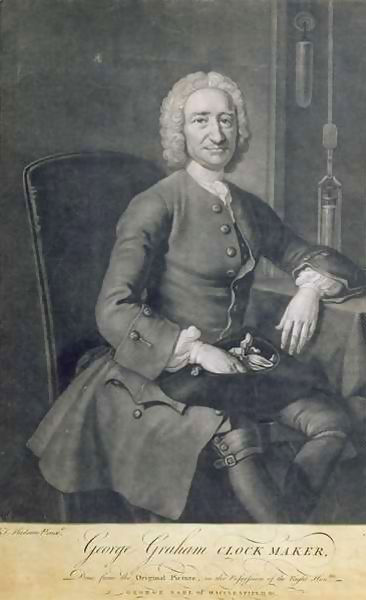
George Graham was a celebrated English watchmaker, inventor, geophysicist and distinguished Fellow of the Royal Society. As already mentioned, he worked with the influential English watchmaker Thomas Tompion during the last years of the latter’s life. Graham is widely recognised for his significant contributions to improving the design of the pendulum clock. He invented the mercury pendulum, which revolutionised the precision and stability of clocks. In addition, in 1715 Graham developed an improved escapement, based on Richard Towneley’s invention of the 1670s.
Between 1730 and 1738 George Graham took Thomas Mudge as an apprentice; Mudge later became famous for his invention of the lever escapement in 1755. Besides his work as a watchmaker, Graham was also known for his knowledge of practical astronomy and for his contributions to the field.
Graham designed and built several valuable astronomical instruments, many of which became benchmarks in their day. Among his notable achievements was the construction of instruments for Edmond Halley, such as the great mural quadrant at the Greenwich Observatory. He also improved the fine transit instrument and the zenith sector used by James Bradley in his astronomical discoveries.
One of his most significant achievements was the creation of an apparatus used to measure a degree of the meridian. This instrument was presented to the Royal Academy of Sciences, demonstrating Graham’s commitment to precision and to scientific progress.
Another notable achievement of Graham’s was the construction of the most complete orrery known at the time. It displayed the motions of the heavenly bodies in an extremely precise and detailed way, providing a valuable tool for the study and understanding of astronomy.
Graham made significant contributions to geophysics. In 1722/23 he discovered the diurnal variation of the Earth’s magnetic field, and he also established the link between the aurorae and the variations of that field. His needle compasses were widely used by the magneticians of the day. Around 1730 George lent some 200 pounds to John Harrison so that he could begin his work on the marine chronometer later known as H1.
In the trade George was known as “Honest George Graham”, because he refused to patent his inventions, seeking to make them available to all watchmakers.
George Graham, London, No. 4573, 1713


This is a gilt brass watch with a full-plate verge fusée movement (40 mm diameter), characteristic of Graham’s watches. The watch has a pierced and engraved cock showing a portrait of Graham’s face, in contrast to the grotesque mask usually found on watches of this type. The watch also has a slide plate (a component used in some types of mechanical watches to control specific functions).
The movement is fitted with a verge escapement and a steel balance, whose spring is blued and held by a square pin. This particular model was first used by Tompion.
On the back of the cock a production number is engraved, as it is on the top plate of the watch. Moreover, this movement was finished in Tompion’s workshop, adding a unique touch to the piece.
It is worth stressing that this is the earliest surviving watch signed by George Graham alone, after the death of Thomas Tompion in 1713. Although an earlier record of a watch attributed to Graham has been found in the manuscript ledger of Benjamin Vulliamy’s workshop, that piece is unfortunately now lost.
George Graham, London, No. 5249, 1727


This is an exquisite gilt brass watch, notable for its full-plate cylinder movement (this refers to a base plate used in mechanical watches that serves as a solid base for mounting the watch’s internal components) housed in elegant leather and gold cases (48 mm diameter). It has gilt pillars inspired by Egyptian architecture and is signed “G. Graham London”.
A striking feature is the pierced cock (a plate or bridge with cut-outs or openings that allow certain parts of the movement to be seen), finely engraved and set with a diamond “endstone” (in Portuguese it can be translated as “Pedra do Fim”). The dust cap is solid and engraved, with an opening in the plate to view the regulator disc, which is silver.
The mechanism has a fusée and chain, together with a barrel (a hollow cylinder housing a mainspring, which is wound by hand or by an automatic rotor, storing energy). The plain three-arm steel balance with a blued steel hairspring ensures the precision of the movement. The barrel is of polished steel, while the large escape wheel is brass.
The original dial was made of gold and white enamel, with Roman and Arabic numerals. The hands are gold, the hour hand with a lyre-shaped tip and the minute hand in the form of a baton.
The gilt outer case is elegantly covered in green leather and decorated with gilt piqué pins, adding a touch of sophistication. Inside the cover there is an engraving of the movement number, a typical feature of the Graham workshop. As well as the movement number, the initials “G G” of George Graham can be seen, delicately engraved in cursive script below the number, suggesting Graham’s personal involvement.
This is one of the first 13 known watches to feature the cylinder escapement, which was designed by Tompion and patented by Edward Barlow, William Houghton and Tompion in 1695. However, it was George Graham who perfected this type of escapement around 1725/26. He began using it exclusively in his watches in place of the verge escapement from production number 5182 and continued up to number 6590 in 1751.
Graham was also responsible for introducing the white enamel dial (mainly enamel on gold) to pocket watches in England, at almost the same time as he switched to cylinder escapements around 1726. This change marked the replacement of silver “champlevé” and gold dials. Surviving original white-enamel-on-gold examples are extremely rare. In addition, Graham abandoned pierced cock feet and engraved side plates in favour of plain plates as soon as he adopted cylinder escapements. As a result, he began using gilt brass dust caps, placing the engraved serial number inside the movement, something that was not common on his earlier watches. All these changes were also adopted by his apprentices and employees when they set up their own businesses.
The introduction of the cylinder escapement brought considerable improvements in the precision of watches. However, one of the few drawbacks of this type of escapement is that its components are quite delicate and easily damaged. For this reason, French watchmakers preferred the more robust verge escapement, used for years, until Julien Le Roy began using the cylinder escapement regularly around 1740.
Notes:
(1) Meaning of “gold watch in a consular case”.
“Gold watch”: This refers to the material used to make the watch case, which is made of gold. Gold is a precious metal valued for its durability, lustre and resistance to corrosion.
“Consular case”: The expression “consular case” may refer to a specific style of watch case. This style is usually characterised by a rectangular or square shape, with rounded corners and an elegant profile. This style of case is believed to have been popularised during the 19th century, and the term “consular” may be associated with the fact that it was used by diplomats or high-ranking people at the time.
So a “gold watch with a consular case” would be a watch with a case made of gold that follows the consular case style, with a rectangular or square shape, rounded corners and an elegant profile. It is important to stress that this is only a general interpretation of the term, and the specific details may vary depending on the context and the characteristics of the watch in question.
(2) Tulip pillars are considered classic design elements and are commonly found in antique watches, especially in the Rococo and Neoclassical styles.
(3) Tall-case clocks, also known in English as “longcase clocks” or “grandfather clocks”, are upright clocks, traditionally built with a tall wooden case that housed the clock mechanism. They are characterised by a long visible pendulum and a dial decorated with Roman numerals to indicate the hours


Comments