
THE CALENDAR OF THE ANCIENT EGYPTIANS WENT GLOBAL

by: Telo Ferreira Canhão
IWC Portuguese Perpetual Calendar, International Watch Company,
in 18K rose gold, reference number IW503302.
Basic data
Brand: IWC
Model: Portuguese Perpetual Calendar
Reference number: IW503302
Country of manufacture: Switzerland
Year of manufacture: Unknown
Gender: Men's/Unisex watch
Movement
Movement: Automatic
Calibre/Movement: 52610
Power reserve: 168 h
Number of jewels: 54
Case
Case material: 18K rose gold
Diameter: 42.3 mm
Thickness: 15.6 mm
Water resistance: 3 ATM (30 metres)
Crystal: Sapphire crystal
Dial numerals: Arabic
Bezel material: Red gold
Dial: Silver
Caseback: transparent sapphire crystal
Functions:
Moon phases,
Date,
Month display,
Four-digit year display,
Perpetual calendar
7-day power reserve indicator
IWC Schaffhausen was founded in 1868. In 1939, two Portuguese businessmen commissioned the Swiss brand to make a wristwatch with the precision of naval chronometers. Thus the IWC Portugieser line was born, which today counts numerous excellent pieces. The most complicated mechanical watch ever made by IWC is the Portugieser Sidérale Scafusia. In addition to solar time, this watch also displays sidereal time, which differs from the former by about 4 minutes a day and is widely used in astronomy.
Nowadays it is common to wear watches with a calendar. A calendar watch is a mechanical instrument that, in addition to the hours, minutes and seconds, indicates the days of the month, sometimes the names of the days of the week and of the months, and, in some watches, the phases of the moon as well. Three types of calendar are usually distinguished in watches. The simplest are full-calendar watches, which simply indicate the days, and may also show the names of the days and months and, in some cases, the moon phases. These watches always need to be corrected by hand in the months that do not have 31 days (cf. Oliveira, 2007: 34). Then there are annual-calendar watches, in which the mechanism indicates the days and the names of the days and months, allowing for months of 30 and 31 days, as well as a 28-day February, and possibly the moon phases. But since they do not allow for leap years, they have to be corrected by hand every four years (cf. Oliveira, 2007: 34). Finally, the most intricate are perpetual-calendar watches, a complex mechanical solution to an astronomical problem. They can indicate the seconds, minutes and hours, the days, the year, the names of the days of the week and of the month, and the moon phases. Through wheels, springs and balances they manage to reproduce the Earth's revolution around the Sun, automatically determining whether the month has 28, 30 or 31 days and calculating leap years. Thanks to Gregory XIII, this calendar only needs correcting at each change of century, except in centuries divisible by four hundred, as we shall see. In fact, a perpetual-calendar watch is a masterpiece of technology in which the date is always displayed correctly, regardless of the number of days in the month and of whether or not it is a leap year. Obviously, this means that the technical devices which ensure that the perpetual calendar always works without any problem are many and complex. That is why it is mainly the finest watch brands, in the highest price range, that offer them in their collections. However, some modern technologies now make it possible to bring certain perpetual-calendar watches within reach of an ever wider public (cf. Oliveira, 2007: 34-36). How did we get here?
THE GLOBALISATION OF THE CALENDAR
Anno Domini (A.D.) is a Latin expression meaning “year of the Lord” and is used to mark the years following year 1 of the calendar most commonly used in the West. In the Western world, the way of counting time is linear and takes as its starting point the birth of Jesus Christ, which is why it is called the Christian Era. From that moment, time is counted forwards (A.D. – all dates without this indication are considered to be dates after the birth of Christ) or backwards (B.C.), adding days, months and years one after another in both directions. The system for organising and counting time is based on observing the movement of the heavenly bodies, that is, on astronomy, and it is therefore called the calendar, a term that derives from the Latin word kalendae, the name of the first days of the months in the Roman calendar.[1] Time-keeping and calendars are very ancient things, for they arose almost everywhere as human beings gradually settled down. But as for the calendar we use today, what is its origin? Most people know to call it the Gregorian calendar, going back to the 16th century and Gregory XIII; others still manage to go back to the 1st century B.C., to the Julian calendar, named after the man responsible for it, Julius Caesar. But they stop there. Few know how to go further! Yet it is possible to go back much further, even as far as the Neolithic. And although we know that in other parts of the world the domestication of plants and animals led to the conception of different calendars, we can follow this adventure back to ancient Egypt, linking that ancient civilisation to today's Western calendar. It is true: in ancient Egypt the year already had 365 days divided into 12 months, each with its own name, and it was, moreover, far more perfect than the Roman calendar.
The rapid links between all parts of the world, near or far, that exist today thanks to globalisation, besides energising its first aims, the economic and the social, have also energised the spread of the traditions and trends of each place through cultural globalisation. With the growing flow and speed of information and transport, much of what was simply local or regional has gone global, and each region now lives, grosso modo, a mixture of local preservation and international blending. Our daily life is full of examples showing us that, in the most remote and primitive places, there is always one or more objects of “modernity”! And if, historically, the beginning of the globalisation of culture was above all exercised through the hegemony of Europe, which imposed its culture on the peoples of all the other continents, regional values persisted everywhere that, little by little, managed to introduce and reproduce themselves in other territories, sometimes on the opposite side of the world, in many cases reinventing themselves. Today, the process of cultural globalisation is ingrained in our daily life, showing different cultures and societies of the planet side by side. One of the most visible examples is that of the restaurant trade, with eating places of the most diverse latitudes and flavours open wherever we go: Italian, Indian, Vietnamese, Nepalese, Japanese, Chinese, Thai, Angolan, Brazilian… not to mention the main American fast-food brands that turn up everywhere.
In some exceptional cases, the extension of a local conception to the whole planet has a far more remote origin. And at times when no one yet knew what globalisation was, nor foresaw that the concept would ever emerge! One of the most extraordinary and ancient cases is that of the calendar we use. Even though there are some regional calendars, mainly religious or festive, the Western calendar is the tool for international relations all over the world. And, as I shall tell, it originated in ancient Egypt, probably even before the pharaonic period. I have already written an article on the conception of time and the Egyptian calendars (2006), which was later adapted and published in English (2013), both listed in the bibliography, but neither of them focusing on this perspective.
THE RECKONING OF TIME IN ANCIENT EGYPT
Our idea of eternity today is that it is something infinite, which neither begins nor ends; in other words, it is the absence of time, and since it transcends time, it cannot be measured by it. The ancient Egyptians expressed the concept of eternity in a dual form, as happened with almost everything in Egypt. Their conception of time rested on the union of two complementary ideas of eternity: djet, a linear count of cycles that began each time a new king ascended the throne, following one another irreversibly and eternally, “after all, the absence of time in a timeless time” (Araújo, 2001: 350), and whose earth determinative linked it more closely to the ideas of permanence and duration;[2] and neheh, a continuous, endless cyclical count, because it repeated itself permanently, based on the periodicity of cosmic phenomena, in particular the movement of the Sun which, regenerating itself, began its cycle anew every day, and was therefore linked to the idea of “being born”, “transforming oneself”, “becoming”. The very conception of history in ancient Egypt was a “celebration” of the eternal return to the “first time”, to the time when the creator had established the primordial order that the pharaoh had to maintain. Through the Osirian myth, the king took on the role of a new Osiris, entering eternity (neheh) perpetually (djet), two concepts which, when they appeared together, expressed the idea of “for ever and ever”. It is the perfect coexistence of two different concepts: a cyclical time marked by traditions and religious rituals, and therefore related to the sacred; and a linear time, governed more by daily activity and therefore profane. The union of these two concepts represented the totality of time (Canhão, 2006: 39).
THE 365-DAY YEAR
And it is evident that, pragmatic as they were, their conception of eternity did not prevent them from counting time. Without marking any founding event, the years were of 365 days counted from the accession of each king. The second year of this new cycle began on the date immediately following the last day of the current year, and so on. With the next king, the count started again from zero.
The number 365 would originally have been calculated, most probably in the Predynastic Period, or before the end of the Neolithic, by working out the average of the systematic record of the days imposed by lunar observation, or else by observing the interval between two appearances of a reference star which, as we shall see, was Sirius.
THE SEASONS OF THE SOLAR YEAR
This count was independent of the three seasons into which the solar year was subdivided, which had a precise existence, marked exclusively according to agricultural needs:
- Akhet (period of the flood or Inundation season, which in the Julian calendar ran from 19 July to 14 November, and in the current calendar from 15 June to 11 October);[3]
- Peret (period of plant growth or Winter season, from 15 November to 14 March, and in the current calendar from 12 October to 8 February);
- Shemu (harvest period or Summer season, from 15 March to 13 July, and in the current calendar from 9 February to 9 June).
THE MONTHS
Each season (ter) had four months (abed) of thirty days (heru) each, numbered from 1 to 30, making 360 days, to which five days were added (heru renpet – “those that are above the year”, considered to be outside the year and numbered from 1 to 5), which the Greeks called epagomenal, for a total of 365 days, at the end of which “The Opening of the Year”, that is, the New Year, was celebrated. On each of the five epagomenal days the birth was commemorated, respectively, of Osiris (mesut Usir, 14 July/10 June), Horus (mesut Hor, 15 July/11 June), Seth (mesut Set, 16 July/12 June), Isis (mesut Iset, 17 July/13 June) and Nephthys (mesut Nebet-hut, 18 July/14 June), the five deities who, in Heliopolitan theology, the oldest, represented Time. In turn, on the first day of the year, 19 July/15 June, the “birth of Ra” was celebrated, mesut Ré (cf. Canhão, 2006: 40). The fruit of concerns related to food production, the ancient Egyptian calendar was based on lunar observations combined with the annual cycle of the Nile floods, measured by means of systems known as nilometers. Each month was given a name, usually the name of the festival held at that time and, at the same time, the name of the deity being celebrated. This is attested for the Middle Kingdom, in the Memphis region:
- the 1st month of Akhet was called Tekhi, the 2nd Menekhet, the 3rd Khenethuthor, the 4th Nehebkau;
- the 1st month of Peret (5th month) Chefbedet, the 2nd (6th month) Rekehaá, the 3rd (7th month) Rekehnedjés, the 4th (8th month) Renenutet;
- the 1st month of Shemu (9th month) Khonsu, the 2nd (10th month) Khenetkhetyperetj, the 3rd (11th month) Ipethemet and the 4th (12th month) Upetrenpet (Allen, 2000: 108).
In the New Kingdom most of these names were changed, above all as a reflection of the supremacy of the festivals held in Thebes. Reinforcing theophoric naming, that is, giving them the names of gods or forming their names from divine names, a common practice in ancient Egypt when naming individuals, the Egyptian names survived in Greek and are still used today in the religious calendar of the Coptic Church. The new names (with the Greek name in brackets) were:
- the 1st month of Akhet was Djehuti (Thoth), the 2nd was Paneipet (Paophi), the 3rd was Huthor (Athyr) and the 4th was Kahorka (Khoiak);
- the 1st month of Peret was Taabet (Tybi), the 2nd was Panepamekheru (Mechir), the 3rd was Paneamen-hotep (Phamenoth) and the 4th was Panerenenutet (Pharmouthi);
- the 1st month of Shemu was Panekhensu (Pakhons), the 2nd was Paneinet (Payni), the 3rd was Ipip (Epiphi) and the 4th was Mesutré (Mesore) (Allen, 2000: 108; Depuydt, 1997: 129). Depending on the sources, variants of some of these names appear.
The names of the months appeared mainly in festival lists or in private letters, and were rare in ordinary texts.[4] There, when they wanted to record the date of an event, they did so according to a fixed dating, as follows: “Year 6 (i.e., regnal year number), 2 Winter 12 (i.e., second month of the season of Peret, Panepamekheru, day 12), under the majesty of the king of Upper and Lower Egypt (followed by the coronation name of the reigning pharaoh)”. The date in hieroglyphs that appears, for example, on the verso of the Ebers Papyrus is:

[5]
There is also a variation regarding the position of the epagomenal days. Although the last day of the year is always 30 Mesutré and the five epagomenal days lie beyond the year, in the Old Kingdom they preceded the year and in the Middle and New Kingdoms they were placed at the end of the year.

Fig. 1 - Revolution: the 36 decanal stars of the year. Every ten days of the Earth's orbital movement a new star appears. With the Earth at A, only the stars on the outer side, the night side, are visible. The Sun prevents Sirius from being seen. This is its period of invisibility. An observer at B2 (beginning of the night) cannot see Sirius because of the mass of the Earth; but at B1 (end of the night) he will see Sirius just before dawn: this is the heliacal rising of Sirius. At C, Sirius remains visible all night.
The natural division of the lunar month into irregular quarters still gives rise today, as a first approximation, to our months with different numbers of days. At the beginning of Egyptian civilisation they probably had weeks of seven and eight days that alternated in accordance with the lunar phases, but these were soon superseded by the introduction of a much more regular system: the Egyptian month of three decades, each marked by the appearance of a decan. The Egyptian decans were stars that were born, lived and died according to the movements of the Earth, above all its rotation and revolution, which is why they were called “the living ones” (ankhu), as opposed to the circumpolar stars, “those that know no destruction” (ikhemu-sek), because they were always visible. In the decanal cycle, the complete course of each decan was 360°. There were 36 stars and, owing to the Earth's revolution, each was visible for periods of ten days, hence their name (Sauneron, 1970: 80) (fig. 1). Thus the year was divided into 36 periods of ten days and each month into three decades: tepi, the first, her-ib, the second, and pehui, the third. All the decans had their own name and deification. For example, the decanal cycle that began with the appearance of Sirius was called tepa-kenmut and its god was Seb. Although the word “week” was unknown to the Egyptians, each decade corresponded, in today's terms, to a ten-day “week”. The gap of five days between the last and the first decan of this decimal organisation was filled by the epagomenal days, marginal to the decanal cycle (36 x 10 days = 360 days; or 12 months x 30 days = 360 days; or 3 seasons x 120 days = 360 days) and, as such, dealt with after the 36 decades, only then completing the 365-day year.

Fig. 2 - Rotation: the twelve decans visible each night. Owing to the Earth's rotation, each one indicates an hour of the night. At the equinoxes each hour of the night is equal to the 24th part of the day.
HOW THE DECANAL SYSTEM WORKED
The very workings of the decanal system would lead the Egyptians to divide the day into twenty-four hours (unut), each equal to 1/24 of the day, with sixty minutes each (Brier & Hobbs, 1999: 77), twelve of them night hours, the “hours of darkness”, and twelve day hours, the “hours of the Sun”, with the Sun at its zenith as the reference. The day was naturally divided into ten hours according to the movement of the Sun, plus two of twilight, dawn and dusk. The fact that in Summer, at the latitude of Egypt, only twelve decans could be seen rising in the darkness each night (fig. 2) led them to divide the night into twelve “hours”. At night the system worked as follows: decan I rose at the beginning of the night of 19 July/15 June and its departure from the field of view marked the end of that night, and the same happened on the following nine nights. It was then replaced in that function by decan II for another ten days. After the same number of days it was replaced by decan III, and so on until decan XXXVI was reached. In each 1/24 of the day the next decan came in, waiting for its decade of “command”. Thus the star clocks were organised in tables of thirty-six columns, one for each decade, and twelve rows, one for each hour of the night. The simplicity of the scheme became complicated by the epagomenal days, for which another twelve intermediate decans were introduced. Each decan moved regularly and diagonally upwards from one decade to the next.

Each hour had a divine couple and a name, used mainly in astronomical texts. For example, they called the first hour of the day ubenut, “the luminous one”, the last hour of the night peter neferu neb set, “she who sees the beauty of Ra”, and the sixth hour of the day, noon, ahat, “she who stands upright”, expressing the verticality of the shadow. In everyday texts, however, the hours were named by counting with ordinal numbers. For example: unut mehet-10 net heru is the “tenth hour of the day” (four o'clock in the afternoon) or unut 4-nut net gereh the “fourth hour of the night” (ten o'clock at night). The division of the day and of the night into twelve hours each seems to be originally Egyptian and may be related to the practical need to maintain throughout the year the equinoctial equality between day and night, combined with mythological matters, the twelve territories of the Duat that Ra crossed on his nocturnal journey, for example, or else by analogy with the twelve months into which the year is divided.
HOURS OF 60 MINUTES
However, the division of the hour into 60 minutes was introduced by the Babylonians, who used the sexagesimal system created by the Sumerians, the first to cultivate astronomy and to apply to it mathematical methods that we still use today in measuring time (60 is divisible by 30, 20, 15, 12, 10, 6, 5, 4, 3 and 2). Their day was divided into twelve double hours, the hour into sixty double minutes and the minute into sixty double seconds. Although the division of the minute into sixty seconds was not achieved by the Egyptians, they were aware that the minute was still too long a measure of time in certain circumstances, since they recognised as the smallest unit of time the at, usually translated as “moment” or “instant” and of no defined duration (Shaw & Nicholson, 1995: 58). Besides the names used in religious and astronomical contexts, there were popular names for the hours, in which certain expressions had a numerical correspondence with the hours of the day or night, such as: em duá, “in the morning”; nu en seti-rá, “the hour of perfume for the mouth”, that is, the time of the midday meal; mesit, “supper”, “last meal of the day”; er ter en khani, “at the hour of night”.
TIME-MEASURING DEVICES AND TECHNIQUES
Fig. 3 - Shadow clock marked with the first to the sixth hour of the day.
The day began at sunrise, and there were various devices for measuring the hours. By day the shadow clock was used, which the Greeks and Romans called the gnomon, literally the “indicator”. It was a simple sundial that measured the length or direction of a shadow, produced by a rod and cast horizontally, vertically or obliquely onto a flat or curved graduated surface (fig. 3).
Fig. 4 - Time-measuring device consisting of a wooden board graduated with dots, with two vertical wooden gnomons, or “posts”. The position of the shadow cast by the horizontal piece joining the gnomons indicates the hour. Egypt, 1000-800 B.C. Science Museum, London.
Fig. 5 - Sundial discovered on the floor of a workman's hut in the Valley of the Kings, dating from the 13th century B.C., 19th Dynasty. This time-measuring device is about a thousand years older than the sundials of this type found in ancient Egypt, which date from the Graeco-Roman period (332 B.C.-395 A.D.).
The simplest ones could have two vertical gnomons, or “posts”, joined by a horizontal piece whose shadow, cast onto the scale marked by simple dots on the horizontal board, indicated the hour (fig. 4). However, a sundial similar to many of our contemporary sundials, recently discovered by a team of Swiss Egyptologists in the Valley of the Kings, the burial place of the rulers of Egypt in the New Kingdom (c. 1560 to 1070 B.C.), may be the oldest Egyptian sundial in the world (fig. 5). Dating from the 13th century B.C., more precisely from the 19th Dynasty (c. 1292-1186 B.C.), it was found on the floor of the hut of one of the workmen of the Valley of the Kings. This time-measuring device is about a thousand years older than the sundials of this type found in ancient Egypt, which date from the Graeco-Roman period (332 B.C.-395 A.D.). Made on a flattened limestone ostracon, it has a semicircle drawn in black, divided into 12 sections of about 15 degrees each, with small dots in the middle of each section, probably to give more precise times. Into the hole it shows where the dividing lines meet a vertical pin of metal or wood would have been inserted, the projection of whose shadow would serve to reveal the time of day. According to the director of that team, the Egyptologist Susanne Bickel, and her colleagues, this piece may have had one of two functions: it may have been used in parallel with the illustrated texts inscribed on the walls of the pharaohs' tombs depicting the night divided into twelve hours, as we see in the “Book of Amduat” (“Book of What Is in the Underworld (Duat)”), and the journey of the sun god through the underworld, overcoming the dangers of each hour, the clock possibly having served to visualise the length of those hours; or simply to measure the working hours of the workmen.[6]
Fig. 6 – Star clocks: the merkhet (A) and the split palm rib (B); the astronomical table (C) which, in the example,
shows the list of stars for the 16th day of Paneipet, the second month of Akhet.
Since sundials were useless at night, the decans were used to determine the twelve hours of the night. On the basis of their observation, a star clock was used, the merkhet, “instrument of knowing” (fig. 6A), a horizontal bar with a plumb line, together with the split palm rib (fig. 6B), a forked staff made from the stem of a palm leaf with a V-shaped notch at its upper end that served as a sighting instrument. Used together they had a function similar to that of the astrolabe (Sales, 2001: 121). With two merkhet and two palm ribs they fixed the sights on the plumb lines through the Vs and aligned them with the Pole Star, fixing the north-south orientation, and estimated the time by the transit of the decanal stars as they crossed that alignment. The observation of the course of the stars was reserved for priests charged with measuring time (fig. 7), a kind of astronomers who systematically measured the height of the reference stars, recorded it in tables (fig. 6C) and compared them with earlier ones (Rachet, 1987: 45). Not precisely, but only approximately, they could determine at any moment of the night what hour it was. It was systematic work, carried out every fifteen days, since the Earth's rotation and revolution cause constant changes in the position of the stars.
Fig. 7 – Hypothetical reconstruction of the sighting and recording of the stars by the Egyptian priest-astronomers.
From the New Kingdom onwards, a complete star table consisted of twenty-four partial tables, two for each month, the epagomenal days not being taken into account. These fortnightly astronomical tables show the image of a man kneeling on the ground, his face turned towards the observer and his body surrounded by stars arranged on a background grid made up of nine vertical columns and twelve horizontal rows (fig. 6C). It is the depiction of one of the two priests charged with measuring time. Each drawing shows only one of these two astronomers, who sat facing each other along the south-north direction on the flat roof of a temple. He had a board on which he recorded the position of the reference stars at each hour of the night, and a sighting instrument to observe the entry of the stars shown on the board into the south-north line.
In this way they could tell at any moment what hour of the night it was. The observer indicated the celestial position of a star according to the position it occupied in relation to the silhouette of his partner: above the middle of the body, above the right elbow, above the right ear or the right eye or, possibly, above the left eye, ear or elbow (fig. 6C). This decanal transit was referenced on the grid in the seven inner vertical lines. There are fine lists of decans, the most famous being on the vaulted ceiling of the tomb of Seti I, organised in fairly complete hourly tables and with their associated deities. It should be noted, however, that because the tables in the royal tombs were mainly intended as decoration, the position of the stars next to the figures does not entirely match, or is even at odds with, the indications of the corresponding table.
Regarding the example in figure 6C, the sixteenth day of the month of Paneipet (Paophi), the second month of Akhet, we have:
Fifteen days later, on the first of Hathor, the 3rd month of Akhet, the stars occupy the following positions in a new table:
After another fifteen days, on the sixteenth day of the same month of Hathor, the stars were arranged as follows in another table:
Fig. 8 – The Karnak clepsydra, dating from the time of Amenhotep III (1402-1364 B.C.). Top right, the dotted scale on its inside, which indicates the 12 months of the year, and, below, three views of its exterior decoration.
In the New Kingdom another instrument was invented to measure time, both by day and by night: the clepsydra or water clock (fig. 8). The oldest date from the 18th Dynasty. They were vessels of stone, copper or ceramic, of considerable size, their exterior decorated with inscriptions and depictions of hour deities, an hour scale engraved on the inside, and a hole in the base to let the water drain out. Because of the decanal movement, for religious reasons, or both, the Egyptians divided the unequal nights into twelve equal parts. In fact, with the exception of the two annual equinoxes, all the other days and nights of the year are of unequal length because of the Earth's axial tilt relative to its orbit which, besides determining the seasons, causes short nights in Summer and long ones in Winter. Different internal graduations of the clepsydras gave the different lengths of the night hours according to the seasons and months of the year. The greater or lesser speed at which the water drained was obtained by varying the diameter of the hole through which the water passed which, keeping the same rate, made the twelve parts of each night run out. They had to change device according to the time of year, since only water clocks with a single hole have come down to us, which, according to the fragments of an inscription by a certain Amenemhat, is an improvement on the clepsydra with multiple holes. The inventor of this improved clepsydra not only recorded the fact that King Amenhotep I considered it “the most beautiful of all things”, but also specifies that from his “excellent vessel for measuring, the water flows out through a single hole only” (Erman & Ranke, 1976: 449-450). There are also pictorial depictions of clepsydras showing the Summer Sun and the Winter Sun at the same time, the former being shown higher than the latter.[7] The use of the various types of clock shows us that the Egyptians alternately used the hour defined by the decans, the equinoctial hour equal to the twenty-fourth part of the Earth's rotation time at the equinoxes, and the solar hour, which varied in length according to the months of the year, graduating their different clocks accordingly.
THE DOUBLE CALENDAR OF ANCIENT EGYPT
The Egyptians disregarded the lunar cycles and the mismatch between the count of days and the real revolution of the Sun (a solar year of 365.2500 days holds 12 lunar months of 354 days, since the Moon takes twenty-nine and a half days to return to the same phase) (Savoie, 1998: 102; Bomhard, 1999: 6), which the Julian calendar would later take into account, keeping their calendar practically unchanged throughout their entire civilisation. But not only were they not unaware of these matters, they did not even set them entirely aside. As the Greek astronomer and mathematician Geminus of Rhodes said in the 1st century B.C., in Elementa Astronomica, the Egyptians tried “to conduct the years according to the sun; the days and the months according to the moon”.[8] For the Egyptians, the solar year automatically marked the astronomical phenomena that governed their agricultural year and, mindful of this, they celebrated another “Opening of the Year” on the first day of each solar year, independent of the first day of each year of the linear count, prompted by royal accessions. This day was determined by the appearance in the east of the brightest star in the night sky, Sepedet, Sirius (Gr. seirios; Lat. sirius), belonging to the constellation Canis Major and, through Latin, commonly called Canicula, which happened systematically on 19 July each year (peret sepedet), when the Nile began to rise (Shaw & Nicholson, 1995: 42). This relationship established between the annual stellar cycle and the life of the Nile, and with the very survival of the Egyptians, early on led to the realisation that the eternal return of the flood coincided with the annual cycle of the star Sirius.[9] Perceiving a phenomenon of good omen, they saw in it the female deity Sopdet (the Greek Sothis), lady of the flood, identified both with Satjet (or Satet), protective deity of the region of the first cataract, and with Isis, whose tears shed for Osiris swelled the Nile.
Two calendars were then in use: one based on the course of the Sun and the phases of the Moon ̶ the civil or wandering calendar; and the other on the heliacal rising of Sirius ̶ the Sothic or fixed calendar. However, regardless of some questions that may still remain open regarding the coordination between the two (such as the lack of agreement between the astronomical cycles or the surplus fraction of ¼ that each 365-day solar year has), on the basis of astronomical documents relying on Sirius and Orion ̶ the male partner of Sirius[10] ̶ the various astral personifications and even other non-astronomical texts, it is highly plausible that the pharaonic calendar brought together the cycles of the Sun, the Moon and Sirius into a single system, a “great year” of 1461 years, a system which, rather than cancelling the civil count, required its maintenance, since the one-day lag every four years of the calendar relative to astral time was only cancelled out at the end of the 1461 years in which the so-called “Sothic period” was completed (Sales, 2001: 166).
Of all the stars, Sirius is the one whose year is closest to the solar tropical year: 365.2500 days against the latter's 365.2422 days. To keep the Sothic calendar in step with the lunar calendar would have meant introducing an extra day every four years. Had this been done, the matter would have ceased to be an epiphenomenon and become the result of a decision that would prevent the two calendars ̶ the Sothic and the lunar ̶ from evolving each on its own, calling into question the natural mechanism of union existing between them, in a cycle that was completed every 1460 years and for which the wandering year was totally absolute. They are two numerically equal periods: a small one, of four years of 365 days each, plus one day, making 1461 days (lunar calendar); and a large one, of four times 365 years plus one year, making 1461 years (Sothic calendar).
This double calendar provided a solid basis both for the technical operations that revolve around time-keeping and for the development of a broader view of the evolution of time itself: they had no leap year, but the one-day lag every four years was cancelled out after 1461 years (Bomhard, 1999: 28-30). Because of the same position that the Earth takes each year owing to its orbital movement, the Sothic year was directly related to the seasons. But if a Sothic year is the interval of time between two heliacal risings at the same reference latitude, one needs to know what that reference was, because the heliacal rising varies with latitude. In ancient Egypt, it was probably Buto, in the western part of the Delta.
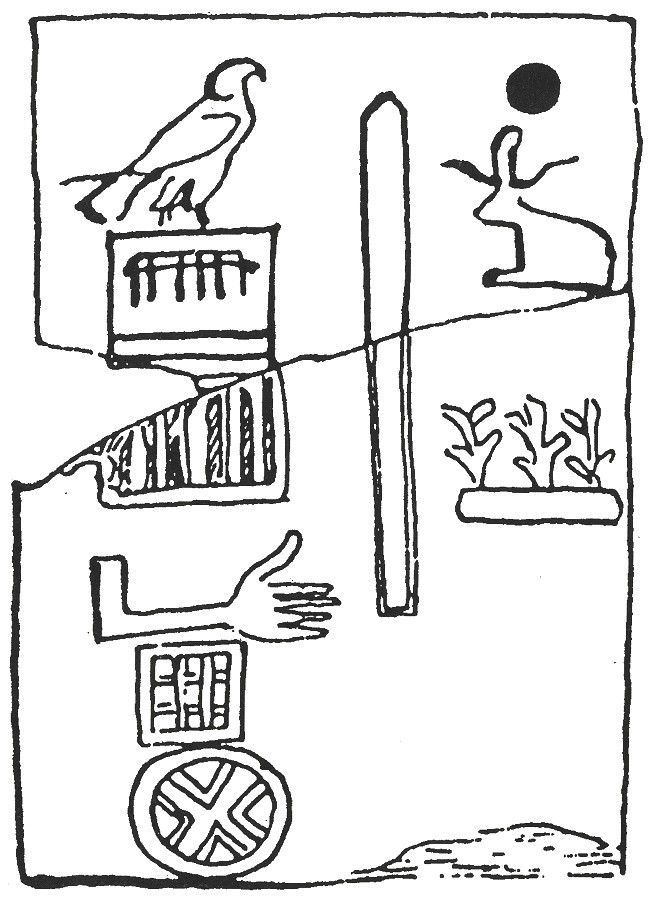
Fig. 9 – Small tablet of Horus Djer, c. 3000 B.C., Abydos.
It is the small ivory tablet of Horus Djer (second or third king of the 1st Dynasty, around 3000 B.C.), found at Abydos, that clarifies this question (fig. 9). In a hieroglyphic script that was still very primitive, its reading has given rise to different interpretations. We share the opinion of those who think that it relates the appearance of Sirius to the beginning of the flood, the name of the town of Buto appearing as possible evidence of the antiquity of the establishment of the double calendar. On the tablet there are two reading columns facing the centre, where there is a solar symbol, an obelisk (tekhen), a “ray of the Sun” held to be sacred at least since the 1st Dynasty and probably evoking the solar component of the king. On the left, from top to bottom, starting with the serekh,[11] we read hor djer dep, “Horus who succours Dep (Buto)” or, taking the following phrase into account, “Horus who ends [the famine] in Dep”; on the right we have su sepedet akhet, literally “on the day when the Inundation comes with Sirius”, that is, “at the opening of the year”. The depiction of Sirius in the form of a cow is not unique,[12] and is probably associated with the concept of the “cow of heaven”, the “nourisher” and protector of the pharaoh and of Egypt, a syncretic figure that can appear as Isis, Hathor, Sekhmet, Sothis or Sekhathor. The plume on the cow's horns has connotations with the cyclical return of the flood[13] and usually appears in astronomical compositions as part of the crown of Sirius, normally surmounted by a solar disc. Moreover, Buto meets the geographical (latitude) and historical (antiquity) conditions required for the Sothic rising (Bomhard, 1999: 46-49).
The Sothic cycle was also the starting point for the attempt to date the establishment of the calendar more precisely. Since in the year 139, during the reign of the Roman emperor Antoninus Pius (138-161), the heliacal rising coincided with the first day of our current calendar, successive subtractions of periods of 1461 years reach first the year 1322 B.C., at the beginning of the 19th Dynasty, then 2783 B.C., in the 2nd Dynasty, the Archaic Period, even before the Old Kingdom began, and 4244 B.C., at the end of the Neolithic or the beginning of the Predynastic Period, which in Lower Egypt corresponded to the Merimde and Omari cultures, in Middle Egypt to the Faiyum A culture and in Upper Egypt to the Tasian culture (Rachet, 1987: 59).[14]
Despite a certain lack of coordination between them, the Egyptians kept their two calendars, the wandering and the fixed, in working order. The occasional references to this event in the documents show that the Sothic year never supplanted the civil year in administrative contexts. They were aware of the disadvantages of using the wandering year, which they described as “bad”, as incorrect, as opposed to the “good”, the correct one, but which, even so, never replaced the fixed year, which was used as an obligation. This ran counter to theology itself and its rituals, particularly with regard to the solar cult, which found no reflection in the nature of the calendar. But this contradiction is only apparent. The use of the wandering year was imperative, since the functioning of the calendar rested on two essential data: the rising of Sirius, which inaugurated the fixed year, and the way of reconciling the extra quarter-day of the Sothic year. To that end, the star Sirius was the crux of the matter.

Fig. 10 – Horizontal arrangement of the astronomical cycles on the ceiling of the Ramesseum (1279-1213 B.C.).
Although the Sothic period was already known to the classical authors, it was only after Champollion had deciphered hieroglyphic writing (1822) that it became possible to confirm it by reading a variety of documents, most of which are of greater value for the study of Egyptian astronomy and chronology than for determining the structure of the calendar. This is not the case with the verso of the Ebers Papyrus, the only manuscript in which there is a relationship between a Sothic date and a list of festivals of the wandering year, both referring to year nine of the reign of Amenhotep I (Bomhard, 1999: 31-33),[15] on the basis of which it is possible to analyse both the structural and the circumstantial aspects of the calendar. The Elephantine stone, the Kahun letter, the Medinet Habu calendar and the Buto stela also contain important contributions to this subject. Other sources (usually royal tombs and mortuary temples) gather information related to the planets, Sirius and the lunar deities.[16]
Particularly important for the study of the calendar are two astronomical compositions: the Karnak clepsydra (fig. 8), in a circular arrangement (Bomhard, 1999: 15-17), and the ceiling of the Ramesseum (fig. 10) in a horizontal arrangement (Bomhard, 1999: 84-85). Both have three registers:
- the upper with Sirius, the decans and the planets (register II of the Ramesseum: Sothic year comprising the decanal cycle, the decans and the planets);
- the middle with the constellations of the northern sky and the lunar deities (register III of the Ramesseum: lunar year and monthly cycles);
- and the lower, where the pharaoh, sometimes assimilated to the solar deity, honours the deities representing the months (register IV of the Ramesseum: celebration, by the pharaoh, of the deities representing the twelve festivals that divide the year into twelve months).
Most depictions include only the first two registers. In the Ramesseum, however, there is a fourth register, register I, with the wandering year to which all the cycles refer.
Always appearing in the central part of the upper register (register II of the Ramesseum ceiling), as in all depictions of the Sothic calendar, Sirius and Orion seem to dominate the whole composition. In its most common representation, the former is placed on a barque, personified as the goddess Isis, as indicated by the name inscribed there: Isis or Sopdet; in front of her, also on a barque and deified, is Sah, her partner Orion, surmounted by the three stars that make up the constellation. Regardless of the small differences between documents and periods, which several authors explain, Sirius and Orion keep their posture with their faces turned in the direction of the progression of the decans, but Orion has his body turned backwards, towards Isis, seeming to go to meet her, all the more so as the barques are prow to prow. This facing each other marks the boundary of the periods, the separation of the annual cycles: while Orion announces the end of the previous year, Isis-Sirius inaugurates the new year.
Although the Egyptians had a word of their own for planet (guenemu), they commonly used the word seba for both star and planet (which prevents us from using this term in the restricted sense of star), although they distinguished them from one another: the 36 decanal stars formed one entity and the planets formed another, placed apart next to the epagomenal days, both located in the upper register in two-register depictions (register II of the Ramesseum ceiling). In pharaonic times, the five planets visible to the naked eye had been identified. Taking into account their orbits in relation to that of the Earth, they were grouped into inner planets, Mercury and Venus (sebeg and djai-benu), and outer planets, Mars, Jupiter and Saturn (hor dechre, sebá-resi and hor ka pet) (Bomhard, 1999: 72-74). The epagomenal days were depicted between these two groups.
In the lower register appear the Moon, its monthly cycle and the lunar year (register III of the Ramesseum ceiling), which is different from the fixed year. On ceilings such as those of the tombs of Senenmut and Seti I, the lunar deities are shown arranged, oriented and framed together with the other elements depicted. Each phase of the Moon in the lunar cycle, which is identified with a special festival, has its own name: New Moon – pesedjenetiu, First Quarter – senet; Full Moon – semedt and Last Quarter – denit. The days of the waxing phase of the Moon are represented by a staircase of fourteen steps, likewise ascending, each step containing one of the gods of the Great Ennead of Karnak. At the top, Thoth presents the most powerful symbol of ancient Egypt, the “Holy Eye”, the udjat, the left eye of Horus which personified the Full Moon, the one that Seth tore out and Thoth recovered (Bomhard, 1999: 79-79).
As the ancient Egyptians seem already to have understood through observing the movement of the planets and determining their periods of synodic revolution, a given position of one or more planets repeating itself periodically makes it possible to build a dating system. Let us clarify, however, the following point: Egyptian astronomy, dominated by a priestly elite, was basically a science of a religious nature that sought to respond to practical concerns which, in addition to measuring time and the beginning of the flood, made possible, for example, the correct orientation of temples and tombs according to their religious principles. However, they never attained the brilliance of Babylonian astronomy. Although they determined the north pole with precision and its variation over time, distinguished the planets visible without the aid of any instrument, observed eclipses, became aware of the existence of meteors and followed a bright celestial body, probably Halley's comet (Sauneron, 1970: 30), they were unable to produce scientific explanations of these astronomical phenomena. Although everything we have mentioned required a good body of observations, Egyptian astronomy as a whole remained rather rudimentary.
THE HELLENISATION OF THE ANCIENT EGYPTIAN CALENDAR
When they settled in Egypt in 332 B.C., the Greeks saw little use in keeping this cosmic calendar, since the wandering calendar, the solar one, was badly out of alignment. Instead, they sought to create a mechanism that would not only correct that misalignment but also prevent it from then on. The gap of one day every four years between the two calendars and, consequently, the shift of the beginning of the year by one month every hundred and twenty years, led Ptolemy III Euergetes I (246-221 B.C.) to try to settle the matter by decree (the Canopus Decree, of 238 B.C.), adding to the wandering year a sixth epagomenal day every four years. But changing the divine law of Thoth was not easy for the Ptolemies. In any case, the day chosen was not that of the Ptolemaic decree ̶ the day on which Sirius rose ̶ but the first day of the month of Thoth in the wandering calendar, which in the year of the reform was 41 days after the heliacal rising. With its inclusion, the old wandering year became fixed, and from then on Egypt had two fixed calendars: the Sothic calendar, which began with the appearance of the star Sirius; and the Alexandrian calendar, which began on the first day of Thoth, 41 days after Sirius rose. This change always met with strong resistance.
THE ROMANISATION OF THE HELLENISED CALENDAR OF ANCIENT EGYPT
In the 1st century B.C., Alexandria was the most populous urban area of the Ancient World, apart from Rome. A myriad of races and cultures from the Greek world, from Rome, Persia and Arabia, including a large Jewish community, joined the native population of Egyptians and Nubians. There, late Hellenistic culture flourished. It was through Alexandria that Egypt opened up to the Mediterranean world. In that same century, the Roman civil year was three months ahead of the solar year, showing the ancestral imperfection of the Roman calendar, initially lunar and later lunisolar. As Maria do Rosário Laureano dos Santos says, “The Romans had great difficulty in counting time, as did all civilised peoples, except for a few, such as the Egyptians, who carefully tried to observe the passing of the seasons” (Santos, 2006: 119 and 125). Let us see how the Roman calendar worked.
The first Roman calendar was attributed to Romulus, its beginning dating from around 753 B.C. It was a lunar calendar in which the year had 10 months of 30 or 31 days, totalling 304 days. The other 61 days coincided with Winter and were not included in the calendar. The year began in March, with the Spring equinox, and was organised as follows:
Martius (31 days) Sextilis (30 days)
Aprilis (30 days) September (30 days)
Maius (31 days) October (31 days)
Junius (30 days) November (30 days)
Quintilis (31 days) December (30 days) (Santos, 2006: 119-120)
In the 1st century B.C., after the reform of Numa Pompilius around 713 B.C., the year still began in March (this was so until 153 B.C.),[17] but the calendar was already both lunar and solar. The beginning of the months continued to coincide with the beginning of the phases of the Moon, the 30-day months became 29-day months, two new months were added at the end of the calendar, and one more extra month, Mercedonius, of 22 or 23 days, was added every two years to complete the solar year. This new Roman calendar was much more precise than the previous one and had been based on the Athenian calendar, which was lunisolar. Even so, the counting of time was still far from perfect. The Roman calendar saw its length increase to 355, 377 or 378 days, at an average of 366.25, organised as follows:
Martius (31 days) Quintilis (31 days) November (29 days)
Aprilis (29 days) Sextilis (29 days) December (29 days)
Maius (31 days) September (29 days) Januarius (29 days)
Junius (29 days) October (31 days) Februarius (28 days) (Santos, 2006: 120)
When he was appointed Pontifex Maximus, Julius Caesar (100-44 B.C.) became responsible for the running of the calendar, like all holders of this office, and was tempted to solve the problem by adding the days needed to adjust the dates of the anniversaries that Rome celebrated. Therefore, to set the year right in 45 B.C., the year 46 B.C. exceptionally reached 445 days, corresponding to the year 708 after the founding of the city of Rome, and it will have been the “ultimus annus confusionis”, according to the writings of Macrobius, a Roman writer of the early 5th century, in his book Saturnalia (Santos, 2006: 120).
From 45 B.C. onwards, the Romans adopted the Egyptian solar calendar of 365 days and six hours, or 365.25, adding the extra days needed to the shorter months. In 25 B.C., Augustus had a day inserted between 23 and 24 February every four years, which was called bissextile, since the sixth day before the calends of March was counted twice. This day gave its name to the year in which it was included, but it was not yet 29 February, which did not exist at the time. In his honour, the Senate gave his name to the month until then called Sextilis, and the days of the months were redistributed, so that the month of Augustus would not be shorter than the one dedicated to Julius Caesar. With the interventions of Julius Caesar and Augustus, the names of the 12 months of the year and the length of each were definitively established: Ianuarius, 31 days; Februarius, 28 or 29 days; Martius, 31 days; Aprilis, 30 days; Maius, 31 days; Iunius, 30 days; Iulius (in honour of Julius Caesar), 31 days; Augustus (in honour of Augustus), 31 days; September, 30 days; October, 31 days; November, 30 days; December, 31 days (Santos, 2006: 119 and 125). The seven-day week, the approximate length of a lunar phase, began to be used at the beginning of the imperial period, after the Julian calendar had come into force. These were, perhaps, the most significant of the reforms that took place up to the great Gregorian reform. This calendar became known as the Julian calendar and was used until 31 December 1581.
The Egyptian calendar, first Hellenised and then Romanised, which Julius Caesar established throughout the Roman world, was of great mathematical simplicity. Although there were other calendars in pre-classical (Sumerian, Babylonian…) or classical (Greek) antiquity, this one did not require constant adjustments by inserting days or months, beyond those mentioned, and served to date any official or semi-official, religious or civil act, leading Julius Caesar to declare it “the only intelligent calendar that has ever existed in the History of Man” (Posener, 1970: 40). On this matter he was advised by the Egyptian hemerologist Sosigenes of Alexandria (Santos, 2006: 120), an Egyptian about whom little is known, but who managed to impose his ideas on Julius Caesar, since they were based on a thousand-year-old practice that had already proved itself truly good. It was also here that the calendar lost all its religious connotation and came to be seen as a simple tool for measuring time.
FROM THE JULIAN CALENDAR TO THE GREGORIAN CALENDAR
On 1 January 1582, Pope Gregory XIII made the last great reform of the Hellenised and Romanised Egyptian calendar, thus implementing the Gregorian calendar as we know it, which is still in use.
The small difference from the real length of the solar revolution (365.2422 days), which every 4 years produced one year too many, led Pope Gregory XIII to correct it in 1582, removing the accumulated difference of ten days' advance relative to the official date (4 October 1582 was followed by 15 October 1582). The error was then avoided by also introducing the rule that only years ending in zero that were multiples of 400 would be leap years. In this way, one day is removed every 100 years and one day is added every 400, that is, three leap years are eliminated every 400 years. The Gregorian reform not only established the current calendar but also embedded its roots deeply in ancient Egypt (Canhão, 2006: 58-59).
CONCLUSION
The Egyptian calendar was clearly decanal in nature, with the star Sirius as the dominant and central element of the astronomical depictions, around which the civil year, always the most usual year, was organised and based, in a system that included natural methods of self-regulation of the astronomical cycles. The equinoctial hour itself was defined according to the length of the year: a new decan appeared every ten days and its revolution advanced one degree a day, being completed in 360 days. Twelve groups of three decades made up the twelve months that coincided with the lunar cycles, the epagomenal days being adjusted so that the wandering year had 365 days. The missing quarter-day was accounted for annually at each rising of Sirius, the day thus generated every four years being concealed. The adjustment between the civil and Sothic years took place naturally, in periods of 1461 years. In fact, a vertical axial reading of the Ramesseum (Fig. 10) shows us Sirius as the pivot of the system, inaugurating the Sothic year, the Sothic cycle, the decanal cycle and the lunar year, its precision, stability and permanence being symbolised by Thoth seated on a djed pillar, whose four steps evoke the Sothic tetrarchy. Moreover, in all the astronomical depictions the register concerning the Moon and its cycle always appears in second place, which does not seem to favour the idea of a calendar that was originally, or essentially, lunar. Hence we think that while most peoples of antiquity developed calendars based on the phases of the Moon, artificially correcting the gap relative to the solar year, the Egyptians, without abandoning that aspect, conceived a calendar based on the cycle of the seasons through the use of fixed stars and with their own self-regulating means. The Egyptian calendar was conceived as a true work of eternity.
The combination of the various elements mentioned makes it possible to draw a parallel between the different calendars, including the one we use today. Not only do documents such as the Ebers Papyrus highlight the relationship between the wandering year and the fixed year of the Egyptians, but certain astronomical events, such as the equinoxes or the heliacal rising, also provide fixed references in any calendar. Thus it is possible to say that the third month of Summer of the Egyptian wandering calendar corresponded to the month of the New Year Festival in their fixed calendar; this began on the first day of the month of Thoth, which corresponded to 19 July of the Julian calendar which, in turn, corresponds to 15 June of our current calendar, at the latitude of Memphis. It is evident that establishing Egyptian chronology is complex and other elements besides astronomy must be considered: king lists, historical texts, biographical inscriptions, lunar dates of Egyptian festivals, correspondence with lists of Mesopotamian and Hebrew kings… And when written evidence is absent or scarce, recourse is also had to other types of documents brought to light by archaeology. All this is why the chronology of ancient Egypt still has so many fluctuations. Many of them small, it is true, but they still exist. However, none of this, including the slight inaccuracy of the Egyptian civil calendar relative to the astronomical cycle and the strong mythological charge that sought to justify the origin of humanity and of everything that interacts with it, prevents many specialists from considering the Egyptian calendar the foundation of the one used today universally, as the most rational, orderly and clear of all those created throughout History.
In fact, the current calendar, the Gregorian, was not created by Gregory XIII. His astronomers simply perfected the Julian calendar, removing deficiencies that persisted even after the earlier reforms. But Julius Caesar did not create any calendar either. He, too, improved something that came from before. Julius Caesar realised that the Egyptian calendar was the one that came closest to the lunisolar system, being much better than the one that had existed until then in the Roman Empire, which was short of days, and he adopted it, making some changes to it. Above all, he broke the 1461-year epiphenomenon and sought to make the time correction quicker and to fit it into the span of human life. In this way, the extra quarter-day each year allowed a correction every 4 years. Therefore, it is to Julius Caesar that we owe the implementation of this calendar throughout the Roman Empire. Later, the Church, merchants and the Age of Discovery widened this expansion, and time and modernisation did the rest. Today no one calls it the Egyptian calendar, but it is the one that prevails throughout the world; in other words, it has gone global. Even in regions that have other calendars, mainly religious or festive, it is with this calendar that relations between everyone are standardised, anywhere in the world. In other words, a local reality ̶ Egyptian ̶ was gradually adapted and improved without ever becoming impossible to recognise its origin. Going beyond its exclusively Nilotic use, it first spread around the mare nostrum, then broadened its horizons even further and, finally, went global. In any contact, for business or leisure, with any part of the world, it is the time zones and this calendar ̶ Egyptian, Roman, Gregorian ̶ that synchronise us with one another: we speak to someone at such-and-such an hour, on such-and-such a day, of such-and-such a year, thanks to the universal recognition of these unrivalled tools. And it is this calendar that many people carry on their wrists, in small great time-measuring machines that enclose in such tiny spaces all the mechanical complexity that makes it possible to include the whole astronomical system allowing them to measure from the second to the year, passing through the minute, the hour, the day, the week and the month, not forgetting the moon phases and other measuring capabilities of watches such as, for example, simple power-reserve indicators.
And if most people are unable to go back beyond Julius Caesar, it is not even their fault! It is a matter owed to the natural unfolding of events. Classical culture began to be studied in the Renaissance when, from the mid-14th century onwards, the humanists, fluent in Latin and Greek, made Classical Antiquity an example for reshaping medieval life and ushering in the Modern Age. Egyptological studies would only begin much later, taking as their starting point the decipherment of hieroglyphs by Jean-François Champollion in 1822. This difference of about five centuries allowed classical studies to gain a great lead over Egyptological studies, but, as we think we have just shown for a single subject, many other subjects began to be developed before the Greeks and the Romans. What is certain and well known is that the more we look to the past, the better we can see the future.
NOTES:
[1] The Romans had special names for three days in each month: the first day of the month was called the Calends (Kalendae), corresponding to the appearance of the new moon; the 5th or 7th day of the month, the Nones (Nonae), corresponding to the first-quarter lunar phase; and the 13th or 15th day of the month, the Ides (Idus), corresponding to the day of the full moon. In January, February, April, June, August, September, November and December, the Nones fell on the 5th day and the Ides on the 13th; in March, May, July and October, the Nones fell on the 7th day and the Ides on the 15th. The other days were identified by counting backwards. For example: 3 September was said to be 3 days before the Nones of September, 7 September 7 days before the Ides of September, and 20 September was referred to as 11 days before the Calends of October (Santos, 2006: 119 and 125).
[2] See in the hieroglyphic inscription below the last hieroglyph, which is under the snake and is the antepenultimate character.
[3] The dates that we make correspond to the current calendar, the Gregorian calendar, are only approximate, and there may be a difference of plus or minus one day in each season, since they depended on variable astronomical phenomena. Nevertheless, together they indisputably add up to 360 days.
[4] It is thought that the names of the months were common in spoken Egyptian, just as today we use “January” for “month one”, “February” for “month two”, “March” for “month three”, etc.
[5] Although without the month and day, it reads renpet hor hem en nesu-bit djeser-ka-ré ankh djt, which means “Year 9, under the majesty of the king of Upper and Lower Egypt Djeserkare (Amenhotep I), may he live for ever.” (Ebers Papyrus, verso).
[6]http://www.ciencia-online.net/2013/03/relogio-de-sol-do-antigo-egipto.html (accessed on 06/09/2022).
[7] Without saying so, it is the empirical recognition that the Earth follows an elliptical orbit, with the Sun at one of the foci of the conic, the Earth passing through the point closest to the Sun, perihelion, in January and through the point farthest away, aphelion, in July.
[8] Geminus, 8, 7 apud Santos, 2006: 122.
[9] Since the conjunction between celestial and terrestrial phenomena was only possible after long observation and recording of data, the tutelary deities of time and the calendar were the divine couple Thoth, god of wisdom, writing and the moon, and Seshat, goddess of writing and measurement.
[10] Sirius and Orion always appear together, in a central position, in depictions of the Sothic calendar.
[11] The serekh was a hieroglyphic symbol representing the façade of the royal palace with the king's Horus name inscribed in it and usually surmounted by a falcon, illustrating the concept “Horus is in the palace”.
[12] A similar description appears in a relief at the entrance to the hypostyle hall of the temple of Dendera.
[13] In this case, it evokes the journey that Thoth made in the form of Shu to Nubia to bring the flood back to Egypt.
[14] While some accept this last date as the starting point of the calendar, others, based on the idea that the fixed year was not originally linked to Sirius and developed from the lunar calendar, consider it unacceptable. They go back about a thousand years, to approximately 3400 B.C., and, taking into account the naming of the epagomenal days, attribute its invention to the priests of Heliopolis, at a time when Heliopolis was the capital of a unified local kingdom, at the end of the Predynastic Period, before or at the time of the probable unification by Narmer and, therefore, at or near the time of Horus Djer.
[15] This is the date reproduced above.
[16] These depictions evoke the solar, stellar and cosmic destiny of the king. Their dating ranges from the 8th Dynasty to the Late Period.
[17] In the Roman Republic, years were not counted as they are now. The first day of the year was the first day of the consular term and each year was the year of the two consuls who took office annually. They were appointed in December and assumed power on the Ides of March, that is, on the following 1 March. For example, the year 154 B.C. was the year of Lucius Postumius Albinus and Quintus Opimius, but the former was murdered and replaced by Manius Acilius Glabrio, the last consuls to mark the beginning of their term, and therefore the first day of the year, on 1 March. The year 153 B.C. was the year of Quintus Fulvius Nobilior and Titus Annius Luscus, the first of whom, on being appointed consul, was given the task of continuing his father's work in Hispania, putting an end to the revolt of the Celtiberians. To defend Rome's interests, he successfully asked to be allowed to take up the post immediately after his appointment. This would happen on 1 January, and the Roman year thereafter began on this date, as it still does today. Only at the end of the Republic did some historians and scholars begin to count the years from the date of the founding of the city of Rome, the most commonly used date being 753 B.C., which was calculated by Marcus Terentius Varro for the founding of Rome (cf. Santos, 2006: 120-121; List of consuls of the Roman Republic, at https://pt.wikipedia.org/wiki/Lista_de_c%C3%B4nsules_da_Rep%C3%BAblica _Romana).
Bibliography:
Allen, J. P. (2000). Middle Egyptian. An Introduction to the Language and Culture of Hieroglyphs. Cambridge: Cambridge University Press.
Araújo, L. M. (2001). Eternidade. In Luís Manuel Araújo (ed.), Dicionário do Antigo Egipto. Lisbon: Editorial Caminho, 350-351.
Bomhard, A.-S. von (1999). Le calendrier égyptien. Une œuvre d’éternité. London: Periplus Publishing London Ltd.
Brier, B. & Hobbs, H. (1999). The Ancient Egyptians. Westport, Connecticut/London: The Greenwood Press, 77 and 239-40.
Canhão, T. F. (2006). O calendário egípcio: origem, estrutura e sobrevivências. Cultura, vol. XXII, 2nd Series, 39-61.
Canhão, T. F. (2013). A Timeless Legacy: The Calendars of Ancient Egypt. In R. Sousa, M. C. Fialho, M. Haggag and N. S. Rodrigues (eds), Alexandrea ad Aegytum: The legacy of multiculturalism in Antiquity (283-301). Porto: Edições Afrontamento.
Demichelis, S. (2002). Il Calendario delle Feste di Montu. Papiro ieratico CGT 54021 verso. Turin: Catalogo del Museo Egizio di Torino. Serie Prima – Monumenti e Testi. Volume 10.
Depuydt, L. (1997). Civil Calendar and Lunar Calendar in Ancient Egypt. Leuven: Peeters Publishers & Department of Oriental Studies.
Erman, A. & Ranke, H. (1976). La civilisation égyptienne. Paris: Payot, 446-454.
Franci, M. (2010). Astronomia egizia. Introduzione alle conoscenze astronomiche dell’Egitto. Florence: Edarc Edizioni.
http://www.ciencia-online.net/2013/03/relogio-de-sol-do-antigo-egipto.html (accessed on 06/09/2022).
http://cienciaviva.org.br/index.php/2020/05/03/construarelogiosolegipcio/ (accessed on 06/09/2022).
Oliveira, F. C. de (2007). Dicionário de Relojoaria. O Universo do tempo e dos seus medidores. Lisbon: Âncora Editora.
Posener, G. (1970). Calendrier. In G. Posener, Dictionnaire de la civilisation égyptienne. Paris: Fernand Hazan, p. 40.
Rachet, G. (1987). Astronomie e Calendrier. In Dictionnaire de l´Égypte ancienne. Paris: Éditions du Félin, 44-45 and 58-59.
Sales, J. C. (2001). Astrologia e Calendário. In Luís Manuel Araújo (ed.), Dicionário do Antigo Egipto. Lisbon: Editorial Caminho, 120-121 and 165-167.
Santos, M. R. L. (2006). Os contornos do Tempo: calendários na Roma Antiga. Cultura, vol. XXII, 2nd Series, 119-129.
Sauneron, S. (1970). Astronomie. In G. Posener, Dictionnaire de la civilisation égyptienne. Paris: Fernand Hazan, 30.
Sauneron, S. (1970). Décans. In G. Posener, Dictionnaire de la civilisation égyptienne, Paris: Fernand Hazan, 80.
Savoie, D. (1988). Calendrier. In Dictionnaire de l´Égypte ancienne. Paris: Enciclopædia Universalis/Albin Michel, 102-103.
Shaw, I. & Nicholson, P. (1995). Astronomy and astrology and Calendar. In British Museum Dictionary of Ancient Egypt. London: British Museum Press, 42-43 and 58-59.
Source of the figures: figs. 1, 2, 3, 8, 9 and 10 adapted from Bomhard, 1999: 65, 65, 68-69, 15-16-17, 48, 18-19; fig. 4 adapted from http://cienciaviva.org.br/index.php/2020/05/03/construarelogiosolegipcio/; fig. 5 adapted from http://www.ciencia-online.net/2013/03/ relogio-de-sol-do-antigo-egipto.html; fig. 6 adapted from Erman & Ranke, 1976: 449-450; fig. 7 adapted from Franci, 2010: 90.


Comments