
Who Sets the World's Time?

The World Clock (Weltzeituhr) on Alexanderplatz, Berlin. Photograph by Diego Delso, delso.photo, CC BY-SA 4.0 licence (cropped).
We set our watch by the phone, the phone sets itself by the network, and the network sets itself by… whom, exactly? Nobody is in charge of the time on their own. There is an international system of laboratories, satellites and treaties — and it is worth knowing from the inside, especially for those who make a living measuring time.
From the Sun to the atom
For millennia, time was a local matter: noon was when the Sun crossed each town's meridian, and Lisbon and Porto were about two minutes apart. Railways and the telegraph made that unworkable. In 1884 the International Meridian Conference in Washington brought 25 countries together and chose Greenwich as the prime meridian; Greenwich Mean Time (GMT) became the world's reference.
That reference was still the rotation of the Earth, as measured by astronomers. Clocks merely kept the time between two observations: Huygens's pendulum (1656), then quartz (1927), so regular that it began to reveal the irregularities of the planet itself. In 1955 Louis Essen and Jack Parry got the first reliable caesium clock running at Britain's NPL. From then on, the standard was no longer in the sky.

Christiaan Huygens (1629–1695), inventor of the pendulum clock and the balance spring. Portrait by Caspar Netscher, 1671. Image: Wikimedia Commons (public domain).
The second: 9,192,631,770 oscillations
Until 1960 the second was 1/86,400 of the mean solar day. That year it became a fraction of the year 1900 — the “ephemeris second”, more stable but impossible to measure day to day. In 1967 the General Conference on Weights and Measures (CGPM) adopted the atomic definition: the second is the duration of 9,192,631,770 periods of the radiation of the hyperfine transition of caesium-133. The 2019 revision of the International System changed the wording — the value of the frequency is now fixed — but the number is the same.
The number is not arbitrary: it was measured between 1955 and 1958 so that the atomic second would match the ephemeris second, which in turn reflected the length of the day around 1820. The Earth has slowed since then, and the real day is now one to two milliseconds longer than 86,400 atomic seconds. That small difference is where the leap-second problem comes from.
Today's best caesium clocks are “fountains”: a small cloud of atoms, laser-cooled almost to absolute zero, is tossed a metre upwards and passes twice through a microwave cavity, on the way up and on the way down. The microwave frequency is tuned until the largest number of atoms change state; that frequency is the second. A caesium fountain will not drift by a second in more than a hundred million years.

NIST-F2, the caesium fountain at NIST (USA), one of the primary standards that calibrate world time. Image: NIST / Wikimedia Commons (public domain).
TAI: a clock made of paper
A well-defined second is not enough: seconds have to be counted without interruption, in a way everyone accepts. That job belongs to the BIPM — Bureau International des Poids et Mesures —, created by the Metre Convention of 1875 and based in Sèvres, on the outskirts of Paris.

The Pavillon de Breteuil in Sèvres, home of the Bureau International des Poids et Mesures. Image: Wikimedia Commons.
The BIPM has no master clock. It has the data from about 450 atomic clocks, kept in about 80 laboratories around the world.
The laboratories compare their clocks with one another through navigation satellites and two-way links over telecommunications satellites, and send the results to Sèvres. The BIPM computes a weighted average — each clock weighs according to its stability, with a cap so that none dominates — and corrects the rate of that average using measurements from the primary standards, the caesium fountains. The result is International Atomic Time (TAI), counted without interruption since 1 January 1958.
TAI is therefore a “paper clock”: no dial shows it, and it is known only after the sums are done. In real time, each laboratory keeps its own approximation, called UTC(k) — UTC(PTB) in Germany, UTC(NIST) in the United States, UTC(IPQ) in Portugal. Every month the BIPM's Circular T publishes how far each one strayed from the reference, at five-day intervals; a rapid solution, UTCr, comes out weekly. The best laboratories stay within a few nanoseconds.
Einstein has to be taken into account too. Time runs faster where gravity is weaker: for every metre of altitude, a clock gains about one part in 10¹⁶. A clock in Boulder, Colorado, at 1,600 metres, runs measurably faster than an identical one at the seaside, and every contribution to TAI is corrected to mean sea level.
UTC: civil time
TAI ignores the Earth. The time we actually use, UTC — Coordinated Universal Time —, is TAI adjusted by whole seconds to follow the planet's rotation. It has existed in its present form since 1 January 1972, when it started 10 seconds apart; today the gap is 37. The abbreviation is a compromise between English (CUT) and French (TUC). GMT survives as the name of a time zone; its scientific heir is UT1, the time given by the Earth's actual orientation.
Each state then chooses its offset from UTC. Time zones run from UTC−12 to UTC+14, and China, which would span five, uses just one. In all there are nearly forty local times in force, because not all of them differ from UTC by whole hours.
India and Sri Lanka use UTC+5:30; Iran, UTC+3:30; Afghanistan, UTC+4:30; Myanmar, UTC+6:30; central Australia, UTC+9:30; Newfoundland, in Canada, UTC−3:30. And there are 45-minute offsets: Nepal (UTC+5:45) and New Zealand's Chatham Islands (UTC+12:45).
There are three kinds of reasons. Geographical: when the centre of a country lies halfway between two zones, the half hour brings the clock closer to the Sun. India, rather than split into two zones, chose the meridian of 82.5° East; Iran follows the meridian close to Tehran. Historical: Newfoundland was already keeping the solar time of its capital when it was a dominion separate from Canada, and held on to it. Political: Nepal set its time by the meridian of a mountain east of Kathmandu, which leaves it 15 minutes from India; Venezuela put its clocks back half an hour in 2007 and reversed the move in 2016; North Korea created “Pyongyang time” in 2015, half an hour behind Seoul, and dropped it in 2018.

The world's time zones, all defined relative to UTC. Image: CIA World Factbook / Wikimedia Commons (public domain).
Not every system follows UTC. GPS satellite time was set in 1980 and has never received leap seconds: it is now 18 seconds ahead, and it is the receiver that does the conversion.
The Earth, an imperfect clock
In the long run the Earth is slowing down: tidal friction, caused by the Moon, lengthens the day by about two milliseconds per century. In the short run it is unpredictable. The liquid core, winds, ocean currents and melting ice redistribute mass and change the speed of rotation; the 2011 earthquake in Japan shortened the day by 1.8 microseconds.
Without correction, a few thousand years from now noon on the clock would no longer coincide with the Sun overhead.

The Earth, the original — and imperfect — clock. “The Blue Marble”, photographed by the Apollo 17 crew in 1972. Image: NASA / Wikimedia Commons (public domain).
The rotation is watched by the IERS — International Earth Rotation and Reference Systems Service —, in operation since 1988. It measures the planet's orientation with radio telescopes pointed at distant quasars, with lasers fired at satellites and the Moon, and with satellite navigation networks. The rule in force requires UTC to stay within 0.9 seconds of UT1. When the limit approaches, the IERS announces a leap second six months in advance: the last minute of 30 June or 31 December gets 61 seconds. It has happened 27 times, most recently on 31 December 2016, and it is already confirmed that there will be none at the end of 2026.
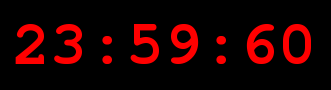
23:59:60 — the rare instant of a leap second. Image: Wikimedia Commons.
The end of the leap second
A 61-second minute, announced with half a year's notice and impossible to predict further ahead, is a nightmare for software. In 2012 it brought down websites and an airline's check-in system; in 2017 it hit one of the internet's largest content delivery networks. The big technology companies began to “smear” the extra second over several hours, each in its own way — which means that on those days several slightly different times are in circulation.
Meanwhile the Earth has wrong-footed everyone: since 2020 it has been spinning faster, with a record in July 2024, when one day lasted 1.66 milliseconds less than 86,400 seconds. If the trend continues, a negative leap second will be needed — a 59-second minute —, something that has never been done or tested. The BIPM puts the probability of that happening by 2035 at about 30%.
In 2022 the CGPM decided to widen the tolerance between UT1 and UTC by 2035. The timetable has now been brought forward: the 28th CGPM, scheduled for 13–15 October 2026 in Versailles, votes on a proposal that sets the maximum difference at 3,600 seconds — one hour — and provides for a continuous UTC from 20 May 2027. If it is approved, there will be no more leap seconds for several centuries, and civil time will, for the first time, no longer be tied to the movement of the planet.
The next second — and time on the Moon
Caesium has a successor in sight. Optical clocks use atoms of strontium or ytterbium, which oscillate at the frequency of visible light — hundreds of terahertz, tens of thousands of times higher than caesium — and slice time far more finely. The best reach uncertainties of one part in 10¹⁸: they would not lose a second over the entire age of the Universe, and they are sensitive to a height difference of one centimetre. The same October conference discusses the roadmap for redefining the second, with a formal proposal expected in 2030.
Also on the agenda is a reference time scale for the Moon. With weaker gravity, a clock on the lunar surface gains about 56 microseconds a day on one on Earth — irrelevant for an astronaut, decisive for a navigation system.
How time reaches the wrist
Satellites. Every GPS or Galileo satellite carries atomic clocks on board and broadcasts its time. An error of one nanosecond is 30 centimetres in position, so an ordinary receiver ends up synchronised to better than a microsecond.
Long-wave radio. The German transmitter DCF77 (77.5 kHz, near Frankfurt) sets Europe's “radio-controlled” clocks and watches within a radius of about 2,000 km, the limit at which Portugal lies. The United Kingdom, the United States and Japan have equivalent transmitters.
Internet. The NTP protocol, dating from 1985, synchronises computers and phones in a cascade from servers connected to atomic clocks, with errors of the order of milliseconds.
Optical fibre. Laboratories, stock exchanges and telecoms operators use dedicated links, accurate to better than a microsecond.
A great deal depends on this without anyone noticing: mobile networks, the power grid, navigation. In the European Union, high-frequency trading venues must timestamp every order to within 100 microseconds of UTC.
And in Portugal?
Legal time is a decision for each state, but that decision comes down to choosing the offset from UTC and the dates of the clock changes — the latter harmonised at European level.
Portugal does not set the world's time reference: it defines its legal time on the basis of UTC, which is established internationally.
It was not always so. Until the end of 1911, legal time followed the meridian of the Lisbon Astronomical Observatory, 36 minutes and 44 seconds behind Greenwich; on 1 January 1912 the country's clocks were put forward by that amount. Summer time arrived in 1916. Twice, from 1966 to 1976 and from 1992 to 1996, Portugal aligned with Central European Time, and twice it went back, after winters in which the Sun rose after nine. Since 1996 the mainland and Madeira have used UTC in winter and UTC+1 in summer; the Azores, one hour less. The change takes place on the last Sunday of March and the last Sunday of October, and the 2018 European proposal to end it remains stalled.
A country without a timekeeper
What each country does is realise the time, maintain it and distribute it. In Portugal that mission fell from 1878 to the Lisbon Astronomical Observatory, which the law put in charge of the legal time service, with a Standing Committee on Time attached to it. The Observatory received its first atomic clock in the 1980s and renewed the equipment in 2001.
What failed was the organisation, not the technology. In 2013, when Lisbon's two universities merged, the Observatory came under the National Museum of Natural History and Science, whose remit is heritage; the time service was left without an owner and was kept going by staff of the Faculty of Sciences. In 2022 a decree-law was announced to transfer it to the Portuguese Institute for Quality (IPQ), in a process involving two ministries and the National Security Office. There is no record of it having been published.
The paradox is that the capability exists. The IPQ's Time and Frequency Laboratory, in Caparica, realises the national atomic time scale, UTC(IPQ), with three caesium clocks that contribute to TAI: it is through it that Portugal appears in the BIPM's calculations. What it lacks is the legal mandate to be the “legal time” and the obligation to disseminate it. The result is that no body has that mission formally assigned today, and the risks are concrete:
Legal certainty. Court and administrative deadlines, public tenders, auctions and electronic contracts close to the second. In a dispute, there is no clock that the law designates as the one that counts.
Timestamps. European rules require qualified electronic timestamps to be traceable to a UTC(k) recognised by the BIPM, with a maximum error of one second. In practice that points to the IPQ or to foreign laboratories, not to the “legal time”.
A service nobody answers for. Anyone still setting their systems by the Observatory's servers depends on a service that no one is obliged to maintain. In June 2023 the Observatory's online clock was found to be eight minutes off, and was corrected after the case was reported.
Dependence on satellites. Without a designated national source, telecommunications, energy and banking networks set themselves by navigation systems the country does not control and whose signal can be jammed or spoofed.
What this means for a watchmaker
To say that a watch gains four seconds a day is to compare it with something. The timing machine on the bench compares it with a quartz oscillator; that quartz was calibrated against a better reference, and the chain always ends at UTC. Every clock in the table does the same thing — it counts oscillations — and the history of watchmaking is, to a large extent, the search for faster and more stable oscillators.
Oscillator | Frequency | Typical deviation |
Huygens's pendulum (1656) | about 1 Hz | about 15 s per day |
Balance of a certified chronometer | 4 Hz | −4 to +6 s per day |
Wristwatch quartz | 32,768 Hz | about 15 s per month |
Caesium fountain | 9,192,631,770 Hz | 1 s in more than 100 million years |
Strontium optical clock | about 429 THz | 1 s in more than 15 billion years |

The balance wheel and hairspring of a 1950s Benrus wristwatch (ETA 1280 calibre): the same principle as an atomic clock — a regular oscillator — on a very different scale. Image: Chetvorno / Wikimedia Commons (public domain).
World time, in the end, is not defined by anyone in particular. It is defined by all those who measure it — and agree to share the result.
Quiz: how much do you know about world time?
Nine quick questions. Pick an option to see at once whether you got it right, and why; all the answers are in the article.


Comments