
COSC: the complete guide to official Swiss chronometer certification


Accuracy is an interesting question in the watch enthusiast community. For some, as long as their watches stay reasonably close to real time, all is well. For others, accuracy is paramount. In Switzerland there is a body that certifies the precision of watches and awards the COSC certificate: Contrôle officiel suisse des chronomètres.
History
Created by five watchmaking cantons (Bern, Geneva, Neuchâtel, Solothurn and Vaud) and by the Federation of the Swiss Watch Industry (FH), COSC brings together several laboratories that were originally founded as independent institutions at the end of the 19th century. The first “Office for the Control of Civil Watches” was set up in Biel in 1878.
Before 1973, the five watchmaking cantons had “official offices for the control of watch precision”, located either in watchmaking schools or in engineering schools. They assessed the quality of “horological objects” according to various criteria, which often differed from canton to canton.
In the early 1970s, faced with a lack of unity in approach and of solidarity among the control offices – among other things – as well as a threat to their official status, the Central Inspection Commission of the offices proposed the creation of a Commission made up of the five cantons where the control offices are located, the Swiss Chamber of Watchmaking and the FH. The result was the creation, in 1973, in La Chaux-de-Fonds, of the “Contrôle officiel suisse des chronomètres” (Official Swiss Chronometer Testing Institute). Since then, COSC has been a non-profit organisation serving Swiss watch brands.
COSC today
Today, COSC has three control offices in French-speaking Switzerland, located close to the manufacturers, which operate 7 days a week, 350 days a year, and are coordinated by the management team in La Chaux-de-Fonds.
The public authorities play an important role in the concrete structure of COSC, since the premises of the three control laboratories belong to them and the staff of these laboratories are employed either by the municipality (Le Locle, Saint-Imier) or by the canton (Bienne).
The three control offices are practically exact replicas of one another. Carrying out the same work, each of them has the same equipment and systems and applies the same procedures in its activity.
In total, around 60 people work full time in the control office (plus around 70 auxiliaries trained by COSC). Most of them are specialised operators. But there is no watchmaker among them: COSC is there to observe and test, not to guide or advise a brand – absolute independence and neutrality are essential.
COSC’s activity runs 7 days a week, for around 350 days a year – a work rhythm imposed by the ISO standard, which requires 15 days of testing + day 0, with measurements every 24 hours. Once an observation has begun, the cycle must be respected, ruling out any possibility of reducing activity to the traditional rhythm of the working week.
Precision
One of the criteria for “chronometer” certification is the average daily rate over the first 10 days of testing: from -4 sec. to +6 sec., that is, up to 10 seconds a day. A tolerance which, as such, may seem high, but which is in reality the result of an extraordinary level of demand.
Even if a watch gained 6 seconds a day, this would mean not only that it was extraordinarily precise, but also that the error after one year would be equivalent, using the metric system for comparison, to about 7cm for every 1000m! But a mechanical watch undergoes slight fluctuations depending on temperature and its position, partly compensating for its own deviations – which is the main hallmark of a high-quality mechanical watch.
The technical value of a certified chronometer compared with a model without certification is incalculable.
Because it also represents recognition for the brand of an impeccable quality system, proof that the notion of “chronometer” is present at every level of its production: research and development, design, production, choice of components and partners, assembly, adjustment, inspection, with a constant concern for the criteria that define a true chronometer. The failure rate of the major brands is extremely low in relation to the volume submitted, which proves the rigour of the brands concerned.
The chronometer certificate is not obtained by chance: it is the symbol of a culture of high-quality manufacturing, of precision and of exacting standards, of the passion that drives Swiss watchmakers.
Technology
The premises housing the three testing laboratories are new and ultramodern. They are equipped with the most advanced infrastructure in order to provide the strict environmental conditions required by the ISO standard. The specific testing equipment, developed and produced by COSC, is regularly updated to keep pace with progress in the watchmaking world, that is, to go beyond the limits that are constantly being pushed by the latest watches.
Custom-made tools
The three observation laboratories are equipped with state-of-the-art technology, designed in-house by the engineers in charge. The specific nature of the requirements is such that all COSC instruments (winding machines, vision machines) have been made to measure, according to exceptional requirements.
Adapted facilities
To guarantee the rigour of its tests, COSC has equipped its facilities with adapted systems:
A hydraulic lift to avoid sudden movements and keep shocks to a minimum
An earthed floor with a copper grid, to prevent staff from becoming charged with static electricity, which could affect the instruments being tested
An airlock to filter dust and guarantee constant levels of temperature and humidity in the thermal chambers and in the measuring laboratory
Specific IT systems
COSC’s new IT portal, developed specifically for its needs, works to everyone’s satisfaction, particularly that of its clients. Every brand can connect to it using its own specific security code. Each of them has a personalised channel, which allows it to communicate with COSC in complete confidence.
Atomic clocks
In each of the three control offices, two atomic clocks and a DCF77 OCXO rubidium clock serve as the time reference. Two of them are linked to GPS time, the third to DCF time in Frankfurt. It is the cross-referencing of these sources that guarantees absolute reliability. Indeed, the three clocks must be synchronised for the time to be distributed to the testing machines.
Permanent monitoring
The air is continuously monitored by probes in all the thermal chambers and in the laboratory. Temperature, humidity and dust are subject to around 180 measurement points per minute per control office, 24 hours a day, 365 days a year. These measurements are stored in the IT system, which allows COSC to answer any question from an applicant about environmental conditions, since the temperature curve, the humidity curve, the atmospheric pressure and the dust readings are all archived. This is the price of traceability that is as complete as possible.
The same procedure is followed for alarms. Monitoring is carried out in real time, with full traceability. Anomalies are recorded and cannot be deleted. A rigour that goes beyond what the ISO standard requires, but which COSC respects, as it represents a guarantee of the conformity of its work.
Rigour and confidentiality
The management team in La Chaux-de-Fonds keeps IT control of all data relating to the arrival of batches, conditioning, environmental conditions, any alarms, the measurements and, of course, the results. This applies to all three control offices. Confidentiality is thus respected: only the management team sees the details of the activity of the three laboratories.
Prepared for any eventuality
COSC is the only body in Switzerland and in the world to carry out chronometer certification on this scale. No other organisation is capable of measuring up to two million watches a year. Should one of the three control offices fail, Swiss watchmaking would therefore have no alternative for the certification of its watches. To be ready for any eventuality, COSC plays the card of absolute security in its spacious and superbly equipped laboratories: if work in one of the three control offices were interrupted, the other two could absorb the production of the entire Swiss watch industry.
Test criteria and types
The control office is, as far as we know, the only laboratory in the world to apply this standard industrially and to issue more than 1,000,000 official chronometer certificates a year. However, this represents only about 6% of Swiss watchmaking, which highlights the exceptional character of the chronometer.
To this end, the watches are subjected to the strict test conditions described in the standard.
It is important to remember that these tests bear no relation to simulating the way a watch behaves when worn.
They are static laboratory tests, applied to timekeeping instruments and not to finished watches. The results obtained give a picture of how a watch performs at a given moment and attest to its intrinsic precision.
However, given their rigour, these tests are extremely selective and only timekeeping instruments of the highest quality can aspire to pass them. It is therefore a test of excellence, although the behaviour of the successful watches when worn always depends directly on the wearer. To obtain the chronometer certificate, a watch must not only be made with components of the finest quality, but must also have been assembled with the greatest care by the best watchmakers. It is therefore a product with very high added value, clearly distinct from watch production of ordinary quality.
The chronometer and the chronograph
The exact definition of chronometers and chronographs is given by the International Organization for Standardization (ISO). (Horological vocabulary according to the ISO 6426 / 2-1984 standard, which defines the main technical and commercial terms used in the watch industry).
Conformity with the definition of chronometer is approved by a neutral official body, which carries out the checks on the watch or movement and issues an official certificate. In Switzerland, each chronometer is unique, identified by a number engraved on its movement and by a certificate number issued by COSC.
The term chronometer is often wrongly applied to instruments fitted with a push-button-activated mechanism that allows a short period of time to be measured. An instrument of this kind is known as a chronograph, whereas a chronometer is a high-precision watch.
Types of mechanical instruments
The watches that can be submitted to obtain the title of chronometer are classified into four types.
Mechanical instruments (with balance oscillator)
Type I: wristwatches
Type II: pocket watches (Lépine or Savonette)
Type III: fixed timepieces (column clocks, table clocks, etc.).
Type IV: wristwatches with quartz oscillator
Type I (balance oscillator) accounts for the overwhelming majority of the instruments COSC tests. Its certification refers to the ISO 3159 standard. The certifications for the other three types are defined by COSC, since there is no international standard for them.
Measuring methods
The ISO 3159 standard gives the definition of a wristwatch chronometer with balance oscillator. Only movements or watches that meet the precision requirements of this standard receive an official chronometer certificate.
The checks carried out by COSC consist of static tests performed in the laboratory. Each individual movement/watch is subjected to a battery of tests specific to each of the four types, over several consecutive days, in five positions and at three different temperatures (8°, 23° and 38°C).
On the day the movement is received (day 0), COSC does the following:
checks the numbers engraved on the movement (against the list supplied by the applicant).
places the movements in holders of five pieces each
winds the movements (delivered unwound) according to the manufacturer’s instructions
places the pieces in an enclosure at 23°C (± 1°C), where they must remain for at least 12 hours so that their temperature stabilises before the testing phase begins.
Then, for 15 days for wristwatches and pocket watches, 19 days for column and table clocks and 13 days for quartz timekeeping instruments – a long and rigorous period – the pieces undergo daily tests. Every day, including weekends, the instruments are measured and wound. On the basis of the measurements, 7 elimination criteria are calculated for Type I. If and only if all 7 criteria are met is the movement / watch certified as a chronometer.
SAS accreditation
COSC has been accredited for twenty years as a calibration laboratory by the Swiss Accreditation Service, SAS.
This accreditation is a guarantee of the quality, consistency and neutrality of the measurements carried out. COSC’s independence (which gives it the status of an association) is an essential factor in its rigour and credibility.
The Swiss Accreditation Service comes under the State Secretariat for Economic Affairs (SECO). SAS is actively involved in designating conformity assessment bodies (CABs) in accordance with international standards. It takes its own accreditation decisions, autonomously and independently.
Certificates
For timekeeping instruments that pass the tests, COSC issues a collective certificate under official seal, with the option of an individual rating certificate or an individual inspection certificate.
The collective certificate (Appendix Ia of the COSC General Conditions) is dated and signed by the head of the Control Office. It lists the results obtained for timekeeping instruments of the same category, belonging to the same batch and to the same applicant. It contains:
the unique number of the collective certificate
the chronometer control number
the watch brand and the data needed to identify the origin of the request
the calibre reference, its type, category and specific features
the dates on which the tests were submitted and completed
the measuring method used
the place and date of issue of the bulletin
the COSC seal of the observation laboratory and the signature of the laboratory director
the measurement uncertainty
the unique number of each movement
the states, daily rates and results obtained for the various criteria, including failures
the collective statistics of the certificates, as well as the summary of failures
The optional documentary report (Appendix Ib of the COSC General Conditions, A4 format or 3 pages), dated and signed by COSC management and containing the results of all the tests, contains:
the chronometer control number
the unique number of the chronometer or of the chronometer movement
the reference of the collective certificate number
the category, specific features and dimensions of the movement
the brand of the watch or timekeeping instrument
the statement of performance, the results obtained for the various criteria and the date the tests were completed
the place of testing
the date of issue of the report, with the COSC seal of the observation laboratory and signed by COSC management.
The individual control certificate (Appendix Ic of the COSC General Conditions, strip format), dated and signed by COSC management, without specifying the results obtained, contains:
the chronometer control number
the unique number of the chronometer or of the chronometer movement
the brand of the watch or timekeeping instrument
the COSC seal of the control office, the reference of the collective certificate number and the signature of COSC management
On request, any buyer of a chronometer can ask for the results obtained by their timekeeping instrument by contacting the brand, which is the sole holder of this information.
Mechanical movements
During the 15 days of testing, the precision of the watch is checked against two essential parameters:
temperature
the position of the watch (3 o’clock, 6 o’clock, 9 o’clock, dial up, dial down)
Placed in holders of five pieces each, the movements are successively set in the various positions, inside the thermal enclosures corresponding to the different temperatures required. Each piece remains in a given position and temperature for 24 hours. Every day, they are briefly taken out of these thermal enclosures for measurements to be taken, using vision machines equipped with five cameras.
The daily measurements carried out by COSC on each movement therefore consist of determining the state of each instrument in relation to a reference period. Measuring by the difference between states makes it possible to integrate the behaviour of the movement over time and to calculate the daily rate.
Minimum requirements (for balance-spring wristwatches) – Type I *

The minimum requirements are considered absolute limits and no calculation result is rounded up or down.
Definitions
State
The difference, at a given moment, between the time indicated by a timekeeping instrument and the reference time given by a master clock.
The state is positive or negative depending on whether the timekeeping instrument is ahead of or behind the reference time.
Rate
The expression of the difference, per unit of time, between two states of a timekeeping instrument, separated by a given interval of time (duration).
If it is positive, the instrument gains, and vice versa.
Daily rate: the expression of the difference between two states separated by a time interval of 24 hours.
Each Control Office uses a time base made up of two atomic clocks and a synchronised DCF77 OCXO clock, and uses two different time references (GPS and DCF). Data entry and calculation are fully computerised.
Avg R
Arithmetic mean of the daily rates over the first 10 days of testing.
Avg V
Arithmetic mean of the five absolute values of the rate variations obtained for the five positions of the watch during the first 10 days of testing.
Max V
The absolute value of the largest of the five rate variations for the five positions of the watch during the first 10 days of testing.
D
The difference between the vertical and horizontal rates of the watch, obtained by subtracting the average rate of the 9th and 10th days of testing from the average rate of the first two days of testing.
P
Absolute value of the largest of the differences between one of the first 10 rates and the average daily rate of the tests.
C
The variation of the rate as a function of temperature, obtained by subtracting the rate at 38°C from the rate at 8°C and dividing the total by the temperature interval between these two rates.
R
Variation between the last rate of the tests and the average of the first two rates of the tests.
Category 1
This consists of wristwatches whose casing-up diameter is greater than 20 mm or whose casing-up surface is greater than 314 mm². Category 2 includes all wristwatches whose casing-up diameter is equal to or less than 20 mm and whose casing-up surface does not exceed 314 mm².
Quartz movements
COSC also certifies quartz chronometers. Since no international standard currently applies to the electronic quartz watch, COSC has established a test requirement for quartz chronometers based on the ISO 3159 standard. This specification certifies their performance, just as with the mechanical chronometer.
In absolute terms, a quartz movement is more precise than a mechanical movement. In reality, quartz is more inconstant, as it is very sensitive to temperature and humidity, which can significantly alter its running precision. Quality quartz is therefore equipped to adapt the oscillator frequency automatically according to environmental conditions. It must be encapsulated in an absolutely hermetic way so as not to be sensitive to humidity.
Minimum requirements (for wristwatches with quartz oscillator) – Type IV
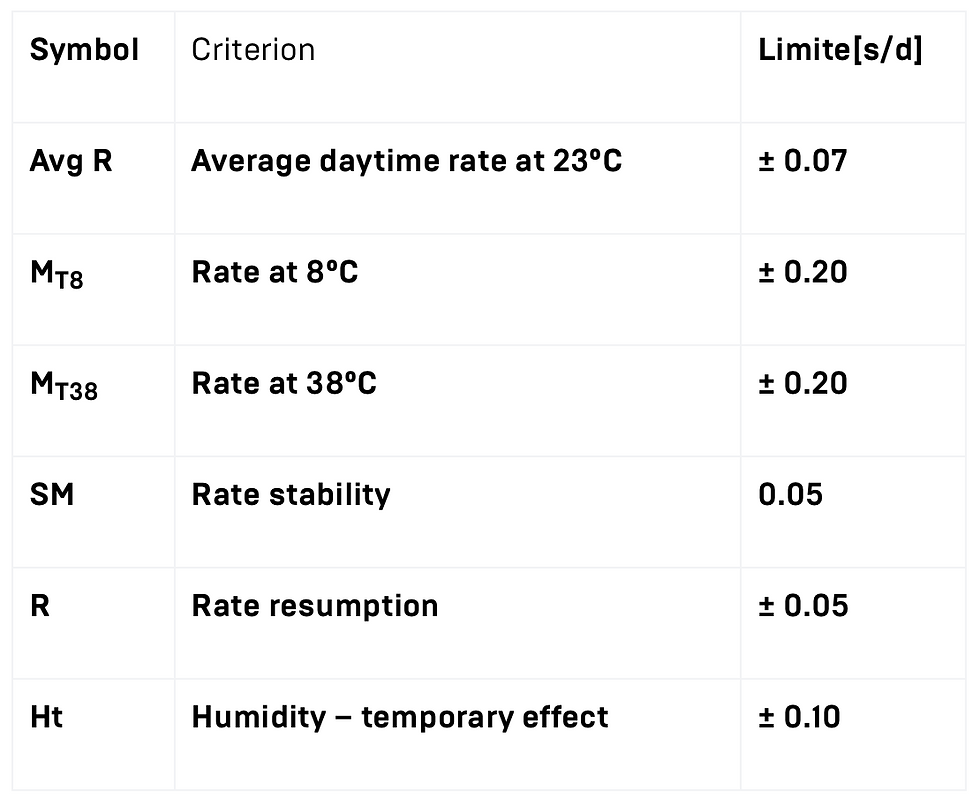
To take account of the technological characteristics of these products, COSC has adapted its tests and its precision requirements. To obtain the COSC label, a quartz instrument must have thermocompensation and rigorous encapsulation. Each quartz chronometer is tested for 13 days, in a single position, at 3 different temperatures and 4 different levels of relative humidity. The criteria are fewer, but the tolerance levels are much stricter.
Testing movements or complete watches
COSC works mainly on the observation of movements, but it also tests complete watches. The ISO 3159 standard specifies that certification may be carried out at the level of the watch case or at the level of the movement, the title of “chronometer” applying in the same way in both cases.
The choice is therefore up to the manufacturer. Testing the complete watch is the most absolute, since there is no further intervention at production level. But testing the complete watch is more expensive, since the assembly and observation work, which requires the presence and manual work of an operator for each piece, takes longer. This work is carried out mainly on so-called exceptional watches.
The minimum requirements for complete mechanical watches are the same as for Type I instruments.
Requirements for certification
The know-how and equipment used in chronometer certification activities can be made available to the Swiss watch industry for any type of check relating to the frequency of timekeeping instruments.
COSC is in a position to carry out multiple rate tests on the timekeeping instruments entrusted to it. These tests do not necessarily lead to the title of chronometer, but they can facilitate or even speed up the development and industrialisation of watches at the manufacturers.
The owner of the watch brand or of the movements submitted assumes full responsibility for compliance with the conditions for submission to COSC.
COSC Management, in collaboration with the applicants, organises the logistics to distribute production optimally among the laboratories, taking into account the needs and wishes of the clients.
Specifications
The movements or timekeeping instruments submitted must be numbered. The number of each piece may be used only once by the same applicant for the same calibre.
The timekeeping instruments must be fitted with a seconds indication. Calibres with a chronograph function must be submitted with the chronograph hand in addition to the seconds hand.
The movements must be submitted in specific working casings. The models and specific features of the calibres can be consulted in the COSC submission specifications.
Handling the bulk of movements to be certified involves the use of equally specific working dials and hands. The COSC submission specifications define the exact dimensions, shapes and colours authorised for the semi-automatic tests.
The calibres must be characterised by the applicants by means of an identification sheet, in order to ensure the best handling conditions and to avoid breakages during the repeated winding operations throughout the tests.
Accreditation and Certification
Accreditation = confirmation and recognition of technical competence
Confirmation by a third party (SAS), formally recognising that a conformity assessment body (COSC) is competent to carry out specific conformity assessment tasks.
Certification = confirmation of compliance with prescribed requirements
Procedure by which a third party (COSC) confirms in writing that products, processes, systems or persons comply with the prescribed requirements (in this case, the ISO 3159 standard).
Questions and answers
COSC and its observation offices are accredited by the SCS, STS and SCESp. What does this mean?
COSC and its laboratories comply with a Quality Manual (in accordance with the ISO 17025 and 17065 standards) whose content and application are governed by the Swiss Accreditation Service (SAS). They are subject to regular control audits.
What information can the buyer of a certified chronometer watch obtain from COSC?
None. COSC is the repository of the analytical results that belong to its clients (the watch brands). It has no authority to disclose information to anyone other than the legitimate owners of those results. The buyer should contact the headquarters of the brand to which the chronometer belongs.
Are all chronometers sold with a COSC certificate?
No. The documents issued by COSC are optional. It is up to the brands, and to them alone, to decide whether or not to communicate the results obtained when the movement or watch was certified by COSC.
What if a COSC certificate is lost?
A COSC certificate is considered a valuable document. COSC is authorised to issue only one copy of a certificate, bearing the word “duplicate”. If a duplicate is lost, the only way to obtain a new document is to submit the watch to a new check. In that case, only the brand can request this service. It is therefore necessary to contact directly the headquarters of the brand that sold the chronometer.
What should be done if a COSC certificate has been damaged?
The damaged certificate must be returned to the brand that sold the chronometer. Only the brand can obtain a new original certificate (not a duplicate), by returning this document to COSC.
Can a chronometer be certified several times during its lifetime?
Yes, a chronometer can undergo as many checks as necessary, particularly if important components of the movement have been replaced. However, only the brand can request this service.
How long is chronometer certification valid?
The chronometer label can be compared to a university degree. At a given moment in their life, the candidate has proved, on the basis of an examination, that they met the performance criteria entitling them to bear the label. In the case of a graduate, this title is acquired for life, even if their performance may undergo some changes over time.
How long does COSC keep the results of its measurements?
The results relating to a chronometer are kept for 10 years from the day the tests were completed. After this period, no further information about a chronometer can be issued.
Why can a chronometer be sold at a higher price than a non-certified watch?
The cost of the COSC check is reasonable. However, as with driving tests, it is not the test that is expensive, but all the time and effort invested in trying to pass it. In the case of a chronometer, its design, manufacture, assembly, adjustment and all the checks on the components and the movement needed to achieve the required precision call for much more care and time. It is therefore the intrinsic quality of the product that justifies its price.
Is a non-certified watch likely to meet the precision criteria of a chronometer?
No, because the components of a chronometer are of superior quality and the care taken in assembling and adjusting it is incomparable.


Comments