
The Balance Spring: The Dispute between Hooke and Huygens over the Soul of the Watch

GREAT CONTROVERSIES IN THE HISTORY OF WATCHMAKING
Sílvio Pereira

The history of watchmaking is, to a large extent, the history of the taming of time. In the 17th century, when mechanical knowledge and natural science were intertwined with the curiosity of craftsmen, a small component would definitively change the course of portable timekeeping: the balance spring (or hairspring). Its introduction transformed the pocket watch from a curious toy into a precision instrument, giving it a constant and predictable beat.
However, the authorship of this invention — seemingly so simple — became one of the most heated disputes in the history of science and horology. Between Robert Hooke, the restless English genius, and Christiaan Huygens, the Dutch scholar of methodical temperament, a contest was fought that crossed borders, temperaments and academies.


Historical context (17th century)
The balance spring was the key part that turned portable timepieces into instruments of practical use: coupled to the balance, it creates a harmonic oscillator with a relatively stable period, greatly reducing the watch's sensitivity to variations in driving force. Before the hairspring, foliots and balances without a spring were used, and they were highly inaccurate. The practical and theoretical importance of the invention made the question of who fathered it a matter of controversy from the 17th century itself.
Chronology and key documentary evidence
Robert Hooke (England)
There are notes and sketches by Hooke (the so-called Hooke folio and other manuscripts) documenting his thinking on elastic bodies and the application of an elastic element to a balance around the decade of 1650–1660. Some researchers claim there is a patent application (or a draft) datable to between 1663–1665, indicating that Hooke already had the idea of “coupling an elastic piece to the balance” before Huygens published.


Pages from the "Hooke Folio"
Christiaan Huygens (Netherlands)
Huygens noted down a concrete solution on 20 January 1675 (diary), drawing a spiral spring attached to the balance and developing, almost simultaneously, the theoretical argument that supported the practical usefulness of the device. Huygens formally published and disseminated his idea, worked together with watchmakers (notably Isaac Thuret) and obtained a working watch with a balance spring very soon after the discovery.


Two views of the movement of the first watch with the balance spring of Huygens made by Isaac Thuret - 1675 (Antique
Horology)
Technical players — Tompion, Thuret, Hautefeuille
Besides Hooke and Huygens, other relevant actors emerge: Thomas Tompion (English watchmaker), Isaac Thuret (French watchmaker who collaborated/potentially and built one of the first examples with the hairspring of Huygens) and Jean de Hautefeuille (who also claimed priority in France). The disputes involved both the idea and the practical execution of the mechanism.
Nature of the dispute — idea vs. implementation
The controversy comes down to two distinct questions:
Who first had the conceptual idea of adding an elastic element to the balance?
Who conceived the spiral spring and built the first truly working sprung balance?
The facts point to a division: Hooke appears to have conceived the primitive idea first (notes in the 1660s), but Huygens was the one who formalised the balance-spring solution (with drawing and analysis), published it and, crucially, produced a practical watch that worked with the hairspring — often recognised as the first to demonstrate real usefulness. There are thus two legitimate ways of claiming priority: that of the initial idea (Hooke) and that of the concrete, operational solution (Huygens/Thuret).

Assessment of the evidence
Hooke's documents: Hooke's manuscripts show that he had the intuition of using an elastic body coupled to the balance. The discovery, and some sketches, predate 1675. However, the evidence that Hooke built or demonstrated a faithfully working mechanism with a spiral spring is weak — his documentation appears to be mainly conceptual and experimental, in the laboratory, without robust public proof of a portable watch with satisfactory performance.
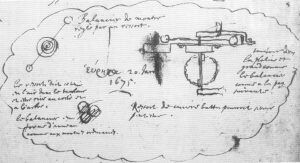
Records of Huygens: the diary entry of Huygens (January 1675) is explicit and was followed by swift action to realise the invention with watchmakers. Huygens sought protection and publicity for his discovery and described the principle mathematically, which eased its practical adoption. The documentation of Huygens is, in terms of publication and demonstration, more direct and verifiable.
Contemporary testimony and scientific politics: in England, personal relationships (e.g. Hooke vs Newton, and the influence of figures such as the President of the Royal Society) complicated recognition and the preservation of evidence. The history of priority often also reflected rivalries and the protection of reputations, not merely the cold assessment of technical facts.
Technical differences between the proposals

Concept of Hooke: an elastic body linked to the balance to resist motion and produce restoring force — an idea correct in essence, linked to his studies on elasticity (Hooke's Law). However, the surviving sketches do not seem to detail the ideal geometry of the spring (spiral) nor the most effective practical way of attaching and manufacturing it for a pocket watch.

Solution of Huygens: Huygens explicitly proposed a spiral spring (hairspring) which, when fixed to the balance staff, provides an almost linear restoring torque for small oscillations — an arrangement that allows an oscillator with a determined period and greater isochronism. The theoretical formulation of Huygens and his collaboration with a watchmaker made it possible to turn the concept into practicable technology.
Technological consequences and historical recognition

The adoption of the balance spring drastically improved the accuracy of portable watches and was decisive for modern watchmaking. Historically, Huygens became more associated with the technical credit because he published and demonstrated the invention; Hooke, despite posthumous claims on his behalf and manuscript evidence, suffered from the lack of formal publication and from institutional antagonisms that hampered his historical “visibility”.
A critical, well-founded opinion
I consider it fair to share the credit, with clear distinctions — and I explain why:
To Robert Hooke goes the recognition for having had the first intuition and for having worked experimentally on the idea of coupling an elastic element to the balance before 1675. His manuscripts confirm that he grasped the relevance of the problem and proposed a conceptual solution years earlier. The documentary discovery of the Hooke folio reinforces this position.
To Christiaan Huygens credit is due for formalising the solution (spiral spring), for developing the analytical reasoning that supported the concept and for quickly achieving a practical execution (with watchmakers such as Thuret) which demonstrated the applicability of the invention in portable watches. That step — from idea to technical demonstration and dissemination — is decisive for an invention to pass from hypothesis to useful technology.
My opinion, therefore, is that Hooke was the inventor of the initial idea of the ‘sprung balance’, while Huygens (with the collaboration of some watchmakers) was responsible for the technical solution of the balance spring and its practical implementation. If one is looking for a single name for popular historical paternity, Huygens has the edge; if the aim is to give credit for the intellectual genesis, Hooke cannot be ignored.
A note on historical justice and scientific practice
The dispute is a good illustration of a recurring theme: the difference between having the vision and bringing the invention to life. Institutions (Royal Society, and watchmaking workshops) and personal rivalries influenced the legacy. Historically, science and technology rarely advance through a single isolated inventor — here, the interaction between theorist (Huygens), experimenter/ideologue (Hooke) and craftsmen (Thuret, Tompion) was decisive.
Main readings and sources (selected)
Overview article on the balance spring — Wikipedia: “Balance spring” (a good summary and initial bibliography). Wikipedia
Critical horological analysis — WatchesBySJX / Monochrome (modern research that reassesses the evidence and argues for sharing the credit). SJX Watches
Research on Hooke's manuscripts and academic discussion — Ablogtowatch / Hooke folio (documents and historical analysis). ablogtowatch.com
Museum records on movements and watchmaking of the period — Science Museum (London) — objects and a description of the practical disputes with watchmakers. collection.sciencemuseumgroup.org.uk
Historical discussions on intellectual property and scientific priority at the Royal Society — R. Iliffe (1992) (political and institutional context). adsabs.harvard.edu


Comments