
Tissot | 1960 | Gold-plated

Series: GREAT BRANDS
By: Sílvio Pereira
- Lepine-type pocket watch. Dated 1960
- Functions: hours, minutes and seconds
- Serial number: Y511.210
- Manufacture: Tissot
- Country - Switzerland
- Calibre: classic bridge layout. Unitas 6497
- Movement protection: brass dust cover
- Escapement type: Swiss lever
- Balance: Glucydur, with flat hairspring
- Power reserve: 36 hours
- Frequency: 18,000 vph
- Jewels: 17
- Case material: gold-plated
- Dial: enamel without flaws or hairline cracks
- Small seconds: at 6 o'clock
- Case diameter: 48.1 mm
- Thickness: 12.1 mm
- Weight: 75.63 g
- The mainspring is wound via the crown at 12 o'clock.
- Hands: pear-shaped. Set via the crown.
- Numerals: Roman for the hours up to 12 and Arabic from 13 to 24. Indices for the minutes.
- Crystal: in excellent condition.
- Case back numbering: Y511.210
Overall assessment - A watch from one of the most important and oldest brands in world watchmaking, in excellent overall condition. It works perfectly.
Other pieces from the collection
Tissot | PR 516-GL | 1970

Although it does not fit the theme of these articles on pocket watches, there is a very strong connection between the author of the article and this PR 516 GL, as it was his first watch, for which he had to work for 3 months of his school holidays in order to buy it. It was his first job and his first wage, at just 12 years old, in the distant year of 1972.
THE HISTORY OF TISSOT

The beginning of it all
Germany and the Netherlands led watchmaking in the 17th century with inventions such as the fusee chain and the balance spring, respectively. The 18th century brought the dominance of English watchmakers, whose technical innovations are still found in today's mechanical movements.
Meanwhile, Switzerland came onto the scene. The Swiss master watchmaker Abraham-Louis Breguet was an extraordinary inventor, whose achievements included the tourbillon, a rotating device to counteract the effects of gravity in a pocket watch; the anti-shock device, a shock-absorbing mechanism; and the balance spring known as the 'Breguet hairspring'. Peasants and farmers in Switzerland spent the winter months making watch components for watchmaking companies based in Geneva, which allowed the Swiss watch industry to grow enormously in the 19th century.
But Switzerland in the mid-19th century was not the wealthy country it is today, and it was a country in great social and economic flux. In the 19th century, poverty and a lack of job opportunities led many Swiss to seek their futures elsewhere, mainly in North and South America. Watchmaking would prove to be a key industry during this period in establishing economic stability and eventual prosperity in Switzerland.
The Jura - the heart of Swiss watchmaking

Jura
The Jura is an undulating mountain range in north-western Switzerland and covers about one eighth of the country.
For more than a century, 90% of Swiss watch production has been concentrated in the Jura. This region became known as 'Watch Valley – the Land of Precision'. In the early 2000s the historic Watchmaking Route, some 200 km long, was launched in this region. The 38 stages of the route form a kind of watchmaking pilgrimage that passes the most famous watch manufacturers and specialist museums, where unique masterpieces are on display.
The birth and growth of Tissot

Charles-Félicien Tissot and Charles-Emile Tissot
On 1 July 1853, Charles-Félicien Tissot, a gold case maker, founded Ch. Félicien Tissot & Fils in Le Locle in the Jura, with his son Charles-Emile Tissot, a watchmaker.

Tissot's first logo
Tissot began its activity in the town of Le Locle as a comptoir d'établissage, which consisted of a network of highly specialised independent workers who produced the various watch parts, which were then assembled and sold at the comptoir.

Le Locle
Tissot's focus was on pocket watches, luxurious pendant watches or watches with complications, at the time intended mainly for the United States market. In 1858, the founder's son, Charles-Emile Tissot, left Switzerland and travelled to Russia, where he successfully sold Tissot 'Savonnette' pocket watches throughout the vast and influential Russian empire, starting by selling hunter watches to the officers guarding the Tsar's palace.

Tissot factory in the early 20th century
In 1900 Tissot won a highly coveted award, the Grand Prix in Paris, the same year in which the city hosted the 2nd Olympic Games. At the same time, Tissot pioneered a long history of collaboration with its ambassadors, with one of its wristwatches being worn by the iconic actress Sarah Bernhardt, the most successful stage actress of her time. At the end of 1917, the company Tissot & Fils SA was founded and it became a manufacturer with the introduction of the production of movement parts. Within a few years, Tissot managed to build a remarkable presence in the world watch market.
Mergers and the turbulent 20th century
In 1930, Tissot and Omega merged to form the first Swiss watchmaking association, SSIH (Société Suisse pour l'Industrie Horlogère). Watches from the Tissot-Omega era are highly sought after by collectors. Quartz, the greatest revolution of the 20th century in the watch industry, also passed through Switzerland. Although the first quartz watch was developed at the Centre Electronique Horloger (CEH – Electronic Watchmaking Centre) in Neuchâtel in 1967, Swiss watchmakers did not capitalise on this innovation. In the 1970s, the Swiss watch industry was in serious crisis, stemming from the advent of highly successful quartz watches dominated by the Japanese.
The Swiss watch industry would be saved when the watch was reborn as a fashion accessory through Swatch. This analogue quartz watch, which combined high quality and exciting designs with a low price, was first launched in 1983 and became a pop culture sensation and a huge global success in the 1980s. There is no doubt that Swatch saved the Swiss watch industry from its fall and helped to propel it. Thirty years after the 'crisis' in the Swiss watch industry, it has once again become one of Switzerland's most prosperous economic sectors and once more a byword for quality and prestige.
In 1983, Nicolas G. Hayek of Swatch, who had been tasked with auditing the Swiss watch sector, recommended the merger of the main watchmaking groups of the time: SSIH (mainly Tissot and Omega) and ASUAG (a holding company of manufacturers of raw movements and components). The group, then called SMH (Swiss Corporation for Microelectronics and Watchmaking Industries Ltd.), would become The Swatch Group in 1998, of which Tissot is still part today. The Swatch Group is today the largest producer and distributor of watches in the world.

Tissot factory today
Heritage, innovation and global prestige
“Tissot - more than a watch.”
Tissot is defined by its well-known slogan - 'Innovators by Tradition'. The company has proudly had its headquarters in the town of Le Locle, in the Neuchâtel area, in the Jura mountains, since 1853, with a highly visible presence in 160 countries, including many luxurious Tissot boutiques and points of sale in high-quality jewellers and watch shops around the world. Tissot's distribution spread is unmatched by any other Swiss watch company.
Tissot's enviable and ground-breaking innovation has enabled the development of high-tech products, special materials and advanced functions. With a wider and more versatile range of high-quality watches at an attractive price than any other Swiss watch brand, Tissot is also committed to making excellence accessible.
“We have such a strong creative streak because we are a true multi-specialist.”François Thiébaud (President of Tissot).
It is the Switzerland at the heart of Tissot that makes the brand so distinctive. The + in the Tissot logo is the same as the one on the Swiss flag, symbolising the quality and reliability that Tissot has proudly demonstrated since 1853. That is why this innovative brand remains at home in Le Locle in the Swiss Jura mountains, keeping its identity in all its essence.
Collections
Tissot watches are available in various technical variants, so there are many models with automatic and quartz movements, and occasionally also with solar cells as a power source. Most models are also offered in different designs, for example optionally with a case in stainless steel, gold, titanium, platinum or combinations of several metals (two-tone), with dials of distinctive design and various types of strap.
Today the Tissot collection is divided into a total of seven product ranges:
T-Touch
Multifunctional tactile watches, where functions such as chronograph, altimeter, compass, alarm, thermometer, barometer, date and time can be activated by touching the sensor-equipped sapphire crystal. The collections include T-Touch Export Solar and T-Touch Lady Solar.

T-Sport
Tissot's T-Sport range includes its sports and diving watches. Within the range are famous and much-loved collections such as the PRS 516, V8, Seastar 1000, T-Race and many more. The collection consists mainly of men's watches, but there are also some women's sports models.

T-Lady
The T-Lady range is where we find some of Tissot's most emblematic women's watches, such as the Flamingo, Lovely, Generosi-T and Cera collections. Some models are even set with real diamonds and fitted with mother-of-pearl dials.

T-Classic
The T-Classic range mainly includes classic, understated and timeless designs. This is where the Luxury, Bridgeport, Couturier and Tradition collections come together. But models such as the highly praised T-Complication Squelette are also included in this range, which makes it very versatile.

Heritage
Tissot's Heritage range includes reissues of watches from Tissot's early days. It was first launched on the occasion of the company's 150th anniversary in 2003. Today we find the Heritage Navigator and one of the best-selling automatics of this Swiss company, the Heritage Visodate.

Pocket Watch
Staying true to its heritage, Tissot still makes pocket watches, exactly as when it started in 1853. They are proof not only of the brand's fine vintage spirit, but also of its expertise. The collections include the Lepine and Savonnette pocket watches and the very special Musical Seasons, which can play music through mechanical parts.

T-Gold
The T-Gold range includes all of Tissot's gold watches. It is a vast collection that grows from year to year. Some of the newest and most elegant watches in this range are the new 18 kt Gold Vintage collection, available in men's and women's versions.

Innovations
Tissot watches have made inroads in every area, both in shapes and in materials. One of the main highlights was the Tissot Astrolon, launched in 1971. It was the world's first mechanical watch made of plastic. The iconic Tissot Rock watch, launched a decade later, in 1985, had a case made of natural stone from the Swiss Alps. In 1988, Tissot turned to nature again when it made a watch in wood.
The commitment to innovation and technological advances in the watch industry is at the heart and soul of Tissot. Just look at the timeline of innovations we describe below to see how innovation has set Tissot apart over all these years. Not every innovation was a success, but despite the occasional flop, Tissot has continued to innovate over the centuries and to push the limits of what we expect from a wristwatch.

TWO TIME ZONES pocket watch from 1853, a mass-produced marvel of its time that launched the Tissot name to the world.

PENDANT WATCH from 1878 made in gold with diamonds and enamel for the Russian market.

The TISSOT PRINCE 'BANANA' watches of 1916 featured a curved case and Art Deco styling to the delight of European and Russian customers.

1929 TISSOT HERMETIC, a watch with a lever escapement movement that adjusts automatically when subjected to temperature changes.

1930 TISSOT ANTIMAGNÉTIQUE, the world's first non-magnetic wristwatch.

1951 TISSOT NAVIGATOR, the world's first automatic wristwatch with 24 time zones displayed without manipulation.

1954 TISSOT VISODATE, a wristwatch with date.

1965 TISSOT PR 516: Particularly Robust (PR), with the world's first registered perforated strap - inspired by the steering wheels of racing cars.

1968 TISSOT CARROUSEL, a watch with interchangeable bezels, with an advertising campaign strongly inspired by the Mexico City Olympic Games of that year.


1971 TISSOT ASTROLON (also known as IDEA 2001), the world's first plastic mechanical watch.
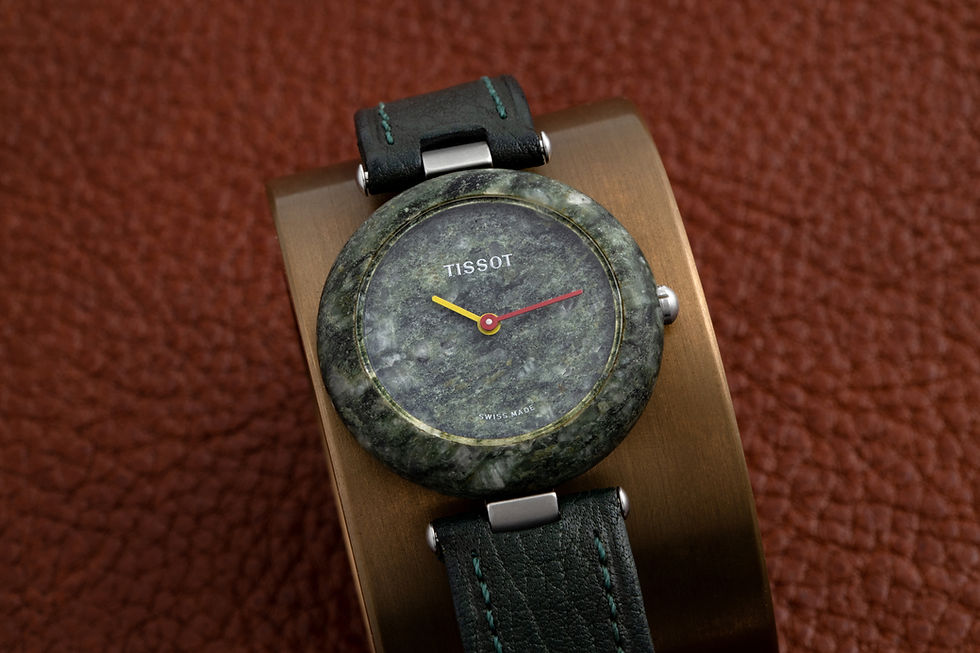
1985 TISSOT ROCKWATCH, the world's first wristwatch with a natural stone case (granite and other stones).

1986 TISSOT TWOTIMER, the world's first wristwatch with analogue and digital time and seven functions operated through a single crown.

1989 TISSOT WOODWATCH, a wristwatch with a wooden case.

1991 TISSOT CERATEN, with a scratch-resistant ceramic case.

1999 TISSOT T-TOUCH, the world's first tactile (touch) watch with new instrument functions - the first truly touch-sensitive crystal technology on the market, almost a decade before mobile phones adopted this feature as standard.

2009 TISSOT SEA-TOUCH, a high-performance divers' watch water-resistant to 200 metres.

2011 TISSOT LE LOCLE wins first prize in the International Timing Competition.

2014 TISSOT T-TOUCH SOLAR, the world's first solar-powered tactile watch.
Tissot and Sport
The brand's strong focus has been repeatedly recognised in global sport. During its illustrious history, Tissot has been named Official Timekeeper and Partner of the NBA, FIBA, CBA, MotoGP, FIM World Superbike, AFL, RBS 6 Nations Rugby and the World Championships of cycling, fencing and ice hockey.
“Tissot has always been drawn to sport.”François Thiébaud (President of Tissot)
Tissot has had a brilliant global sponsorship strategy in which it harnesses the brand power of the leading professional sports. These create a point of sale for its watches, identifying the right vehicle for each exclusive market. A recent case in point is China's CBA League (basketball), which was identified as an ideal sport for reaching and attracting the rising Chinese middle-class consumer, as well as improving recognition of the Tissot brand in the largest and most populous country in the world. The achievements of this sponsorship were tremendous for Tissot and made it the best-selling Swiss watch brand in China.
Tissot watches channel the brand's passion for sport, which is used as a key design aesthetic in many of its luxury watches.
Official timekeeping
Tissot is one of the most prominent official timekeepers in the world across various sports. Being Official Timekeeper means that Tissot has the privilege and the enormous responsibility of timing each of these sports.
The appeal of sport lies in competition, and time is such an integral part of it that getting it exactly right, time after time, is imperative. Tissot has demonstrated its ability to provide absolute precision, and that is why it has become a trusted partner of some of the biggest sports in the world.
Timing is all about precision. Timing any of these sports is no easy task when you consider that motorcycles can be separated by mere thousandths of a second at the finish line, or that fencers separate in just a millisecond. Timing, scoring and statistics in modern competitive sport are not simply a matter of counting down seconds and counting positions. Analysis and statistics are tremendously important for all the analyses of fans, coaches, athletes, commentators and the press. Tissot provides all of this, always with perfect precision.
Some of the sports for which Tissot is a proud Official Timekeeper include:
Moto GP

Motorcycling is speed in motion.
Having been involved in the fast world of motor racing, Tissot further strengthened its ties with motorsport by associating itself with MotoGP™ and becoming its Official Timekeeper in 2001. Tissot's association with the prestigious world events in the technological world of motorcycling reflects the nature of the company and its products, as well as the beauty behind their movements.
Cycling

Cycling is endurance in motion.
Tissot once again distinguished itself in the world of cycling by becoming the official timekeeper of the Tour de France and of all the cycling time trials held by the Amaury Sport Organization (ASO). In 2016, the Swiss watchmaker lent its expertise to a large number of major time trials, from Paris-Nice to Paris-Tours, La Flèche Wallonne, the Tour de France and the Vuelta a España. In sport every second counts, so having a timekeeper of the very highest quality is essential. This sponsorship means that Tissot can attract a large number of cycling enthusiasts committed to endurance and performance.
Fencing

Fencing is finesse in motion.
In 1996 it became a partner of the Fédération Internationale d'Escrime (FIE). Fencing is a fine example of time-honoured tradition and total precision, which are the underlying pillars of the Tissot brand. Fencing is one of the oldest sports in which time is crucial. Fencing is an obvious choice for a watch company and a perfect illustration of Tissot's motto “Innovation by Tradition”. Fencing champions need great dexterity and the ability to constantly surprise their opponent, to the delight of spectators. It is the beauty and grace of gesture and movement that make fencing unique and such a special partner for Tissot.
Six Nations Rugby Championship

Rugby is power in motion.
In 2013 Tissot became the Official Timekeeper of the RBS 6 Nations Championship, the biggest annual rugby championship in the world. Rugby demonstrates many of the core values shared at Tissot, such as teamwork, respect, discipline and love of sport. These championships are therefore the perfect platform for Tissot to showcase its timekeeping expertise in an exciting and international environment, which at the same time represents the brand's powerful and assertive spirit.
Tissot trivia
Here are some interesting facts about Tissot:
- Tissot watches were worn by Sarah Bernhardt, who chose Tissot as her signature watch in 1900 and was Tissot's first celebrity ambassador.

- What do Elvis Presley, Grace Kelly and Nelson Mandela have in common? They were all fans of Tissot watches.
- The Luso-Brazilian music sensation of the 1940s, Carmen Miranda, was also known to love her Tissot watches
- James Stewart wore a Tissot watch in the classic Rear Window by Alfred Hitchcock, from 1954

- Alec Guinness wears a Tissot in the 1955 British classic The Ladykillers

- Angelina Jolie wears a Tissot as the heroine of Lara Croft: Tomb Raider, from 2003

- Several characters wear different Tissot watches during the long-running (2003-2013) hit comedy series Arrested Development
- Both Brad Pitt and Angelina Jolie wear Tissot watches in the 2005 spy thriller Mr and Mrs Smith

- Simon Pegg can be clearly seen wearing a Tissot T-Touch Expert Solar in the 2015 action film Mission Impossible: Rogue Nation


Comments