
Tower clocks

“If it were possible to condense the whole life of the Earth into the space of one year, man would appear on 31 December at 11.45 (Hitti, 1961).”
Because time is neither physical, visible nor tangible, human beings, in setting out to measure it, embraced a challenging goal, creating and developing fascinating devices that, over the centuries, have always moved and captivated generations.

Tower clocks marked the beginning of this journey. Large and sturdy, they gradually became smaller and, little by little, found their way into our homes. First came wall and table clocks, followed by pocket watches and wristwatches. Almost unattainable at first, these timeless time-measuring machines came increasingly within reach of the general public.
This article focuses exclusively on tower clocks, exploring their history from their first appearance through their evolution over the centuries, as well as how they work. It also deals with ironwork clockmaking in Portugal, highlighting its importance and uniqueness in its historical context. As a complement, it recounts a visit to the tower clock of the Church of Santiago at Palmela Castle, a concrete example of the effort to preserve and promote this important historical and cultural heritage.
Man's relationship with the surrounding natural world is inevitable, and nature's influence on human life is another inevitability. The great cycles of nature (year, month, day) repeat themselves without interruption, leading man to establish habits in his relationship with these cycles. The attempt to organise and count time arises almost naturally from the relationship between man and nature. Years, seasons, months, days (light and darkness follow one another without interruption), the visible path of the Sun, among others, are examples of natural cycles that always repeat themselves regularly and, for that reason, also served as a guide in the lives of the people who, in the meantime, organised them.

Today we can divide a second into ten or even a hundred parts, but if we imagine ourselves in the 13th century, when the first tower clocks appeared, the smallest unit of time might perhaps have been the day. The pace of life was less hectic and precision in measuring time was more relative. The working day was defined as the time between sunrise and sunset, and midday was when the shadow was at its shortest. The shadow of a hoe handle cast on the ground marked the time for rest, among other customs.
The importance of the Church
The Church and its religious orders came to play an important role, because this institution already had the habit of dividing the day into smaller “parts”, largely owing to its canonical practices and its routines of work and rest. It was also within the Church that the first impulse arose towards the design of a mechanical device that could autonomously help to count the various parts of the day.
The division of the day in particular – the oldest unit of time – became the first great goal. Dividing the day into smaller cycles owed much to the Church. The bells in convents and monasteries, rung by the monks (bell-ringers), announced, among others, matins, prime, vespers or compline, which are examples of part of this daily organisation and correspond respectively to dawn (4 strokes), sunrise (3 strokes), sunset (3 strokes) and nightfall (4 strokes). These announcements, made by striking the bells, were the task of the monk responsible for ringing them by hand at the required time of day. The bells were of great importance as a means of communicating with the population.

To carry out this task as accurately as possible, the monk in charge relied on the vertical dial (sundial) or, at night and on less sunny days, on the clepsydra (water clock) or on the graduated candle, which roughly every hour dropped nails or weights that produced a warning sound.
Times were calm and unhurried. Perhaps man's relationship with nature was felt more strongly.
Tower clocks
Large and heavy, these clocks were at first built of iron and wood, with toothed wheels driven by heavy weights that descended through a bell tower tall enough to give the mechanism the desired running time. At its top the tower housed the bells that indicated the hours by striking. Heavy masses hanging from hemp ropes were their source of energy; they were regularly wound up to the top and then slowly unwound down the bell tower under the effect of gravity. The taller the tower, the longer the clock would run. From those times, the Portuguese expression for winding a clock, “dar corda” (literally “giving rope”), has come down to us. Most of the time they had no dial at all and were called “striking clocks” because they indicated the hours only through the striking of their bells. Built of materials that quickly wore out or rusted (iron and wood), these clocks were for that reason not very accurate and had to be adjusted with the help of a sundial or a clepsydra, but they were the machines that marked the beginning of the long and unfinished journey in the quest to count time. Over time these clocks underwent several improvements, from the use of new materials in their construction to the replacement of their oscillator, with an effect on their performance.
Origin
In the 13th century the first clocks appeared which, by ringing the tower bells automatically, replaced the monks responsible for that task. At first, because they were not yet very accurate, they could not entirely do without the help of sundials during the day, or of clepsydras at night and on less sunny days, for their regulation.
At first, striking only
Most of these first clocks also had the particularity of not yet showing the hours. They only struck them (striking clocks). At a time when most people could not read, the hours were announced by the ringing of their bells. Only later did the first dials appear, usually with a single hand. The additional hand (for the minutes) only began to appear at the end of the 17th century.
Rapid evolution
These clocks gradually received a number of innovations. The materials initially used in their construction (iron and wood) were gradually replaced by others (bronze and brass) which, unlike the earlier ones, did not rot or rust so easily, making the clocks more durable, robust and accurate. Another innovation worth noting was the introduction of the pendulum oscillator to replace the “Foliot”. This new oscillator, conceived by Galileo Galilei and adapted by Christiaan Huygens and Salomon Coster in the 17th century, brought remarkable precision to the running of these clocks. Unlike the old “foliot” oscillator, the pendulum, drawn by gravity, has a return to the “dead centre”, an important innovation for the time. Another remarkable fact is that clocks quickly evolved to incorporate automata. A display of virtuosity that then, as today, leaves no one indifferent and still draws visitors just to see them in action.
The first steps in controlling time through these mechanisms even helped Europe to assert itself technologically before the rest of the world.
It was not long before people saw the advantage of following the Church's example, leading to the appearance of the public or community clock which, through the “striking” of its bells, made a precious contribution to regulating life in the towns. Independent of people's will, the clock imposed its “authority” and brought about significant social discipline, which met with some resistance from certain people, but it was also an object of pride and prestige that drew outsiders to admire it at work.
Between the 14th and 17th centuries these mechanisms were installed widely throughout Europe. Important in regulating life in society, they were also a source of pride and even of status. At first not everyone could afford to acquire and maintain them, but gradually these fascinating machines spread to towns and villages everywhere.
How they work, in brief
These devices began with a base structure made up of four columns joined by crossbars and fixed with iron wedges (later screws). On two sides of these columns are vertical plates fixed to the upper and lower crossbars, into which the arbors of the going train and the striking train fit respectively, as well as the arbors of the drums/barrels. Hemp ropes are wound around these drums, holding two heavy stone weights (later of lead or iron), and these weights are the energy source of the whole system.
One of these drums transmits its energy through a train of reduction wheels that gradually reduce the force and carry it to the escapement. The escapement gradually releases the energy coming from the drum to an oscillator. This is where the regular, constant ticks that we can hear occur, allowing the clock to run regularly.
Meanwhile the other drum, in the same way, transmits its energy through another train of reduction wheels, but this time to the striking “brake”, which only allows this energy to be released in coordination with the going train (previous paragraph) and only at the exact moment required, resulting in the strokes that mark the passing of each hour.
Time in Portuguese
The first clock in Portugal was installed in Lisbon Cathedral in 1377. Commissioned by King Fernando, this clock had no dial and indicated the hours by ringing its bells. It was during the reign of Philip III, in 1628, that a dial was ordered to be fitted. Its maker is known to have been “Mestre João” (a Frenchman). It required a clockmaker who maintained it, adjusted it, wound it and, among other tasks, tempered it with olive oil (lubricated it). The last mechanical tower clock installed in Portugal is thought to have been the one in the Igreja da Misericórdia in Seia, in the second half of the 20th century, built in Aldeia do Bispo (Penamacor) by Manuel de Sousa Manteigas.
The Franciscan friar Frei João da Comenda is thought to have been the first Portuguese clockmaker to make a clock in our country, in 1478. From the Monastery of Orgens (Viseu) he is said to have built twelve tower clocks, distributed among several towns including Évora, Setúbal and Serpa. The oldest clock made in Portugal thus dates from the 15th century.
At that time the hours were public, provided to the whole population by the monasteries but also by municipal towers (public time). Two of his twelve clocks are still preserved today, one in the Monastery of Orgens and the other in the Monastery of Varatojo. From this period there are also references to a clockmaker in the Alenquer region called Frei João da Montanha.
Of interest may be the installation, in 1628, of a clock that struck its bells every quarter of an hour, built by the “Discalced Carmelite” Frei Francisco de Jesus. Originally installed in the convent of Bussaco, this clock, because it rang its bells every fifteen minutes, is said to have caught the attention of the central authorities and to have been taken to the capital.
The fact that it was not yet customary for makers to mark their clocks with their names has made it somewhat difficult to know both the maker of each clock and the full roll of Portuguese clockmakers of the time. Nevertheless, there are references to the clockmaker Pablo Gomes in Guimarães and, at the end of the 16th century, to the clockmaker Fernão Gonçalves in Braga.
During the reign of King João V, new clocks built with new materials and with pendulum oscillators began gradually to replace the old iron machines, which earned that name because they were built of iron and wood.
Important names in large-scale tower clockmaking during the 20th century were the firms Cardina and Cousinha, in Nazaré and Almada respectively.
They may have been the heirs to this whole legacy, but perhaps ended up as “victims” of electrification and of a country somewhat won over by this novelty and somewhat forgetful of the precious mechanical machines that had measured time until then.
Also worth mentioning is the “Boa Reguladora” which, although it did not devote itself to the large-scale clockmaking that is our subject, made an important contribution to the history of clockmaking in Portugal, from 1895, in Vila Nova de Famalicão, to the present day. There can hardly be anyone who has not had a wall clock or alarm clock of this brand at home.
Electrification/reflection
Could anyone imagine “Big Ben” with an electric clock instead of the original?
Curiously, almost at the same time as man moved away from the rhythms of nature, there was also a proliferation of electric machines which, perhaps with some ingratitude, replaced the centuries-old iron machines. Unlike some countries that strive to preserve their centuries-old tower clocks. Here, few towns still take pride in their venerable old timekeepers. Greater convenience, less maintenance and perhaps lower cost led many mechanical relics, in towers across our country, to be replaced by these electric clocks. Listed buildings of public interest and national monuments, which could serve as an example and a reference, also replaced their mechanical clocks. A timeless legacy that has come down to us and that we are perhaps setting somewhat aside.
Public time is a thing of the past. The hour is no longer shared. We live under the relentless precision of the individual watch, the very opposite of the times described here. With today's bustle and noise we barely hear their bells in the towers of our towns and villages. They perhaps deserve our attention, as a legacy we have received that could be an important source of tourist interest and a guarantee of work both for clockmakers and for guides who present them to tourists interested in admiring them at work.
The clock of the Church of Santiago at Palmela Castle
In Palmela, as fortunately in other towns, there has been sensitivity and commitment to the restoration and conservation of the iron clockmaking heritage. Centuries-old mechanical clocks that are also part of our history and an important legacy to preserve and hand on to future generations.

Dated 1752 and made in Liège, Belgium (the Henry Rossius workshop), this clock is installed in the tower of the Church of Santiago at Palmela Castle. Marked on its count wheel – which determines the number of strokes of the bells indicating each hour – as Henri Rossius A Liége 1752, it points us to a city with a widely recognised tradition of quality clockmaking in Belgium, as well as to the year it was made. On the plate of the going train we can see two plaques recording two repairs, almost certainly major ones.

The first intervention was in 1907 by a German clockmaker working in Lisbon, Oscar Knoblick, and a second in 1997 by the firm Serafim da Silva Jerónimo of Braga. Silent for many years until then, its bells finally rang again after the municipality had it repaired in 1996.
Standing before the clock, we are “hypnotised” by the well-kept, carefully preserved gleam of its bronzes. This material is mostly found in the wheels that make up the two trains, which are driven by independent power sources: two drums, each with a weight and a steel cable that descends through the bell tower. One of the trains, on the left, is responsible for the time and ends in a huge pendulum whose function is to regulate the running of the clock. The other train, on the right, responsible for striking the hours, ends in a fan or fly (dynamic brake) whose function is to reduce and regulate the speed at which the bells strike.
Apparently independent, these two mechanisms are in fact linked so that the striking mechanism (on the right) only starts at the exact moment the going mechanism (on the left) reaches the hour. All of this for more than 250 years, with remarkable accuracy and precision.
On the north-facing façade of the tower there is a beautiful tiled (azulejo) dial with a single hand. Although it does not show the minutes, it perhaps would not prevent us from working out the approximate minute. If the hand is halfway between 10 and 11, we can easily tell that it is 10.30 without needing a minute hand. The same applies if the hand is a quarter of the way between 10 and 11.

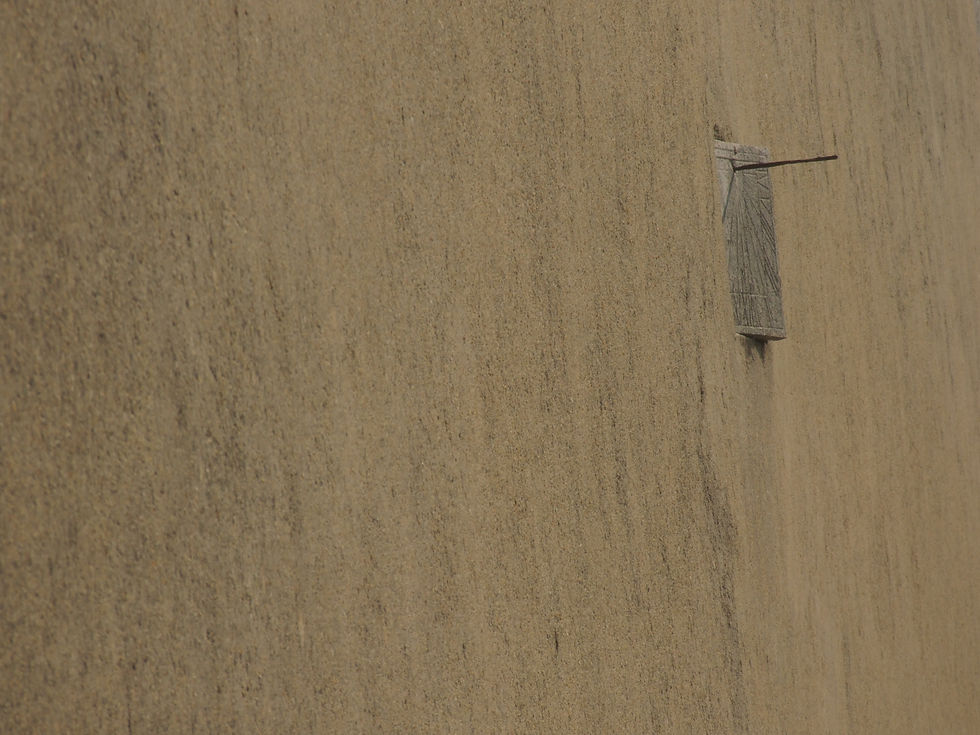
Another interesting detail is the presence of a sundial (vertical dial) on the south façade of the church, which would have helped the bell-ringing monk who, as we have seen, had the task of ringing the bells at certain times of the day to announce ceremonies or other notices to the people of Palmela.
A few years after it was installed, this clock survived the earthquake of 1755, and from 1834, when the castle passed into military administration, there came less interest in this heritage; even so, the clock has survived all these years and now seems at last to give us the privilege of contemplating the slow passing of time by watching its pendulum, as well as the sturdy, noisy mechanism that is set in motion every hour and is responsible for ringing its bells.
The Municipality of Palmela offers, by appointment, guided visits to the tower clock in the Church of Santiago inside the castle.


Comments