
Watches with a dual hour scale

Series: GRAND COMPLICATIONS

What do watches with a dual hour scale do?
These watches have two scales, visible through windows in the dial: one running from 12h to 23h and the other from 0h to 11h.
How it works
The mechanism has two sets of numerals:
Disc for 0h – 11h
Disc for 13h – 23h
When the watch reaches 23h59, the mechanism swaps the visible disc so that the 0–11 numbering is shown again.
This implies:
A rotating disc system that changes as the hours advance.
A change that is automatic in some cases and manual in others
It requires additional mechanism inside the case, which adds to the thickness and the complexity.
Probable origins
This type of complication was never common in industrial mass production. The known examples (mostly pocket watches) appear:
In experimental pieces or prototypes by innovative watchmakers of the late 19th and early 20th centuries.
In pocket watches with special complications made for watchmaking exhibitions or competitions, where the function was not purely utilitarian but could also serve to demonstrate technical skill.
Possibly as bespoke commissions for railway engineers, pilots or military officers who wanted an immediate 24-hour reading without visually overloading the dial.
Rarity and collecting
Extremely rare: far less common than fixed dials
Complexity: it requires additional gearing and numbered discs that are meticulously painted or enamelled.
Value: collectors of watches with mechanical complications regard them as true museum pieces, especially if the mechanism still works smoothly and precisely.
Danger: because of their rarity, there is a risk of confusing them with modern modifications or replicas — an expert examination of the movement and discs is essential.
Technical Characteristics
1. General structure
a) Main movement
The watch keeps the standard 12-hour mechanical movement, with hour and minute wheels, escapement, mainspring barrel, etc.
The hour hand still makes two turns a day — the difference is that it does not “point” to fixed numerals on the dial, but to windows with changing figures.
b) Set of numbered discs
Two concentric discs or one reversible disc with two series of numerals
These discs are indirectly coupled to the hour wheel, receiving a reduced motion so that they advance smoothly.
2. Switching mechanism (changing the numerals)
For the numbering to change series at 12h (midday) and 24h (midnight), a system of jumping discs is needed:
Trigger cam
Fixed to the arbor of the hour wheel there is a cam with two lobes, positioned to act at exactly 13h and 24h.
When the lobe reaches the right position, it pushes a small lever.
Switching lever
This lever is connected to a switching wheel that turns the numbered disc through half a turn (180°), revealing the other series of numerals.
The motion is quick (a “jump”), so that the transition is not seen halfway.
Retaining spring
A spring ensures that the numbered disc sits firmly in its new position, aligned with the windows.
3. Precise alignment
The great challenge of this complication is perfect alignment:
The windows in the dial are stationary and are cut out where the numerals would normally be.
The disc has to rotate exactly so that each numeral appears centred in its window.
Small errors caused by wear or assembly produce visible misalignment.
4. Maintenance and fragility
The disc and switching system requires very fine lubrication and periodic cleaning, since any excessive friction can delay the change or make it fail.
As there are more moving parts, the likelihood of faults is higher than with a fixed dial.
The numbered disc is usually painted or enamelled — a poor restoration harms the historical value.
5. Comparison with other complications
It is a mechanism related to the “jumping hours” that already existed in pocket watches of the late 19th century, but adapted here to indicate the hours on two scales:
It does not replace the hands — these are still present.
It gives a simultaneous reading of the current time and the time in 24h format, but by physically changing the numerals displayed.
Conclusion
Pocket watches with interchangeable numbering shown through windows are a little-known but fascinating chapter of mechanical watchmaking. Designed to offer a clear reading in 24-hour format, they retain a discreet elegance and an internal engineering of rare complexity. The ingenuity of the rotating disc system bears witness to the creativity and precision of the master watchmakers of the early 20th century.
Today, original examples in perfect condition — like the one described here — are genuine museum pieces, coveted by collectors who recognise not only their technical value but also the history they carry. In a world dominated by digital timekeeping, these pieces remind us that mechanical innovation and functional beauty once walked side by side. To preserve them is to preserve not just an object, but also the living memory of an age of ingenuity and refinement.
Technical table of watches with this complication
Characteristic | Description |
Type of watch | Mechanical pocket watch with a dial showing interchangeable hours through windows (cadran automatique). |
Period of manufacture | Approximately 1900–1930. |
Probable origin | France and Switzerland |
Distinctive function | Automatic alternation of the hour numbering from 0–11 to 13–24, visible through circular windows in the dial. |
Mechanism | Hand-wound mechanical movement, 12 hours, with a rotating disc system synchronised with the hour hand. |
Switching system | Trigger cam with two lobes (12h and 24h) actuating a lever that turns the numbered disc through 180°, displaying the other series of numerals. |
Case material | Chromed brass, silver, gold, depending on the example). |
Case diameter | (Measured in mm, for example: +/- 50 mm). |
Condition | Ideally, excellent — precise running and an original dial that has not been repainted. |
Historical application | Normally railway and professional use, where the 24h format made reading easier and avoided confusion between AM and PM. |
Estimated market value | €1500 – €3500 (depending on material, condition, provenance and demand among collectors). |
Other examples
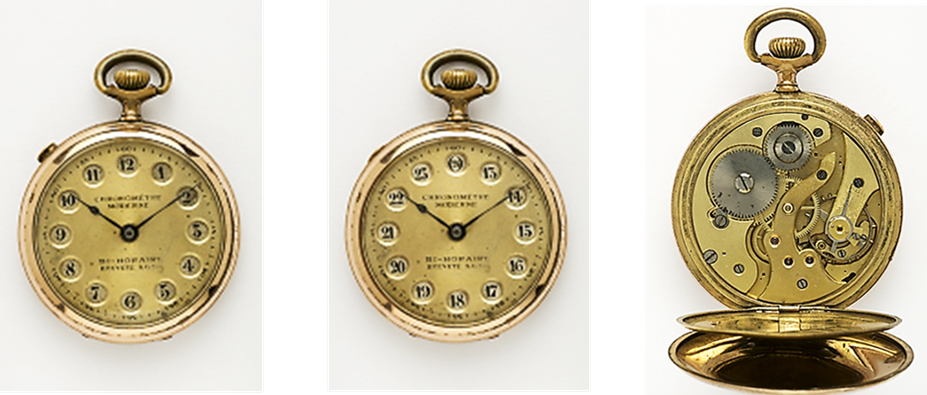
Examples of watches with two hour scales
Why Are Images of These Watches So Scarce?
Some reasons for the rarity of visual examples of this type:
Extremely limited production, especially of original models from the early 20th century.
Little public circulation: many examples are in private collections or museums and are rarely photographed.
Confusion of categories: online they are often mistaken for “jump hour” watches (where the hour numeral jumps in a window), which makes precise searches difficult.
Lack of specific cataloguing: there are no large databases that clearly distinguish this type of automatic disc mechanism.
Technical sheet
- Lépine-type pocket watch, dial with interchangeable hours in windows
- Functions: Hours, minutes, interchangeable hours
- Serial number: None
- Manufacture: Anonymous
- Complication: Dual hour scale
- Country: France
- Calibre: Classic bridge layout
- Movement protection: Silver dust cover
- Type of escapement: Swiss lever.
- Balance: bimetallic, temperature-compensated, with flat hairspring
- Power reserve: 36 hours
- Frequency: 18 000 Ah
- Jewels: 15
- Case material: Silver
- Dial: Silver, with windows for interchangeable hours, in very good condition
- Small seconds: None.
- Case diameter: 51.7mm
- Thickness: 15.3mm
- Weight: 96.54g
- Power source: Mainspring wound by the crown at 12 o'clock
- Hands: Breguet style
- Numerals: Arabic for the hours, in interchangeable windows numbered 0-11 and 12-23h. Arabic for the minutes at five-minute intervals and indexes for the rest
- Crystal: In excellent condition.
- Case number: 43
- Overall assessment: Watch with interchangeable hours in dial windows, in excellent condition.
- Current market value: €1,300.00 to €1,500.00


Comments