

16 October
The day in brief
From today until Sunday, New York has three watch fairs within a few blocks of each other: the Windup Watch Fair, WatchTime New York and The HYPE NYC.
Among the launches, Urwerk presents the UR-300 Time Quantum, with wandering hours that jump 72 degrees at the end of each hour; Arnold & Son adds stop-seconds to the deadbeat seconds of the DSTB; Hublot reissues its 1980 watch in gold; Hermès gives the glass-fibre H08 two new colours; and IWC dedicates a pilot's chronograph to the Year of the Goat.
New York hosts three watch fairs on the same weekend

From today, 16 October, until Sunday, New York has three watch fairs in Midtown Manhattan, a few blocks from each other.
The Windup Watch Fair, organised by Worn & Wound, fills Center415 on Fifth Avenue, with free entry. It is the fair of microbrands and affordable watches, but it also welcomes larger houses: Bremont, Christopher Ward, Oris and Bulova are among the exhibitors, and several brands are using the weekend to show prototypes to the public.
WatchTime New York reaches its 11th edition at Gotham Hall, on Broadway, with 48 brands and paid entry. This is where haute horlogerie gathers: Kudoke debuts the Kudoke 3 Raspberry, Voutilainen shows the 28MPR, Piaget the Polo Minute Repeater, limited to five pieces, and Ressence the Type 11. Urwerk brings the UR-150 Golden Scorpion, MB&F the SP One Pavée and Parmigiani Fleurier the Tonda PF Chronographe Mystérieux.
The third gathering, The HYPE NYC, takes place at the Draper Hotel, on West 37th Street, also with free entry, and is devoted to smaller independents such as Sartory Billard, Ollech & Wajs, Minase and Carl Suchy & Söhne.
With the three venues so close together, visitors can walk, in a single afternoon, from microbrands to independent haute horlogerie — an unusual concentration for one weekend.
Urwerk rethinks the wandering hours with the UR-300 Time Quantum


Urwerk has presented the UR-300 Time Quantum, a new interpretation of the wandering hours. Instead of the usual carousel of satellites, the dial has a T-shaped frame carrying two hour modules, with four rotating three-sided prisms bearing the numerals.
The current hour travels along a curved 0–60 minute scale spanning 108 degrees. When the hour changes, the frame jumps and rotates 72 degrees, and the prisms turn to show the new numeral.
The 108 degrees come from two opposing movements. An arm made by the LIGA process advances 180 degrees per hour and, through a spring, drives a rack; at the same time, a large fixed cam forces the rack back by 72 degrees per hour. The difference, 108 degrees, matches the arc of the minute scale, and over that travel the spring steadily stores energy. At the end of the hour, the rack drops off the cam profile and releases the stored 72 degrees in one go, making the frame jump. It is the principle of the jumping hour, applied to a display that also advances continuously.

The solution comes with a compromise. Setting the time backwards disengages the cam follower: the crown must be turned back until the re-engagement click is heard, and only then forwards; otherwise the display will not jump at the next hour.
The automatic UR-30.01 calibre runs at 4 Hz and is built on a Vaucher base, which replaces the Zenith Elite used in the brand's earlier models, with Urwerk's display module and its Dual Flow Turbines, the patented system that cushions the automatic winding. The case is 18.25 mm thick and comes in bare titanium and in the AlTiN version, with a PE-CVD-applied coating, each in 25 pieces, at CHF 168,000 before tax.
Find out more on the brand's website.
Arnold & Son adds stop-seconds to the DSTB

Arnold & Son has added stop-seconds to the DSTB: pulling the crown halts the seconds hand, so the watch can be set to the second.
The DSTB has deadbeat seconds, also called true seconds. In a 4 Hz movement, the seconds hand normally advances in eight small steps per second; here it moves just once, in a crisp jump. The mechanism sits on the dial side, beneath three openworked gold bridges, with a blued anchor-shaped lever, as a tribute to John Arnold's chronometers.
The two functions complement each other. A hand that jumps from second to second is only useful for setting the time precisely if it can be stopped at the right point — as was done with marine chronometers, synchronised with a time signal.
The automatic A&S6303 calibre runs at 4 Hz, with 32 jewels and a 55-hour power reserve. Hours and minutes are shown on an opal sub-dial at 4 o'clock. The 42 mm case, 12.95 mm thick, comes in 5N red gold with a Cliff Grey dial and in platinum with a Kingsand dial, each limited to 18 pieces, at CHF 46,000 and CHF 56,800 respectively, including VAT.
Find out more on the brand's website.
Hublot returns to 1980 with the Classic Fusion Tributo

Hublot has reissued the watch with which the brand was born, presented in 1980 by Carlo Crocco under the MDM signature: a gold case, a screwed bezel and a black rubber strap, an unorthodox combination for a luxury watch at the time.
The Classic Fusion Tributo keeps the design and changes the engine. The original's quartz movement gives way to the automatic HUB1711 calibre, produced by Zenith from the Elite 670, running at 4 Hz with a 60-hour power reserve. The case grows by 2 mm, to 38 mm, with a thickness of 9.5 mm, a screw-down crown and 100 metres of water resistance. The 12 titanium bezel screws are now H-shaped, matching the counterweight of the seconds hand.
There are two versions, not limited: yellow gold with a matte black lacquered dial and white gold with a polished onyx dial, both at CHF 25,000. The brand has left out its One Click quick strap-change system, to stay closer to the original, and will donate CHF 100,000 to Carlo Crocco's Fondazione Main dans la Main.
Find out more on the brand's website.
Hermès and IWC: new colours for the H08 and a chronograph for the Year of the Goat

Hermès has presented two versions of the H08 with a 39 mm braided glass-fibre composite case: Blanc Chantilly, with a white lacquered dial, and Bleu de Malte, with a sandblasted rhodium dial and blue details. The bezel is ceramic and the movement is the automatic H1837, produced by Vaucher, running at 4 Hz with a 50-hour power reserve. The price is CHF 7,510.
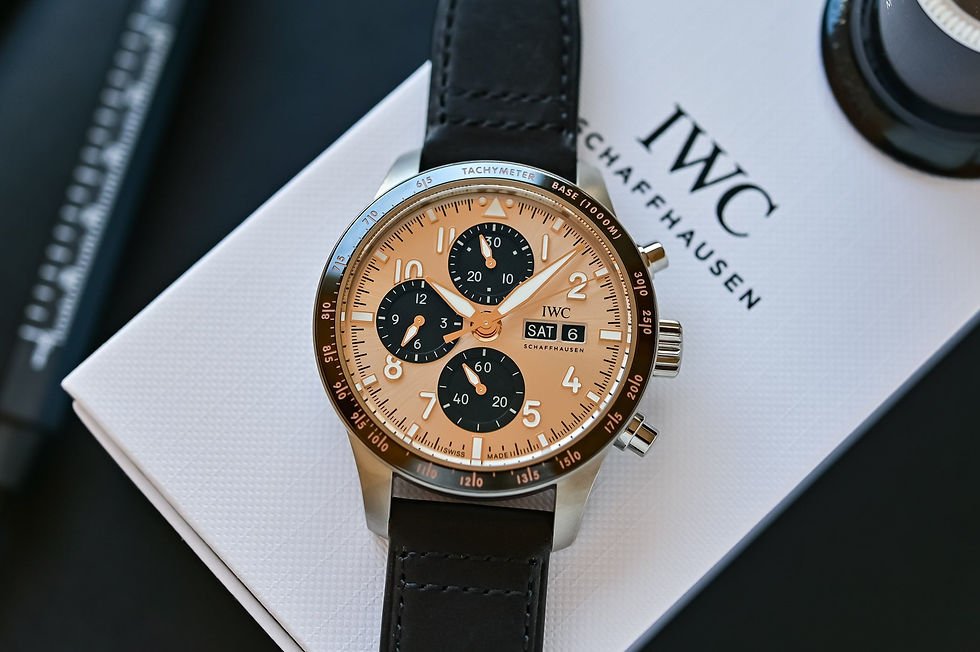
IWC anticipates the 2027 Year of the Goat with a titanium Pilot's Watch Performance Chronograph 41, with a gold-coloured dial and a black ceramic bezel with a tachymeter scale. On the 8th of each month, the date display shows the Chinese character for goat. The column-wheel calibre 69385 has a gilded rotor cut in the shape of three goats. It is limited to 500 pieces, at CHF 10,400.
What deserves attention
The UR-300 confirms a change in Urwerk's mechanical base, moving from the Zenith Elite to Vaucher. Hermès also turns to the Fleurier manufacture for the H08, which shows how much weight Vaucher has gained as a supplier to houses that want an exclusive Swiss movement without developing it from scratch. Meanwhile, the Elite remains at work within the LVMH group, now in Hublot's reinterpreted 1980 watch.
On the technical side, two of the day's watches treat time as energy stored and released in one go: Urwerk to make the hour jump, Arnold & Son to make the second jump. They are different solutions to the same problem — making a reading crisp when the movement produces it continuously.
In New York, attendance at Windup and WatchTime New York is worth following, in a year when Swiss exports to the United States have been falling. American collectors' response to independent brands will say a great deal about the 2027 market.


Comments