
9 October
The day in brief
In Lisbon, the Instituto Português de Relojoaria and the Medeiros e Almeida Museum welcome children this Saturday, 10 October, to assemble a mechanical clock, as part of the Festival Conecta – O Nosso Bairro run by the ACP.
IWC Schaffhausen presented the Portugieser Perpetual Calendar Tourbillon in platinum with a purple dial on 8 October, limited to 50 pieces. On the same day, Glashütte Original revealed the Senator Meissen "Cherry Blossom", with a hand-painted porcelain dial, and Nomos Glashütte gave the Metro an ice blue dial and a new hand-wound calibre, the DUW 4701.
The auction house Marteau & Co opened bidding for The Encore, with 40 watches by independents and a set of five steel F.P. Journe watches sold one by one. France's Pequignet replaced the tachymeter with a beats-per-minute scale on the Royale Paris Chrono BPM.
Young Watchmakers' Workshop brings children to the bench at the Medeiros e Almeida Museum

The Instituto Português de Relojoaria and the Medeiros e Almeida Museum are holding "O Tempo que nos Liga: Oficina de Pequenos Relojoeiros" (The Time that Binds Us: Young Watchmakers' Workshop) on Saturday, 10 October, from 2 pm to 7 pm. The workshop is part of the Festival Conecta – O Nosso Bairro, organised by the ACP – Automóvel Club de Portugal, which runs in Lisbon on 9 and 10 October.
It is aimed at children, accompanied by an adult.
Each child assembles a mechanical table clock with a transparent case, wheels in several colours, a pendulum and a bell. With nothing hidden, the path of the energy is easy to follow: from the power source to the wheels that transmit it, and from there to the escapement and the oscillator, which meter it out. The guide "Monta o teu relógio" (Build your clock), prepared by the IPR, identifies each wheel by its colour and by the name watchmakers give it: centre wheel, third wheel, escape wheel.
Assembly is done in pairs, with loupes, tweezers and tools suited to the children's age, under the guidance of IPR professionals. At the end, each participant receives a certificate and the Almanaque do Tempo, a 24-page booklet of games, curiosities and stories about clocks and watches.
The date coincides with World Watch Day, marked on 10 October, whose theme this year is time as living heritage.
Find out more on the IPR's website.
IWC dresses the Portugieser perpetual calendar tourbillon in platinum and purple

IWC Schaffhausen presented the Portugieser Perpetual Calendar Tourbillon, reference IW504509, on 8 October. The case is platinum, 45 mm in diameter and 15.2 mm high, and the purple dial with a sunray finish is a new colour for the collection. The edition is limited to 50 pieces.
The watch combines two complications in the in-house calibre 51950, with 447 components and 54 jewels. The flying tourbillon at 12 o'clock has 82 parts and weighs 0.635 g; its cage completes one rotation per minute. The balance beats at 19,800 vibrations per hour (2.75 Hz) and the automatic winding, using the Pellaton system, feeds a seven-day (168-hour) power reserve.
The perpetual calendar follows the design Kurt Klaus developed for IWC in the 1980s. Date, day, month, four-digit year and moon phase are linked together and are all set through the crown, with no correctors recessed into the case. That makes the watch simpler to use, but it comes with a known trade-off: the displays only move forward, so setting them past the correct date cannot be undone by turning the crown the other way.
The moon phase display relies on a reduction gear train with two intermediate wheels and, according to the brand, deviates by just one day after 577.5 years.
Find out more on the brand's website.
Glashütte Original paints cherry blossom on Meissen porcelain

Glashütte Original presented the Senator Meissen "Cherry Blossom" (reference 1-36-16-05-05-01) on 8 October, a new chapter in its collaboration with the Meissen porcelain manufactory, a fellow Saxon house. According to Monochrome, it follows the three porcelain-dial models launched in 2025.
The dial is a porcelain disc 0.8 mm thick. Meissen's painters apply the colours with fine brushes, using formulas from the house's own colour laboratory, and each layer is fired in a kiln at 900 °C before the next is added. The motif, white and pink cherry blossom, covers the whole dial, which does without indices; hours and minutes are read from two solid gold hands.
The case is red gold, 40 mm in diameter and 10.2 mm high, water-resistant to 5 bar. Inside is the automatic Calibre 36-16, running at 28,800 vibrations per hour (4 Hz), with a 100-hour power reserve and a silicon balance spring. The regulating organ has no index: according to Monochrome, the rate is adjusted with gold screws on the balance, changing its inertia rather than the active length of the balance spring, and the swan-neck spring is retained.
The watch reaches the brand's own stores and selected retailers in October.
Find out more on the brand's website.
Nomos debuts the DUW 4701 calibre in the ice blue Metro

Nomos Glashütte presented the Metro date power reserve with an ice blue dial (reference 1121) on 8 October and, with it, a new hand-wound movement, the DUW 4701. The same colour comes to the automatic Metro neomatik 41 Update.
The DUW 4701 measures 32.1 mm in diameter and 2.8 mm in height, has 23 jewels and up to 52 hours of power reserve. It brings a quick-set date, which spares the wearer from running the hands through full turns of the dial to correct the calendar, and its power reserve indicator sits directly on the barrel. According to Monochrome, it derives from the DUW 4601 of the Tangente 2date and replaces the DUW 4401, which had powered the Metro since 2014.

The steel case is 37 mm in diameter and 8 mm high, and water-resistant to 5 atm. The galvanised, metallic light blue dial keeps the model's date and power reserve indicator. The sapphire back shows the movement, with Glashütte stripes, blued screws and the house's own regulating organ, the NOMOS swing system. The strap is black Horween Genuine Shell Cordovan.
Find out more on the brand's website.
Marteau & Co opens The Encore with five steel F.P. Journe watches sold separately

The auction house Marteau & Co opened bidding for The Encore on 8 October, billing it as its largest sale to date: 40 watches by independent watchmakers, sold online only. Lots close in batches on 15 October, from 4 pm.
The centrepiece is a complete F.P. Journe Coffret 38, which the auction house says is being offered for the first time. According to SJX Watches, the set was introduced in 2015 to mark the end of the brand's original 38 mm case and brings together five of its core models in steel, a metal F.P. Journe usually reserves for its chiming watches. The example on offer is the penultimate of a series of 38.
The five watches are sold separately. Estimates, in Swiss francs, run from 300,000 to 600,000 for the Tourbillon Souverain, 200,000 to 400,000 for the Chronomètre à Résonance, 100,000 to 200,000 for the Octa Calendrier and 60,000 to 120,000 for each of the other two, the Octa Réserve de Marche and the Chronomètre Souverain. Selling piece by piece widens the pool of possible buyers, but makes it unlikely that the set will ever be reunited.
The catalogue also includes a unique Vingt-8 by Kari Voutilainen and Marco Lang's Zweigesicht-1, both estimated at 200,000 to 400,000 francs, and the Primevère by Yosuke Sekiguchi, also a unique piece, at 70,000 to 140,000. According to SJX Watches, Marteau & Co pays the watchmaker 3% of the hammer price of each watch sold, a resale right the publication describes as a first in watchmaking.
Find out more on the auction house's website.
Pequignet swaps the tachymeter for a beats-per-minute scale
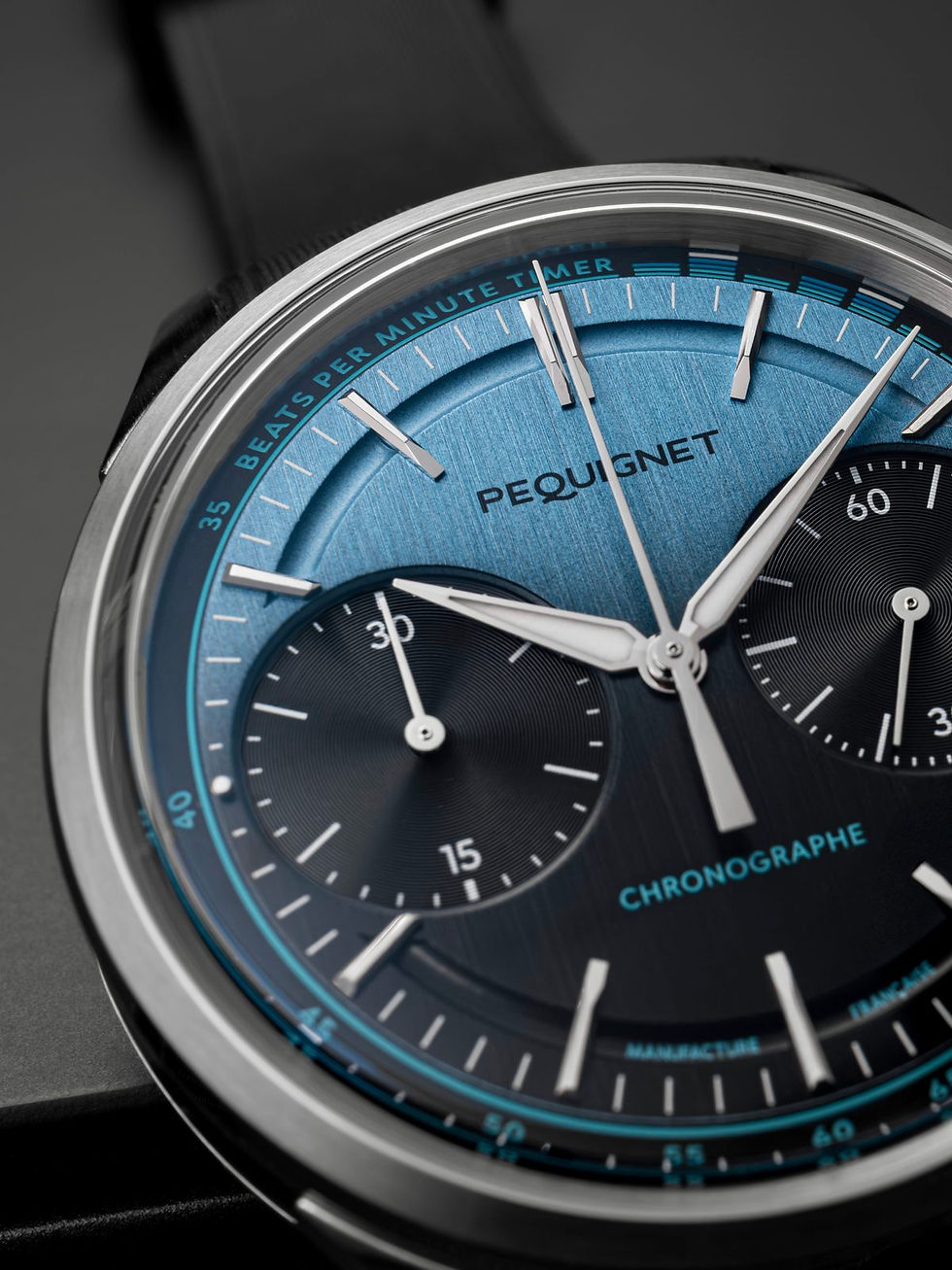
Pequignet, the French manufacture from Morteau, has launched the Royale Paris Chrono BPM (reference 9120343), a chronograph whose outer scale measures the tempo of a piece of music rather than a speed. It is a tribute to French Touch, the French electronic music born in the 1990s.
The principle is that of the pulsometer on doctors' chronographs. Start the chronograph, count 30 kick-drum beats and stop: the central hand shows the number of beats per minute. Thirty beats in 15 seconds, for example, correspond to 120 BPM. The scale runs from 35 to 180 BPM, according to Monochrome, and the brand links its zones to musical genres, from reggae at 60 to techno above 140.
The 316L steel case measures 39.5 mm in diameter and 12.7 mm thick, and is water-resistant to 5 ATM. The automatic Calibre Initial Chronograph uses a cam-operated chronograph, which the brand describes as less sensitive to shocks than a column-wheel one, and is regulated in six positions. The 30-minute counter sits at 9 o'clock and the small seconds at 3.
The watch costs 6,950 euros and joins the permanent collection; Monochrome reports that it will be available from 15 October.
Find out more on the brand's website.
What deserves attention
Three of the day's launches rest on movements of familiar architecture and change mostly what meets the eye: colour at IWC, porcelain at Glashütte Original, the scale at Pequignet. The exception is Nomos, which used a new colour as the occasion to change the calibre. It remains to be seen whether the DUW 4701 will reach the brand's other hand-wound lines.
On the secondary market, the close of The Encore on 15 October will show what steel is worth today at F.P. Journe when the five watches of the Coffret 38 are fought over one by one.
On the trade fair front, the Basilia Jewellery & Watch Fair, which MCH Group and Informa Markets are organising in Basel from 8 to 11 April 2027, announced on 8 October that exhibitor registrations have reached 70% of its target of more than 400. Around 75% of those registered come from jewellery and gems, and Asian exhibitors account for roughly 65% of the space. Watchmaking is, for now, the smaller part of a show born in the city that hosted Baselworld for decades.


Comments