
Active Portuguese brands


Today is a time for the present. After a brief journey through the history of Portuguese watchmaking, it's time to look at the current reality. Who are the watchmakers, brands, projects, and institutions that, today, keep this tradition alive and contribute to the development of watchmaking in Portugal?
Among the currently active Portuguese brands are Reguladora, Prometheus, Borealis, Bruno Moreira, Meia Lua, Eximio, Contar, One, Celsus, Eugénio Campos, Monserrate, Museu do Relógio, Twobrothers, Febres, Les Tugas do IPR – Instituto Português de Relojoaria, and other contemporary structures linked to micro-watchmaking, design, independent watchmaking, or jewelry.
These brands generally share common characteristics: limited production, a strong digital presence, the use of international suppliers, and an identity built primarily through design, communication, creative direction, and, in some cases, a connection to Portuguese watchmaking culture.
Brands owned by Portuguese companies, based abroad.
There is also a particularly interesting group of brands that, although legally foreign, maintain strong Portuguese ties through their founders, cultural identity or conceptual inspiration.

The most obvious example is Isotope , founded by the Portuguese José Mendes Miranda and based in the United Kingdom. Despite being a British brand from a legal and operational standpoint, Isotope frequently incorporates Portuguese references in its designs and communication, becoming an emblematic case of the globalization of contemporary watchmaking.
In a similar context, Escudo also emerged , created by Simon Correia and Richard Johnson. Although it has an international structure, the brand draws strong inspiration from Portuguese maritime history and the aesthetics of nautical instruments associated with the Age of Discoveries.

Monserrate , a brand associated with the Portuguese businessman João Ramalhete and developed outside of Portugal, but deeply marked by Portuguese cultural references, can also be included in this group. The name itself immediately evokes the Palace of Monserrate in Sintra, reinforcing the identity link to Portuguese historical and artistic heritage.
These examples demonstrate how contemporary watchmaking has increasingly blurred the lines between national identity, place of manufacture, and legal headquarters. A watch can be conceived by a Portuguese founder, designed in London, use a Swiss movement, be manufactured in Asia, and still retain a Portuguese cultural identity.
In a way, these projects represent a modern continuation of the history of Portuguese watchmaking itself: a profoundly international reality, built through constant intersections between commerce, technology, design, and cultural identity.
Bruno Moreira and manual finishing in Portugal

Among the most relevant contemporary projects in Portuguese watchmaking is the work of Bruno Moreira, whose approach occupies a very particular place within the national landscape.
In a context where most Portuguese micro-brands rely on industrial components that are practically finished abroad, Bruno Moreira stands out for carrying out manual finishing and mechanical decoration done in Portugal, by himself, which brings him closer to the classic tradition of independent European watchmaking than to the usual logic of contemporary micro-brands.
His work is developed on a small scale, with the production of few units, in order to achieve a level of individual attention that is practically impossible in industrial production. Among the most relevant aspects is precisely the manual decoration of the movements themselves — a practice historically associated with high-end Swiss watchmaking and practically non-existent in Portugal as a structured contemporary authorial activity.
In this case, the watch ceases to be merely an object assembled from external components and begins to incorporate specialized handwork directly applied to the mechanical elements. Finishes, decoration, surface treatment, and attention to detail become an integral part of the watch's identity.
This type of intervention represents the emergence of skills traditionally absent from contemporary Portuguese watchmaking. For decades, Portugal participated mainly in the assembly, marketing, or technical assistance of foreign watches, but rarely in the field of handcrafted mechanical decoration associated with fine watchmaking.
Bruno Moreira's work therefore demonstrates an important shift: independent projects capable of locally executing operations traditionally reserved for specialized workshops in European high-end watchmaking are finally beginning to emerge in Portugal.
In this sense, Bruno Moreira perhaps represents one of the clearest signs of the emergence of a truly independent contemporary Portuguese watchmaking industry.
Bernardo d'Orey and watchmaking as an artistic object.

Among the most unique projects in contemporary Portuguese watchmaking is the work of Bernardo d'Orey, whose approach focuses primarily on creating small-scale, conceptual watch dials.
His work often leans more towards industrial design and aesthetic experimentation than traditional watchmaking in the classical sense. He seeks to create pieces with their own identity rather than simply reproducing existing codes.
In a context where Portuguese watchmaking has always been closely linked to repair, assembly, or commercialization, this type of approach represents something relatively new: the use of the watch as a space for authorial creation and visual experimentation.
Like other independent Portuguese projects, the work is developed on a small scale, which allows for greater creative freedom and a closer relationship between the creator and the final product.
Bernardo d'Orey represents one of the most experimental facets of contemporary Portuguese watchmaking.
Les Tugas — a new approach to national construction


Les Tugas: www.lestugas.pt
The Les Tugas project, developed by IPR, represents a particularly interesting case within contemporary Portuguese watchmaking. Unlike most current micro-brands, whose production depends almost entirely on foreign suppliers, Les Tugas sought to incorporate a significant component of national construction and transformation.
Although it utilizes an international mechanical base, the project distinguishes itself through a deliberate effort to integrate Portuguese production into several fundamental stages of the watchmaking process.
The steel case was produced in Lisbon; the dial was also manufactured in Lisbon; the glass was cut in Salvaterra de Magos; the strap was produced in Gião; the polishing was done in the Porto area; and the transport case was also designed and manufactured in Lisbon.
This approach seeks to revive an idea that has practically disappeared from Portuguese watchmaking: the possibility of locally manufacturing specialized components through collaboration between small workshops, artisans, technicians, and national industrial structures.
In this sense, Les Tugas clearly differentiates itself from most contemporary Portuguese micro-brands. It aims not only to create a Portuguese brand, but also to partially reconstruct a national production chain, albeit on a smaller scale.
Perhaps this is precisely one of the most interesting aspects of the project: not the attempt to compete directly with large international manufacturers, but the demonstration that it is increasingly possible to mobilize Portuguese technical knowledge to produce specialized watchmaking components within the country itself.
In a way, Les Tugas is closer to the spirit of the old Portuguese workshops and manufactories of the 20th century than to the usual logic of contemporary micro-brands.
Tempo Futuro — the emergence of a new Portuguese watchmaking industry
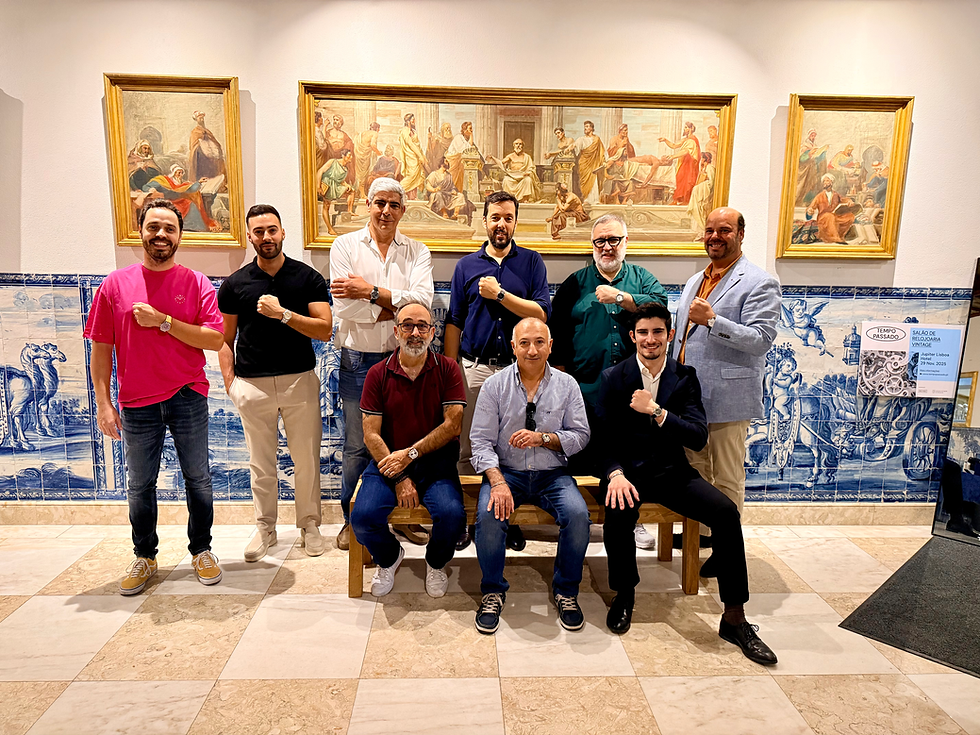
For much of the 20th century, the Portuguese watchmaking industry survived primarily through the repair, assembly, distribution, and adaptation of foreign watches to the national market. Even during periods of peak industrial activity, Portugal never developed a manufacturing sector comparable to the large Swiss, French, or German structures.
However, perhaps it is precisely this absence of a heavy industrial tradition that makes what is beginning to emerge today particularly interesting.
In recent years, we have witnessed the emergence of a new generation of Portuguese projects linked to watchmaking: independent micro-brands, specialized workshops, auteur watchmakers, educational initiatives, and small technical production centers that seek to build something different from the simple resale or customization of foreign watches. It is in this context that the concept of [missing word - likely "custom watch"] arises. Future Time.
Tempo Futuro represents a paradigm shift in contemporary Portuguese watchmaking. For the first time in many decades, initiatives are emerging in Portugal that seek not only to market watches, but also to develop local technical skills, hand-finishing techniques, partial component construction, specialized restoration, and the structured transmission of watchmaking knowledge.
Projects such as Bruno Moreira, Les Tugas do IPR, Monserrate, Meia Lua, Eximio, Prometheus, Borealis, or Contar demonstrate very different approaches, but share a common element: the attempt to build their own identity in a country historically peripheral to the large watchmaking industry.
In some cases, this identity emerges through design; in others, through the recovery of Portuguese cultural references; and in still others, through technical experimentation, handcrafted decoration, or attempts to reconstruct small national production chains.
Perhaps the most interesting aspect of this Future Time is precisely the fact that it does not seek to directly copy Swiss watchmaking. The scale is different, the resources are different, and the historical reality of Portugal itself is different. Instead of competing through mass industrialization, many of these projects are closer to the logic of craftsmanship, small-scale production, and technical specialization.
In a world increasingly dominated by globalized production, this small scale can become precisely the greatest strength of contemporary Portuguese watchmaking: proximity, individuality, flexibility, and cultural identity.
Portugal may never become a watchmaking industrial powerhouse. But perhaps that's no longer the most important issue.
The true sign of maturity emerges when a country stops asking whether it can compete with others and finally begins to build its own language.
More than preserving
In this context, IPR has actively contributed to the creation of new professionals, the emergence of new brands, and the development of a Portuguese community of watch lovers, collectors, and consumers who are increasingly informed and active.
Initiatives such as the Tempo Futuro fair demonstrate precisely this desire to create a meeting space for watchmakers, independent brands, students, collectors and a specialized public, promoting a new dynamic around contemporary Portuguese watchmaking.
The Les Tugas project perhaps represents the clearest example of this vision. It seeks to function as a true proof of concept: demonstrating that Portugal already has the technical, industrial, and artisanal capacity to produce specialized watchmaking components within the country.
At the same time, several new brands developed by IPR alumni are already emerging, currently in the planning phase.
The objective of the Portuguese Watchmaking Institute is precisely to encourage the emergence of new national projects and to actively support all those who wish to develop watchmaking in Portugal, such as independent workshops, emerging brands and factories established in the country.
Perhaps that is precisely where the true future of Portuguese watchmaking begins.


Comments