
The clock Saint Francis Xavier gave to Ōuchi Yoshitaka in 1551

Updated: 6 days ago

In April 1551, the Jesuit Francis Xavier was received by Ōuchi Yoshitaka, lord of Suō province, today's Yamaguchi prefecture. Among his gifts was a mechanical clock: the first European mechanical clock known to have reached Japan.
The context
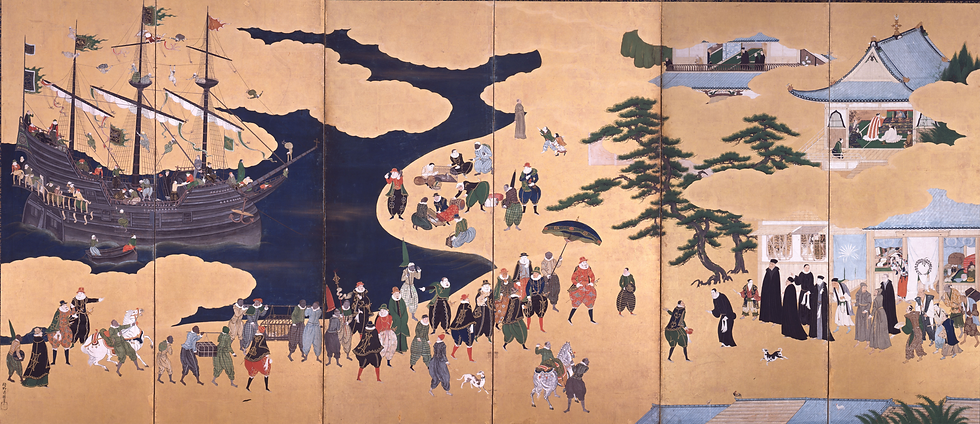
The first Portuguese reached Tanegashima in 1543. In 1549, Francis Xavier arrived in Japan, the first Christian missionary to enter the country.
The clock
The Portuguese Jesuit Luís Fróis describes the gift, in his own words, as «hum relogio de horas de grande artificio»: a striking clock of great artifice.
A letter by Cosme de Torres, from 1551, mentions a harpsichord and a clock. A Japanese biography of Ōuchi also refers to a device that marked twelve periods and rang a bell. According to the historian Ryuji Hiraoka, this is the first mention of such an object in Japanese sources.
Yasuyuki Shirai states that the clock came from Goa. Where it was made is uncertain: A. C. Koch tentatively suggests Germany. The clock has not survived: the oldest European clock preserved in Japan is the one Tokugawa Ieyasu received in 1611.
A gesture that set a pattern
The gift set a pattern. In 1569, Luís Fróis showed a small striking clock to Oda Nobunaga, and a clock also won him an audience with the shogun Ashikaga Yoshiaki. In 1591, Alessandro Valignano gave another to Toyotomi Hideyoshi.
Hiraoka argues that Valignano carried this “clock diplomacy” to China, where Michele Ruggieri gave a clock to the governor-general Chen Rui in 1582. In 1601, Matteo Ricci entered Beijing with two.
What remained
By around 1601-02, Japanese craftsmen trained by the Jesuits were already making clocks in Nagasaki. The ban on Christianity in 1614 did not end the craft: from it came the wadokei, the clock adapted to Japanese hours, whose length varied with the season.

The full story, in Portuguese: Os relógios que chegaram à Ásia pelas rotas portuguesas
Correction: this article was revised in November 2026. The previous version named Ōtomo Sōrin as the recipient of the gift. The sources identify Ōuchi Yoshitaka.


The clock given by Saint Francis Xavier to the Japanese daimyo Ōtomo Sōrin in 1551 is a fascinating historical artifact – it symbolizes the early cultural and technological exchange between Europe and Japan. I recently visited https://luckycapone.com.pt/ and was impressed by their clear, user-friendly approach – a good standard for sharing historical stories.