
The Stackfreed

By: Sílvio Pereira
FORGOTTEN MECHANISMS IN THE HISTORY OF WATCHMAKING
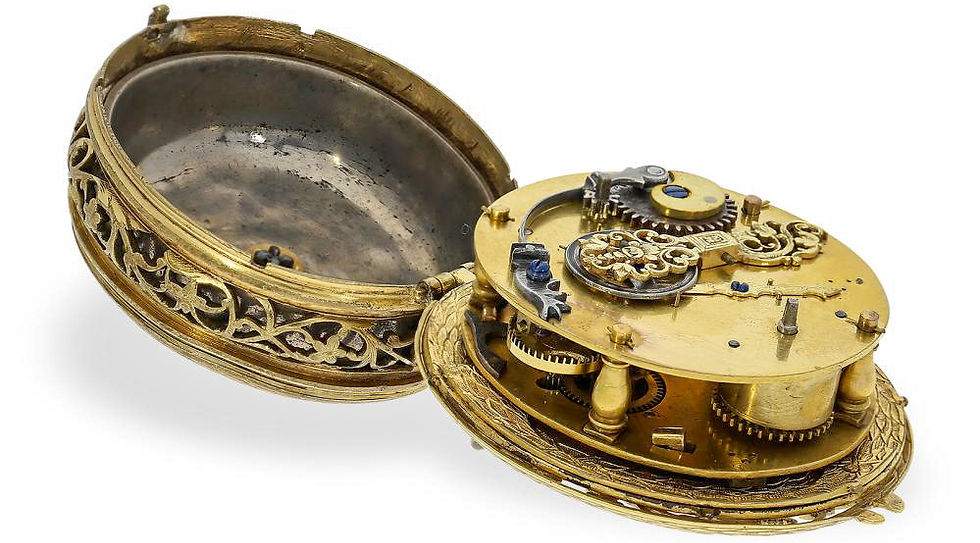
Among the countless artefacts that make up the evolution of portable timekeeping, few are as intriguing as the stackfreed. Today almost unknown outside academic circles and specialist collectors, this device played a central role in the earliest attempts to stabilise the motive force of Renaissance pocket watches. The stackfreed was, in its day, an ingenious answer to a real problem: the irregular torque produced by the mainspring. Although it was superseded by more effective solutions, such as the fusee, the stackfreed survives as a testament to an experimental and inventive phase in the mechanics of time.
This article sets out to revisit, in detail, the history, the working and the significance of this singular mechanism. It is my conviction that understanding the stackfreed is not merely an archaeological exercise; it is an opportunity to observe the creativity of the first watchmakers and to recognise that, throughout history, the pursuit of regularity has almost always proceeded by approximation, by trial and error, and above all by ingenuity.
Historical Background

Portable timekeeping emerged between the fifteenth and sixteenth centuries, driven by advances in metallurgy and in the miniaturisation of weight-driven mechanisms. Replacing weights with mainsprings made it possible, for the first time, to conceive portable objects — the famous “Nuremberg eggs”, associated (though not always with historical accuracy) with Peter Henlein and the German school.
However, incorporating a mainspring brought a new challenge: the torque it delivers is not constant. Immediately after being fully wound, the spring releases a great deal of force; as it unwinds, that force falls off sharply. This variation produced irregular amplitudes in the escapement and the regulator, compromising accuracy. Watchmakers were thus faced with the need for constant-force devices, or for mechanisms that would at least smooth out the torque curve.
The stackfreed appeared precisely in this context, mainly among German and Bohemian watchmakers, between the mid-sixteenth and the early seventeenth century. Before being eclipsed by the fusee — a mechanism that, besides being more efficient, spread rapidly through the British Isles and France — the stackfreed enjoyed a period of moderate popularity, being found in pieces of high quality and aesthetic complexity.
In a way, the stackfreed represents a “transitional” phase in the history of European watchmaking: a moment when the need was urgent, but the solutions were still tentative, pragmatic and heavily constrained by the manufacturing techniques available.
Anatomy and Working of the Stackfreed

The stackfreed typically consists of three fundamental elements:
A spring lever or arm of tempered steel (A);
A roller or secondary cam, located at the end of this lever (B);
An eccentric cam mounted on the mainspring barrel (D).
Its operation is relatively simple to describe, but sophisticated in its mechanical execution:
As the barrel turns (while the spring unwinds), the roller travels over the irregular surface of the cam. The cam is asymmetrical in shape, usually resembling a flattened spiral or snail. On the wider parts of the cam, the lever is forced to compress its internal spring further — producing greater resistance. On the narrower parts, the resistance decreases.
In this way a variable braking force is created, inversely proportional to the natural force available in the spring. When the spring is under high tension, the stackfreed offers greater resistance; when it is nearly run down, it offers less. The intended result was to “flatten” the force curve: a compromise between the abruptness of the spring and the desired regularity.
Practical Effects
In practice, the stackfreed:
Partially improves the regularity of the force transmitted to the wheel train;
Inevitably introduces additional friction, requiring stronger springs;
Increases wear and calls for careful lubrication.
Although functional, it is a solution that sacrifices energy efficiency in exchange for regularity. By Renaissance standards it was acceptable; compared with later solutions, it proves rudimentary.
Technical Context and Mechanical Philosophy
Sixteenth-century watchmakers did not yet have suitable materials for making mainsprings with more predictable torque curves. Nor were there yet reliable methods for calculating, simulating or standardising components. For this reason, many mechanisms of the period should be understood as pragmatic attempts: small local responses to real problems.
The stackfreed is, in this sense, the product of a very particular philosophy: regulation by opposition. The mechanism does not try to optimise the spring, does not try to redistribute the force, does not try to equalise it mechanically — it merely brakes the excess and lets the rest flow. If excess force was the problem, the solution was to introduce resistance.

The fusee, which would emerge as the alternative, represents a different philosophy: a transformation of the force, through variation of the mechanical advantage. The stackfreed simply opposes it.
In my opinion, this contrast reveals a profound intellectual shift in European watchmaking. The stackfreed is pre-scientific, tactile, intuitive. The fusee comes close to proto-mathematical reasoning. History chose the second — but the first should not be seen as a mistake, only as a necessary stage.

Applications and Geographical Spread
The stackfreed is found above all in:
German and Bohemian watches;
Some Swiss and Austrian pieces;
A small number of English pieces from the earliest days of portable timekeeping.
It is often found in richly decorated movements, with enamelled or engraved dials and cases of brass, silver or iron. Museum pieces show that the stackfreed coexisted for some time with calendar mechanisms, moon phases and even rudimentary striking complications.
Its spread, however, was never widespread. There are three main reasons:
Competition from the fusee, more elegant from a mechanical point of view;
High energy cost, which reduced the running time;
Sensitivity to wear, which made maintenance difficult.
By around the 1630s, the stackfreed was already in decline. By 1650 it is rare; by the end of the seventeenth century, it had practically disappeared.
Advantages and Limitations
Despite its limitations, the stackfreed should not be understood as a poorly conceived mechanism. It fulfilled the role that fell to it at the historical moment in which it appeared.
Advantages
Technical simplicity compared with the fusee, requiring fewer parts and less demanding manufacture.
A relatively slim profile, allowing thinner watches than those that used a fusee.
Possible integration with the stopwork, acting at the same time as a winding limiter.
Structural robustness, despite the natural wear at the point of contact.
Limitations
High friction, the main cause of its obsolescence.
Dependence on constant lubrication, at a time when good-quality oils were scarce.
Stronger mainsprings, needed to compensate for the losses, which could shorten their service life.
Limited effectiveness, especially in watches that aimed at greater accuracy.
Regardless of these limitations, I consider that the stackfreed represents an elegant solution to an urgent problem. It was not the best answer — but it was an ingenious answer within the technical capabilities of the time.

The Stackfreed in Restoration and Collecting
Today, watches fitted with a stackfreed are pieces of great historical value, frequently found in museums and private collections. Their restoration demands extreme caution.
Points to watch in restoration

Condition of the arm spring: any softening compromises the resistance curve.
Wear of the cam: small irregularities in the surface alter the progression of the resistance.
Rounding of the roller: uneven wear degrades the smoothness of the motion.
Minimal lubrication, just enough to prevent abrasion without compromising the braking force.
Experienced restorers know that excessive intervention can destroy the mechanical authenticity of the mechanism. In many cases, the best decision is to stabilise and conserve, rather than try to restore full functionality.
Value to Collectors
Pieces with a stackfreed are particularly prized because they:
Represent a short, experimental phase of watchmaking;
Feature richly ornamented movements;
Reveal Renaissance manufacturing techniques;
Are relatively rare on the market.
In my opinion, the stackfreed is undervalued among general collectors, who tend to favour fusees and later English pieces. But for the serious scholar, it is a key element in understanding the origins of portable timekeeping.

The Stackfreed in the Intellectual History of Watchmaking
The value of the stackfreed goes beyond its mechanical function. It represents a stage in the way Europeans began to think about time. Before the sixteenth century, the measurement of time was essentially public and communal: bell towers, tower clocks, water clocks, hourglasses.
With portable timekeeping, time becomes personal, mobile, tactile. The stackfreed is one of the first mechanisms created to tame this mechanical intimacy, seeking to ensure that the time measured in the hand was as trustworthy as the time measured in the town square.
I believe that, in observing this small mechanism, we recognise something greater than its technical aspect: we see the persistent, obstinate human effort to turn a natural phenomenon — the elasticity of metal — into a unit of regular and predictable experience: the minute.
Final Thoughts
The stackfreed is not the protagonist of the history of watchmaking. But it is, without doubt, one of its most striking characters. It represents an early attempt to achieve regularity at a time when materials, techniques and theoretical knowledge were still insufficient.
That is why it deserves particular attention — not only as a historical curiosity, but as an example of applied creativity. The stackfreed shows that watchmaking has never been only the pursuit of perfection, but also the art of finding workable solutions with the resources at hand.
It is my opinion that every watchmaker, restorer, collector or historian of time should study this mechanism with respect and curiosity. It reveals something essential: progress in watchmaking happens in layers, and each layer, even the least perfect, contributes to the elegance of those that follow.
Recommended Reading
Wikipedia overview article on the stackfreed — a good technical and historical starting point. Wikipedia
Pages and images from the British Museum and the Science Museum: collections with movements that show the stackfreed in detail; useful for comparing variants.
Specialist texts on constant-force mechanisms and the history of watchmaking, and technical popular articles (for example, publications such as Hodinkee on constant-force devices) for contemporary critical reading. Hodinkee


Comments