
Patent US10018967B2 | Breguet | Magnetic Pivot


Breguet, the iconic Swiss haute horlogerie brand, has implemented an innovative method for orienting components that contain ferromagnetic material. Developed by the inventors Sylvain Maréchal, Davide Sarchi, Olivier Karlen and Arnaud Todeschini, this system applies two magnetic fields at both ends of the component, deliberately creating an imbalance in the strength of these fields in order to produce a field of forces.
As a result, one end rests against a contact surface of a pole piece, while the other remains suspended, with no direct contact.
The concept took shape as a magnetic pivot, which incorporates a guiding device with pole pieces capable of generating magnetic fields of different strengths, ensuring precise positioning and reducing the friction of the moving components.
Although this news is not recent, it is possibly one of the most important innovations in watchmaking of recent times, with a significant impact on the efficiency and durability of mechanical movements.

THE MAGNETIC PIVOT
With patent US10018967B2 of 9 November 2010, which protects the magnetic pivot, Breguet set a new milestone in the history of watchmaking by using magnetism to improve the precision and reliability of its watches. The impact of this important invention will probably only be fully assessed in a few years' time, even though it is not recent either. The magnetic pivot consists of a carbon-steel balance staff and a rare-earth magnet behind each jewel. One of the magnets is stronger than the other, so that the balance staff remains in permanent contact with the dial-side jewel, which makes it appear to be suspended. As the magnetic bond between the staff and the jewel is stronger than the force of gravity, the staff continues to pivot on the endstone whatever the position of the watch. Breguet's advances in magnetism have also resulted in an unprecedented mechanism for improving the pivoting, the rotation and the stability of the balance staff.
Moreover, the system acts as a shock absorber. If an impact knocks the pivot out of position, the magnetic force pulling it back increases as the lateral displacement of the pivot grows.
The staff thus returns automatically to its position and restores the maximum magnetic flux.

A more stable balance staff
The magnetic field passing through the balance staff keeps the balance stable: it is immune to low-intensity shocks (the most frequent kind) as well as to the accelerations to which the watch is subjected. After stronger accidental shocks it always returns almost instantly to its correct position. The performance of the balance is thereby improved, since it does not have to contend with the friction of a conventionally pivoted balance, particularly in a vertical position. Magnetic induction brings several advantages for the precision of the movement. The balance staff is placed in the magnetic field and held against the endstone by the magnetic flux, which also tends to bring the staff back to its ideal position.
With this invention, Breguet not only overcame the negative effects of magnetism on a mechanical watch, but also managed to harness them to improve rotation and the stability of the balance wheel staff.
AUTHORS
Sylvain Maréchal is a French watchmaker and inventor with a significant career in the watch industry. He worked at Montres Breguet S.A. from 2001 to 2016 and contributed to a number of innovations in the field of watchmaking. Maréchal is co-inventor of several patents, such as mechanical winding devices for watches and magnetic and/or electrostatic pivots for horological components. His education includes studies at the Lycée Polyvalent Edgar Faure and the LEGTP René Cassin.
Davide Sarchi is an inventor with several patents registered in the field of watchmaking. His inventions cover power-assisted clamping devices for handpieces and escapement mechanisms for watches. Sarchi has been associated with Montres Breguet S.A., where he has played an active role in developing advanced watchmaking technologies.
Olivier Karlen is an inventor with notable contributions to watchmaking. His patents include escapement devices for watches and coupling mechanisms for horological parts. Karlen has collaborated with Montres Breguet S.A., taking part in the development of innovative solutions to improve the precision and efficiency of mechanical watches.
Arnaud Todeschini: although specific information about Arnaud Todeschini is limited, he is known to be associated with watchmaking patents, such as the development of the magnetic and/or electrostatic pivot. His collaboration with other inventors, such as Sylvain Maréchal, Davide Sarchi and Olivier Karlen, suggests a significant contribution to innovation in the watch industry.
These inventors are rarely mentioned, yet they have played crucial roles in advancing watchmaking technology, particularly as regards the precision and efficiency of mechanical movements.
Field of the Invention
The invention relates to a method for orienting a horological component capable of guiding its pivoting, the component being made of a material that is at least partially magnetically permeable or magnetic, and/or of a material that is at least partially conductive or electrified. This component is mounted in a chamber between a first and a second end.
Background of the Invention
Micromechanics, and watchmaking technology in particular, use conventional solutions to position the staff or arbor of a component, which are always exposed to mechanical friction. In a pivoting component incorporated in a watch movement or an oscillator, a recurring problem lies in the strong dependence of the component's efficiency or quality factor on the position of the watch. The efficiency or quality factor is considerably reduced when the watch is in a vertical position, which is not the case in other positions.
Summary of the Invention
The invention proposes a method for orienting a horological component, more specifically for aligning the component on a pivot axis, so that friction is significantly reduced.
The intention is thereby to make the running quality of a watch movement more independent of its orientation in space.
To this end, the invention implements a guiding device for the pivoting of the component by means of a magnetic pivot, so as to provide an efficiency or quality factor that is independent of position.
According to the invention, on either side of the first and second ends of the component, two magnetic or electrostatic fields are created, each attracting the component towards a pole piece, creating an imbalance between the fields around the component in order to produce a differential of forces, so that one end of the component is pressed against a contact surface of one of the pole pieces, while the other end is held away from the other pole piece. The magnetic or electrostatic fields are asymmetrically distributed and have different strengths at the two ends.

Figure 1: Partial schematic elevation view of a guiding device according to the invention.
Figure 2: Representation of a component incorporated in a magnetic pivot.
Figure 3: Representation of a magnetic pivot with the component in a position of stable cooperation.
Figure 4: System of forces acting on the component.
Figure 5: System of forces when the component is in an unstable position.

Figure 6: Longitudinal section of a magnetic pivot according to a first variant.

Figure 7: Alternative variant of the magnetic pivot.
Figure 8: Partial schematic perspective view of a watch incorporating a magnetic pivot.

Figure 9: Component of a balance fitted in a guiding device.
This invention proposes a new method and device for orienting horological components by means of asymmetrically distributed magnetic or electrostatic fields, ensuring stability, reduced friction and improved efficiency and quality of the watch movement, regardless of the position of the watch.
APPLICATION
The Breguet Classique Chronométrie 7727 is powered by the calibre 591C, a hand-wound mechanical movement. This movement is remarkable for its precision and features several technical innovations, such as the magnetic pivot.

The magnetic pivot is a key feature of this movement. It is used in the escapement and replaces the traditional metal pivot with a magnetic system that minimises friction, as we have seen.
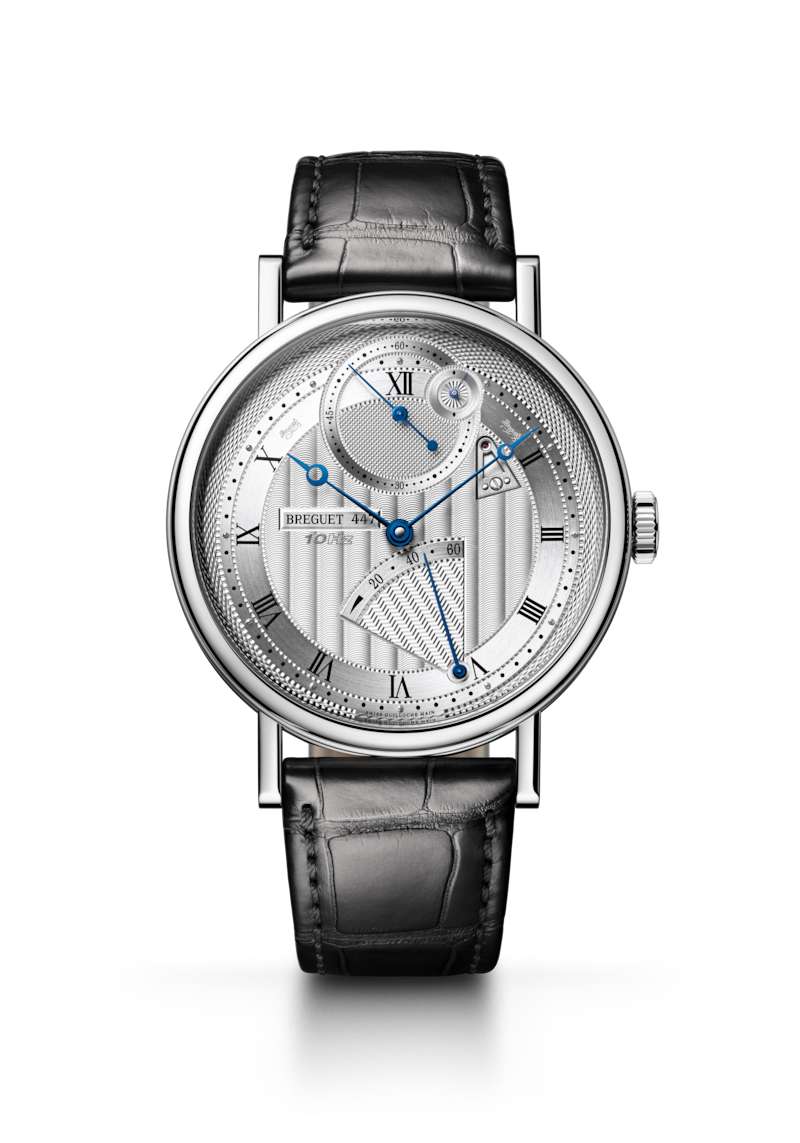
The Breguet Classique Chronométrie 7727 is powered by a hand-wound mechanical movement, the calibre 591C, which offers a 60-hour power reserve. With a diameter of 32.1 mm and a thickness of 3.5 mm, this movement is extremely thin. Fitted with 45 jewels, the calibre operates at a frequency of 10 Hz, equivalent to 72,000 vibrations per hour, ensuring exceptional precision. Its escapement features a double silicon hairspring, with benefits for reliability and wear resistance, as well as better resistance to temperature variations. In all, it is made up of 286 components.


Comments