
Breguet Expérimentale 1 - Magnetic Escapement

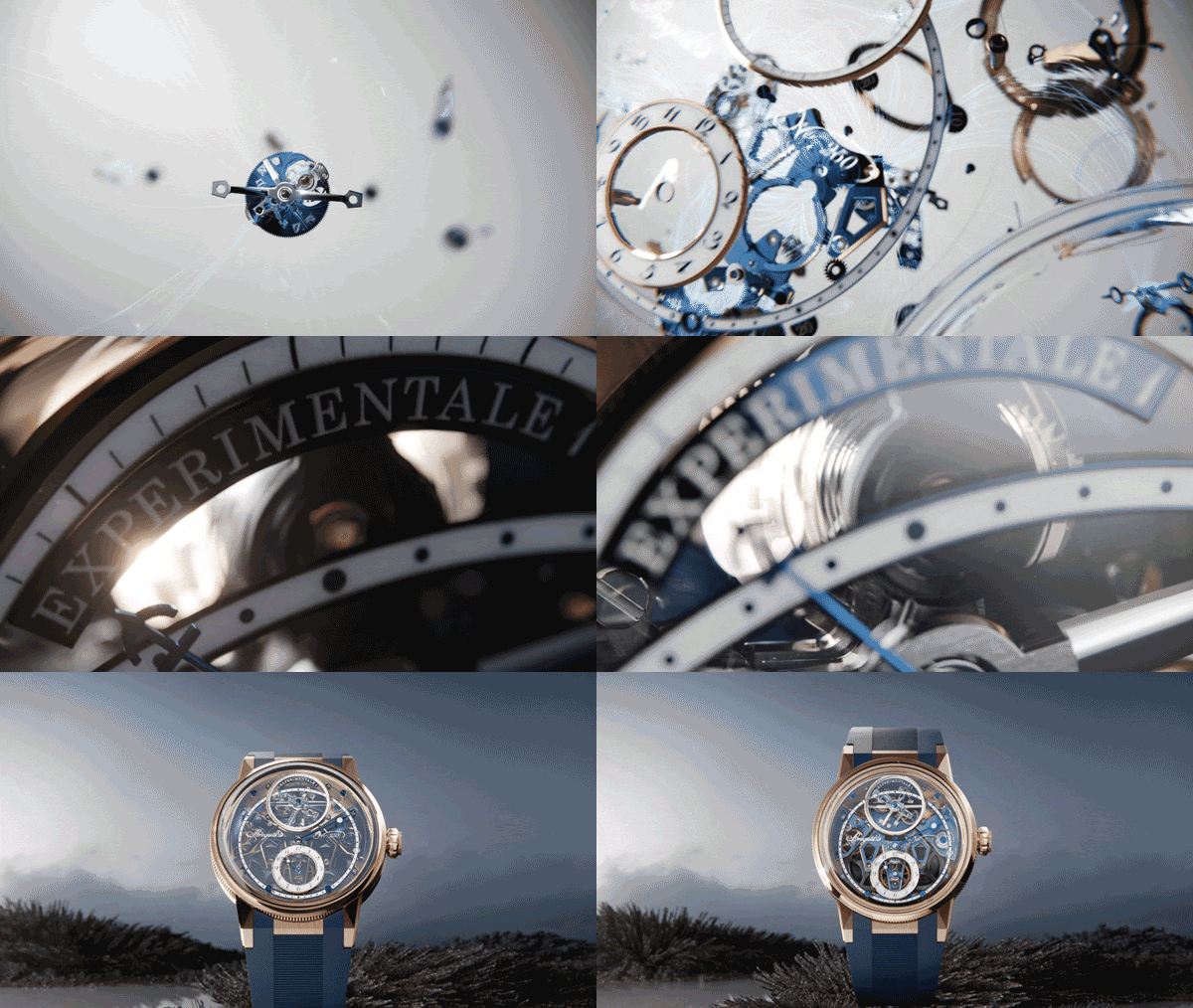
Breguet has launched a new line of watches resulting from several years of silent research. This silence also defines its communication style, a choice difficult to understand considering that it can boast, without a doubt, of presenting some of the most advanced technological developments in watchmaking today.
What Breguet achieved this year would have justified a deafening and widely celebratory communication, never such a discreet presentation as the one adopted. Even so, the brand maintained its trademark reserve and restraint.
The Expérimentale 1 line incorporates what can be considered the most sophisticated escapement system currently available, the result of in-depth research into energy efficiency, rhythm stability, and mechanical longevity. This technical milestone confirms, once again, Breguet's role as the leading innovation laboratory at the heart of haute horlogerie.

In 2025, Manufacture Breguet presented the Expérimentale 1 , the first creation in a new line entirely dedicated to watchmaking research and development. This piece simultaneously marks the closing of the brand's 250th-anniversary celebrations and the beginning of a new phase: an experimental platform designed to introduce cutting-edge technical and aesthetic solutions, developed over several years of silent research.
Constructed from Breguet gold (an 18-karat gold alloy, created by Breguet, containing 75% fine gold, to which silver, copper, and palladium are added in specific proportions), the Expérimentale 1 embodies an unprecedented technical achievement:
The first 10 Hz tourbillon with constant force magnetic escapement , capable of supplying regular energy to the oscillator throughout the entire lifespan of the motion.
The timepiece has Breguet's Scientific certification, which guarantees an accuracy of ±1 second per day — an extremely demanding mark for a mechanical wristwatch, even more so in a model with a tourbillon.
Research & Development Legacy

The Breguet chronometer-demonstrator No. 1252, which combines a tourbillon regulator with a constant-force escapement , was sold in 1814 to the Prince Regent of England.
For 250 years, R&D has been at the heart of Breguet's creations. This spirit was instilled by Abraham-Louis Breguet himself, responsible, since 1775, for most of the watchmaking innovations of his time: the tourbillon, the perpetual watch, the natural escapement , the constant force escapement , the "observation" seconds counter (the origin of the chronograph), the shock absorber, the Breguet spiral with terminal curve, the acoustic spring for sonnerie, the first wristwatch, among others.
To embody this philosophy of continuous progress, the Manufacture decided to develop a collection parallel to the existing collections, called Expérimentale .
This series of special pieces pays homage to the creations of A.-L. Breguet, all of which underwent an experimental phase.
The collection was designed to showcase the brand's latest technical and aesthetic developments, offering a glimpse into the future of Breguet watchmaking. For collectors, it also represents an opportunity to acquire, in strictly limited series, pieces of Haute Horlogerie whose scientific content will be further developed in other collections.
Expérimentale 1 – Pioneer by nature

Although it is the last piece launched as part of the brand's 250th-anniversary celebrations, the Expérimentale 1 simultaneously represents the first chapter of its future. An inaugural creation destined to open new paths for the Maison .
It is not the result of an isolated impulse, but of many years of behind-the-scenes research, work that gave rise to the current Classique, Tradition, Marine and Type XX collections.
The Expérimentale program aims to highlight this research, illuminating watchmaking through the study of materials, electromagnetism, vibrational mechanics, and acoustics—science in the broadest sense, directly linked to design.
Highlighted historical memory

In this first edition, Breguet responds to two objectives:
The pursuit of precision , the foundation of all technical development.
The link between heritage and the future , framed within the celebrations of the 250th anniversary.
The Expérimentale 1 is part of the Marine collection, recalling that, after being appointed to the Bureau des Longitudes de Paris in 1814, A.-L. Breguet received from Louis XVIII the title of Horloger de la Marine Royale — the highest distinction awarded to a watchmaker, in a field that demanded true scientific rigor.
This piece represents a continuation of that tradition, with the introduction of technical advancements that are undoubtedly shaping the future of Haute Horlogerie.
Historical inspiration
Expérimentale 1 is based on complementary aesthetic principles that form a unique and harmonious whole.
For this first opus, the designers drew inspiration from the history of the Marine collection:
Sports character box
Central wings very close together
Rubber belt (interchangeable for the first time)
Extreme focus on legibility, reinforced by fully luminescent indicators.

Historically, it evokes the Breguet No. 3448 pocket chronometer, especially in the dial and movement architecture.
It also includes the 1747 reference from 1997, created for the 250th anniversary of the birth of A.-L. Breguet, a model that was the brand's first modern wristwatch with a regulator-type dial — a design adopted by the Expérimentale 1 as its direct successor.
The lineage goes back to the marine chronometer No. 104 , the first known piece from Breguet in this field and also the first to use Arabic numerals — which were also adopted in the Expérimentale 1.
The pursuit of precision

Precision has always driven Breguet's innovations. During his lifetime, A.-L. Breguet registered few patents, but two became iconic:
1798 — constant force system
1801 — whirlwind
Two centuries later, the Manufacture continues this legacy by further elevating these two fundamental pillars — vortex and constant force escapement — now combined with an innovative magnetic escapement , the technological core of the Expérimentale 1.
This marks a new era for Breguet watchmaking, in which scientific research is directly materialized in the timepieces.
The problem of precision

The pursuit of precision is not reduced to a single problem with a single solution, but rather results from the combination of at least three variables .
The first is the constancy of the foliot 's amplitude. This is located downstream of the string drum, whose torque decreases as the speed reserve is depleted. It therefore becomes inherently very difficult for the foliot to maintain a constant amplitude when the energy it receives is not stable.
The second variable is the influence of Earth's gravity , which particularly affects the entire regulatory organ ( foliot and spiral ), conditioning its performance.
The third factor is shock resistance . All contemporary watches are subjected to accelerations that are multiples of the Earth's gravitational acceleration, expressed in " g ". More critically, they are also subject to impacts, including those generated by gestures as mundane as placing the watch on a hard surface.
Every impact and every movement interferes with the regular functioning of the watch and, consequently, degrades its accuracy.
The solution - a 10 Hz vortex with constant force magnetic escapement.

With the Classique Chronométrie 7727 and Classique 7225 models, Breguet demonstrated that magnetism is not necessarily the enemy of a watchmaking movement. On the contrary: when used intelligently, it can become a true ally.

In the case of the 7727 and 7225 , the solution adopted consisted of using a magnetic pivot , in which two micro-magnets, each integrated into a support stone, generate opposing magnetic fields that keep the axis of the balance perfectly centered.
This architecture almost completely eliminates positional errors, dramatically increases shock resistance, and allows operation at a frequency of 10 Hz with minimal wear, thanks to a substantial reduction in friction.
The formulation of this watchmaking equation helps explain the three technical options adopted by Breguet to solve it. These are combined into a single solution that is as elegant as it is ingenious: a 10 Hz tourbillon with a constant-force magnetic escapement .
Magnetism ensures the application of a stable impulse to the regulating organ throughout the entire range of motion, in addition to dissociating the impulse function from the rotation of the escape wheel, the vortex cage, and the rest of the gear assembly.
The high frequency allows the regulatory organ to return more quickly to its normal amplitude after suffering a disturbance caused by an impact.
The tourbillon travels through the different vertical positions the watch can assume in a 60-second cycle, thus naturally compensating for variations in rhythm caused by gravity.
Video from RODA - Whirlwind: The Heart of the Matter
— Regarding the advantages of the vortex for precision —

Breguet's first 10 Hz tourbillon with constant-force magnetic escapement .

Since the early 2010s , the Manufacture has been continuously refining its mastery of the magnetic field . This research has now been extended to the exhaust system , while maintaining the founding principle: the creation of a carefully controlled magnetic field and equally controlled interactions.
This architecture uses two escape wheels , each equipped with a magnetic track, in the center of which acts an anchor with magnetic vanes .
The concept is inspired by constant-force devices: below a certain operating torque, the tourbillon stops very quickly; above that threshold, the foliot oscillates at its maximum amplitude .
This new escapement also allows the impulses transmitted to the balance to be dissociated from the rotation of the escape wheel and, consequently, from the rest of the gear train . Unlike what happens in a Swiss-anchored movement, the inertia of the tourbillon cage exerts a practically negligible influence here.
By separating these two functions, Breguet was able to develop a tourbillon with a 10 Hz oscillator in dimensions compatible with a contemporary wristwatch, which simultaneously opens up new design possibilities, such as offsetting the balance wheel from the axis of rotation of the cage.
Technical description of the whirlwind

When compared to most traditional tourbillons , which operate at 2.5 Hz , this represents a four-fold increase in frequency. The 10 Hz frequency even surpasses that of most watches equipped with classic Swiss anchors without tourbillons , virtually all of which operate between 3 and 4 Hz .
The 10 Hz tourbillon with magnetic escapement thus presents itself as a more stable and precise system than most contemporary wristwatches.
The Expérimentale 1 wristwatch is certified by the Breguet hallmark in the "Scientific" category, guaranteeing an accuracy of ± 1 second in 24 hours .
The construction of the exhaust mechanism also reveals some unusual solutions.
Between the two exhaust wheels equipped with magnetic tracks, an intermediate retaining wheel ensures that the system does not experience any unwanted bouncing.
Most of the remaining components of the vortex use non-magnetic materials in order to avoid unintentional interactions that could compromise its smooth operation. The spiral is made of silicon , the seconds wheel is fixed in ALLOY (NiP12) , and the remaining components use titanium or Nivagauss .
General architecture

43.5 mm Breguet gold case
Sapphire crystal dial allowing full view of the movement.
Regulatory provision :
Hours at 6 am
Off-center minutes
Seconds above the whirlwind at 12:00 PM
Patented double drum , arranged in series, with a total of four blue springs.
Maximum optimization of energy management.
Traditional Breguet elements:
Double ribbed case
Six wings very close together
Open blue hands with Super-LumiNova®
Breguet numerals
Secret signature
The entire aesthetic vocabulary has been completely reinvented .
Creation of the 21st century

Solid gold bridges, now with sharp angles and satin-finished surfaces. The edges are finished by hand with a mirror polish.
The sapphire crystal dial rests on four gold pillars. The hours are displayed in three interconnected luminescent rings.
The peripheral minute scale encircles the hour mark at 6 o'clock, while the tourbillon "escapes" this limit, positioning itself at 12 o'clock.
At the center appears the designation “Expérimentale 1” , symbolically crowning the 10 Hz magnetic vortex.
Main features
Box
Breguet 18K Gold
Diameter: 43.5 mm
Thickness: 13.30 mm
Watertightness: 10 bar (100 m)
Sapphire crystal glass with anti-reflective and hydrophobic coating.
54 components
Display
Sapphire with anti-reflective treatment.
Regulator type indication
Gold rings and scales with Super-LumiNova®
Breguet numerals
Individual numbering
Movement
Caliber 7250 , manual winding
18K gold Breguet
Double drum in series (four blue springs)
266 components, 37 rubies
Reservation: 72 hours
Magnetic resistance up to 600 gauss
Constant force magnetic escape
Frequency: 10 Hz (72,000 alternations/h)
Silicon spiral
Tourbillon in grade 5 titanium
Cage dimensions: 13.7 mm × 5.45 mm
Weight: 0.60 g
Belt
Blue eraser with tool-free replacement system.
Interchangeable buckle in 18K Breguet gold.
Total weight
104 g
Guarantee
5-year international warranty
Ref.
Breguet Expérimentale 1 – E001BH/S9/5ZV


Comments