

Keeping Time at TEFAF Maastricht 2026 – A Selection of Horological Pieces

Updated: Apr 30
About TEFAF Maastricht 2026
Founded in 1988, The European Fine Art Foundation (TEFAF) is widely recognised as one of the leading not-for-profit organisations dedicated to art, antiques and design. It organises two annual fairs: TEFAF Maastricht, the foundation’s flagship event, encompassing over seven millennia of artistic production; and TEFAF New York, with a particular emphasis on modern and contemporary art and design. Each assembles a highly selective group of dealers and an international audience of collectors, professionals and scholars alongside a broader public of art lovers, establishing a context in which acquisition, research and professional exchange remain closely interconnected.

TEFAF also develops a range of programmes extending into the fields of conservation and knowledge dissemination. Among these, the TEFAF Museum Restoration Fund provides annual support for the conservation and study of works of art in public institutions, while the TEFAF Summit, organised with the Netherlands Commission for UNESCO, operates as a forum addressing current issues in the cultural sector. Other formats, including the Collectors Talks, Meet the Experts sessions and The Art Business Conference, reinforce the fair’s intellectual dimension. Another initiative is the TEFAF Curator Course, in partnership with Maastricht University, which offers specialised training to a cohort of ten international museum curators, fostering closer links between museums and the art market.
The present article draws on institutional involvement over the past two years. Following my participation in the TEFAF Curator Course in 2025, I returned in 2026 as an Assistant to the Clocks and Watches Vetting Committee. These two distinct roles provided a contextual understanding of the processes preceding the opening of the fair, as well as of the objects and specialists involved. This perspective is further grounded in my own curatorial work at the Medeiros e Almeida Museum, whose collection comprises over 650 timepieces, and in specialised training undertaken at the IPR – Portuguese Watchmaking Institute. The reflections that follow draw on this combined experience to examine a selection of horological pieces presented at TEFAF Maastricht 2026.
Vetting as a Scholarly Mechanism
The authority of TEFAF rests not only on the calibre of the works presented, but also on the procedures governing their admission. Central to this is the vetting process, through which every object is examined by independent specialists prior to the opening of the fair. This assessment extends well beyond market valuation, drawing on connoisseurship, technical expertise and legal due diligence. Overall coordination is overseen by the Global Chairman of the Vetting Committees, a role held in 2026 by Wim Pijbes, former Director of the Rijksmuseum.
Each piece is subject to verification against relevant international databases, including the Art Loss Register, and assessed within applicable legal and regulatory frameworks, including the Convention on International Trade in Endangered Species of Wild Fauna and Flora (CITES), particularly in relation to provenance and the use of protected materials.
In the 2026 edition, multiple vetting committees composed of international specialists examine each object in regard to authenticity, attribution, condition and legal compliance. The committees are supported by a scientific research team specialising in conservation science, technical imaging and material analysis, enabling further investigation where necessary.
Within this framework, vetting emerges not merely as a procedural requirement, but as a form of applied scholarship. Technical analysis, documentary research and comparative expertise converge in a practice that remains largely invisible to the public, yet fundamentally shapes what is ultimately presented. The fair, as encountered by visitors, thus constitutes the final stage of a rigorous and collaborative process.
Vetting Clocks and Watches: Practices and Challenges
Although not the most numerous category at TEFAF—particularly when compared with painting or other branches of the decorative arts, such as jewellery and furniture—clocks and watches present specific challenges arising from their technical complexity and diverse historical contexts.
Horological objects are inherently hybrid, situated at the intersection of artistic craftsmanship, scientific instrumentation and advanced metallurgy and micro-engineering. To approach them solely through stylistic attribution is insufficient; their evaluation requires attention to movements, workshop practices and material history. Conversely, movement-based connoisseurship in isolation risks detaching the mechanism from the broader cultural context in which the object is conceived and used. Only through the integration of these perspectives can these objects be properly understood. The examples examined in this article make this interplay particularly evident.
Timepieces combine mechanical systems with complex decorative programmes. The architecture of the movement must be analysed in conjunction with external components such as the case and dial, which involve practices associated with multiple branches of the decorative arts, including cabinetmaking, metalwork, painting, sculpture and enamelling. These draw on diverse materials, from wood and lacquer to ceramics and glass, precious metals and gemmological materials. Their study therefore requires a multidisciplinary approach.
The authentication of horological objects presents further challenges, as timepieces frequently undergo successive phases of repair, restoration or modification over the course of their working life. Components may be replaced, movements transferred between cases or decorative elements renewed. The identification of such interventions is a central aspect of vetting and plays a role in the overall assessment, particularly where inconsistencies are identified.
When later interventions are identified but considered historically coherent, their explicit acknowledgement becomes integral to the object’s presentation. References to restoration campaigns, replaced components or later additions form part of the interpretative framework through which the piece is understood. In practice, the level of detail provided may vary; however, when such information is clearly articulated, it enables a more precise understanding of the original configuration and the extent to which the present condition reflects its successive phases of use. Within the context of the fair, this clarity of documentation supports scholarly interpretation, while also contributing to the object’s credibility.
The preparatory phase is characterised by sustained and methodical examination, supported by technical expertise and documentary research. Attention is directed to structural, material and historical aspects, within a framework of specialised assessment, ensuring a rigorous and critically grounded evaluation.
The Clocks and Watches Vetting Committee comprises specialists in horological practice, restoration, academic research and museum curation. Its scope occasionally extends to related scientific instruments, including sundials, sandglasses, globes, astrolabes, quadrants, sextants and automata, reflecting the close historical relationship between horology, astronomy, navigation and the development of precision technologies.
In the 2026 edition, the committee included:
Helmut Crott — horological consultant specialising in authentication and valuation; founder of Auktionen Dr. Crott (1975), with a significant role in the development of the vintage mechanical wristwatch market; collaborator with Stern Creations (Geneva) on dial archive research related to Patek Philippe; member of the foundation council of the Horopedia Foundation.
Jean Genbrugge — watchmaker, horological design engineer and Master Enameller based in Antwerp, with expertise in movement construction, dial production and decorative surface techniques; known for his work in miniature enamel and for the development of the retrograde Mercator mechanism, later adopted by Vacheron Constantin.
Michael van Gompen — conservator-restorer of clocks and scientific instruments and director of Horlogerie Ancienne Sprl, with experience in institutional consultancy and conservation practice, including work with the Wallace Collection, Sotheby’s and several Belgian institutions.
Dominique Mouret — horloger-pendulier and co-founder of Mouret Pendulier Sàrl, specialising in the manufacture and restoration of complex pendulum clocks, with particular focus on eighteenth- and nineteenth-century Neuchâtel production; collaborator with several horological museums and private collections.
Patrick Rocca — engineer, Professor and Chief Curator of the Arithmeum (University of Bonn). Combining expertise in conservation and technical photography, he has led major restoration projects and contributes to research and publications in the history of scientific instruments.
The composition of the committee reflects the methodological requirements inherent to horological vetting. Distinct typologies frequently entail specific technical and historical problems, requiring differentiated analytical approaches. Through this sustained process of examination, the timepieces presented at TEFAF are considered as historically stratified objects, whose present configuration results from successive phases of use, alteration and conservation. Vetting thereby defines the conditions under which these objects may be subjected to critical interpretation. It also highlights specialised forms of expertise associated with this context.
A Selection of Horological Pieces
The works discussed below are a considered group of timepieces that stand out within the broader context of the 2026 edition. While other objects might equally have been included, this choice remains necessarily selective and does not seek to establish a hierarchy of importance. Rather, the examples examined are chosen for the clarity with which they illuminate key aspects of horological production, use and historical development, while also reflecting a number of personal favourites.
German Renaissance Astronomical Türmchenuhr
Germany, c. 1560. Fire-gilded copper alloy, silver, brass and iron. H. 63 × W. 42 × D. 42 cm. Presented by Kollenburg Antiquairs.
The first example, a German astronomical Türmchenuhr (“small tower clock”) dating from around 1560, stands out as one of the earliest clocks presented at the fair.
Objects of this type belong to the early development of spring-driven clockmaking in central Europe and are closely associated with the intellectual culture of the sixteenth century, namely the phenomenon of the Kunstkammer (cabinet of curiosities). Within these collections, clocks appear alongside other scientifica and function not merely as timekeepers, but as expressions of cosmological order.

The case is conceived as an architectural structure in fire-gilded copper alloy. Its base, worked in repoussé and chased with arabesques, foliage and fruit motifs, rests on the backs of four sculptural kneeling unicorns. The body of the clock is framed by four elaborately moulded and chased corner columns, while the surfaces of the square panels are densely decorated with symmetrical scrolling ornament. Above the main body rises a circular gallery containing two bells, supported by columns alternating with atlantes, who “bear” the weight of a pierced dome above, crowned by a sculptural figure of Chronos holding a sickle and an hourglass.
This elaborate ornamental programme illustrates the close relationship between Renaissance clockmaking and contemporary traditions of metalwork, while the pierced dome evokes the broader circulation of oriental decorative vocabularies across Europe during the sixteenth century.
The principal element of technical interest is concentrated in its front dial, conceived as an astronomical device inspired by the astrolabe. At the centre, an openworked rete rotates over an engraved and silvered background, representing the celestial sphere. Encircling this system, concentric rings engraved with different indications are arranged: the outer ring, bearing Arabic numerals from 1 to 24, enables the reading of the hours across the full daily cycle; within it, a ring with double Roman numeration, from I to XII, corresponds to the twelve-hour system. The time is indicated by a hand with a solar motif, counterbalanced by a second hand showing the hour in the antimeridian.
Further rings provide calendrical and astronomical information. One is engraved with the months and days of the month in Latin; another with the signs of the zodiac. Lunar indications are also present: a scale from 1 to 29½ records the age of the moon, while a small aperture reveals the lunar phase. The central disc is engraved with a geometric diagram known as “aspectogram”, alluding to planetary relationships in astrological practice and functioning primarily as symbolic, rather than a computational device.

In addition to the principal dial, further indications are arranged across the remaining faces of the case. One lateral side incorporates a subsidiary dial with Arabic numerals for setting the alarm. The rear face is fitted with a chapter ring graduated from 1 to 12, indicating the position of the hour-striking system, and includes three winding apertures corresponding to the hour-striking, quarter-striking and alarm mechanisms; a small auxiliary aperture further allows, when necessary, the synchronisation of the striking system with the going train.


Astronomical Türmchenuhr, lateral and rear views. © Kollenburg Antiquairs.
The movement is constructed predominantly in iron, with certain later components—namely within the escapement—executed in brass. It is powered by three mainsprings housed in separate barrels and transmitted via chain fusees. The going train has a duration of approximately 24 hours. The striking system comprises independent hour and quarter mechanisms, each regulated by a countwheel: the hours are sounded in full on a bell of lower pitch, while the quarters are struck on a higher-pitched bell housed in the upper gallery. According to the dealer, regulation is presently ensured by a later verge escapement associated with a front pendulum.


Astronomical Türmchenuhr, views of the movement. © Kollenburg Antiquairs.
As frequently observed in clocks of this period, the movement reflects successive modifications accrued over its working life. The current escapement and pendulum correspond to later interventions replacing an earlier regulating system, consistent with broader patterns of technical adaptation in sixteenth-century clocks that remained in extended use.
This Türmchenuhr represents a significant example of early modern horology. The richness of its astronomical indications and the complexity of its movement illustrate the convergence of scientific inquiry, mechanical experimentation and artistic craftsmanship that characterises Renaissance clockmaking. Examples of this type rarely appear on the market, reinforcing its relevance within this selection. It is included here for its early date and typological significance, as well as the particular interest of its dial, whose layered structure reflects the ways time, astronomy and symbolic representation intersect in early clockmaking.
Column-shaped Renaissance Table Clock
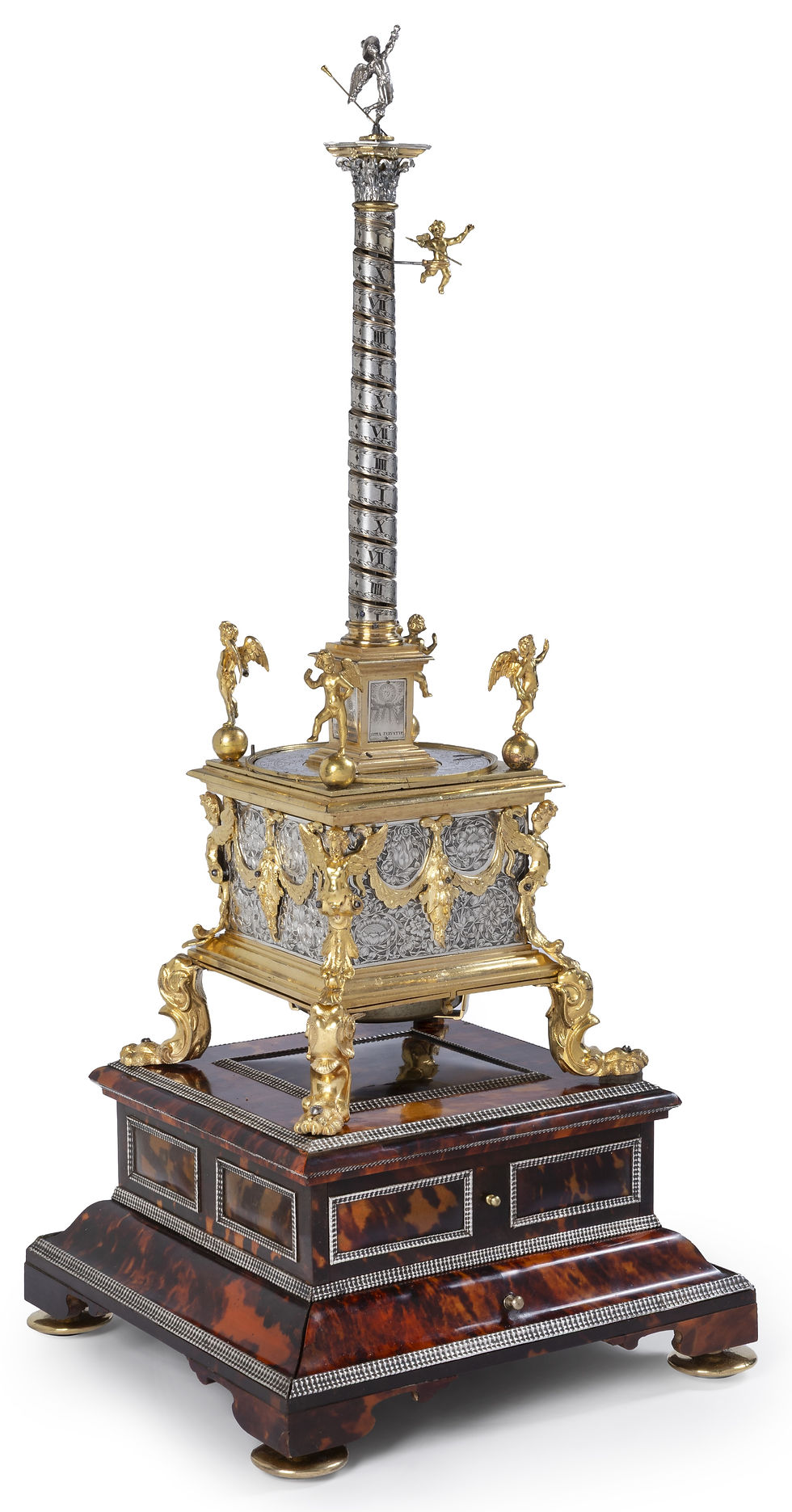
David Buschmann (1626–1701). Augsburg, c. 1660. Silver, gilt bronze, brass, iron, steel, wood, tortoiseshell and velvet. H. 58 × W. 26 × D. 26 cm (clock); H. 69 × W. 33 × D. 33 cm (case). Presented by Mentink & Roest.
Among regular exhibitors at TEFAF, Mentink & Roest occupies a distinctive position as the only dealer specialising exclusively in clocks and watches. Their presentation brings together objects spanning several centuries of worldwide horology.
This column-shaped table clock, produced in Augsburg around 1660, immediately commands attention. Its impact lies not only in the richness of its materials and ornament, but in a more fundamental aspect: time is not confined to its dial, but unfolds through the structure of the object itself.
The movement is enclosed within a cubic case clad in engraved silver and enriched with gilt-bronze mounts, from which a central column rises. It rests on a tortoiseshell-veneered base fitted with drawers, conceived as a miniature piece of furniture, and is accompanied by a period wooden case with glass panels, as a protective vitrine.

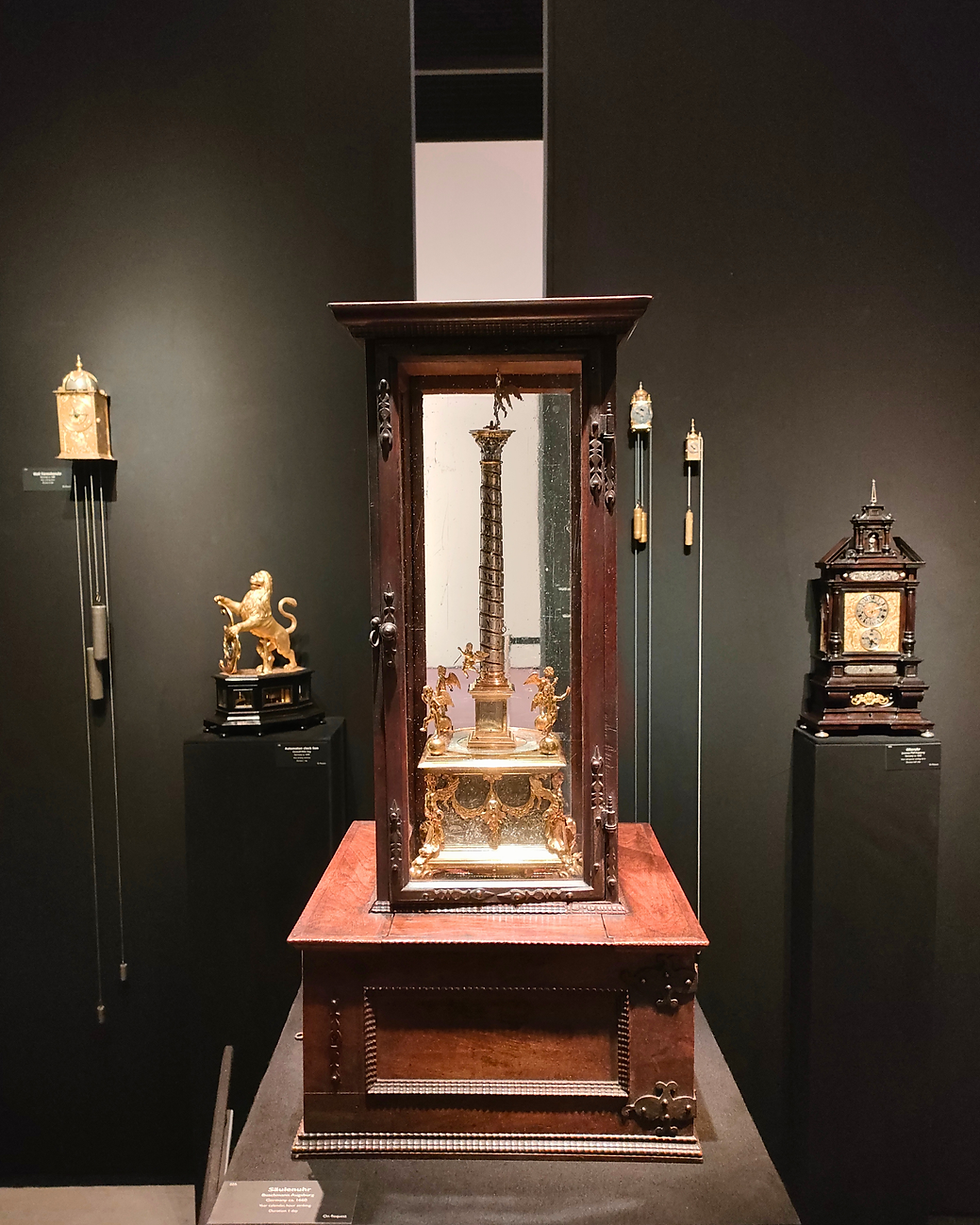
Column-shaped table clock, views of the base and display case. Photos by the author, TEFAF Maastricht 2026.
It has a one-day movement with chain and fusee, striking the hours on a bell via a countwheel. The backplate bears the signature “Davidt Buschman Aug”, identifying a member of a prominent family of clockmakers active in Augsburg since the early sixteenth century. Constructed predominantly in iron, with elements in brass and steel, it remains representative of mid-seventeenth-century German horology. As is frequently the case, later adjustments are likely, and its current impeccable state depends on specialised intervention—expertise supported by the in-house restoration workshop of Mentink & Roest.
Calendrical information is displayed on a ring at the top of the case, indicating year, month, date and zodiac sign. A secondary dial positioned above the column offers a more conventional point of reference. Neither, however, constitutes the primary means of reading time.

That function is assumed by its most striking element: a sculptural gilded Cupid rising along a spiralling path around the central column. Observing the figure’s ascension, it becomes apparent that time here is not simply measured, but staged. As noted by Menno Hoencamp (horologist and director at Mentink & Roest), this corresponds to a form of “time in three dimensions”, in which temporal progression is made visible along a helicoidal trajectory that evokes broader cosmological associations, linking earth and heavens (Mentink & Roest 2026, 45; Hoencamp, pers. comm., 2026).
At the base of the column, four engraved plaques bear the inscriptions “SVPRA FERVNTVR”, “CONTRA FERVNTVR”, “INFRA FERVNTVR” and “VNA FERVNTVR”, which may be rendered as “are driven above”, “in opposition”, “below” and “together” (author’s translations). These references reinforce the dynamic logic already expressed by the ascending figure, extending it into a conceptual register that resonates with early modern understandings of order and movement.
Comparable column clocks attributed to Buschmann are preserved in the Kunsthistorisches Museum, Vienna (Inv. No. Kunstkammer 6832 and 6833), indicating that this was a recognised type within his workshop. Variations in scale and ornament suggest a flexible typology rather than a fixed model.
Among the clocks presented at the fair, this is one I found myself returning to repeatedly, drawn in by the kinetic and theatrical qualities of its motion. The combination of materials reflects the collaborative practices characteristic of Augsburg, where clockmakers worked closely with goldsmiths and cabinetmakers, and recalls the production of elaborate cabinets—often incorporating clocks—situating the object within a broader culture of composite works that blur distinctions between instrument, furnishing and object of curiosity and display.
Night Clock
Lorenzo De Ruggiero (active late 17th century; movement); attributed to Paolo De Matteis (1662–1728; dial painting). Naples, c. 1685–1695. Ebonised wood, gilt bronze, copper, glass, brass and steel. Approx. H. 60 cm. Presented by Galleria Porcini.
This example belongs to the rare and distinctive category of night clocks (orologi notturni), a typology developed in mid-seventeenth century Rome under the pontificate of Alexander VII (1655–1667). Originating with the invention of the oriolo muto by Pier Tommaso Campani (1630–1705), these clocks were conceived to be read in darkness without disturbing the sleep of their owner. They combine near-silent operation with an internally illuminated display, allowing the hours to be perceived through apertures. Following the expiration of the Campani privilegio, the typology spread across the Italian peninsula, finding particular resonance in Naples.

The case, in ebonised wood with gilt-bronze mounts, follows the established architectural form of these clocks, recalling the structure of small devotional cabinets. The painted copper dial, protected by a glass door and without hands, is animated by rotating hour discs visible through apertures, while pierced markers indicate the hours, quarters and half-quarters. The painted scene on the dial, drawn from the Metamorphoses of Ovid (c. 8 CE), depicts the moment in which the nymph Daphne, pursued by Apollo, prays for deliverance and is transformed into a laurel tree to escape him. This moment of metamorphosis introduces a temporal dimension centred on change and transition, subtly echoing the function of the clock.
The composition has been attributed to the Neapolitan painter Paolo De Matteis (1662–1728), with parallels in his treatment of the same subject (Ceretti 2025, 143–146). The present work may be understood as an early interpretation of the theme, anticipating compositions developed by the artist and his workshop at the turn of the eighteenth century.
The presence of a floral still-life on the rotating disc appears unrelated to the mythological subject. However, this pictorial choice reflects the prominence of still-life painting in late seventeenth-century Naples, where it constitutes a distinct and highly valued genre, characterised by strong chromatic contrasts and pronounced decorative effect (Ceretti 2025, 145).

The movement, signed “Lorenzo Di Ruggiero Napoli”, is constructed in brass and fitted with a verge escapement, incorporating a fusee with gut line and pendulum regulation. It drives a system of rotating discs that render time legible through apertures in place of hands, reinforcing the distinctive mode of temporal indication characteristic of this typology: time is not pointed, but revealed.
The present example preserves no visible trace of the internal lighting apparatus. In some comparable examples, this comprises a small oil lamp placed on an internal shelf, often accompanied by a reflector or chimney. The absence of these elements may suggest either their loss or early modification, and underscores the material vulnerability of these objects, whose operation depends on the controlled presence of a flame within the case.
Few night clocks survive, largely due to the risks associated with internal illumination systems, which eventually resulted in damage or destruction. The present example occupies a significant position within this rare typology. It was included here not only for its rarity, but also for the insight it provides into a mode of timekeeping conditioned by light, silence and domestic use, and which, in this instance, resonates with a comparable example preserved in the collection of the Medeiros e Almeida Museum, providing a direct point of reference within my own curatorial experience.
Portable horizontal sundial
Signed “Le Maire Fils à Paris”; attributed to Pierre II Le Maire (1699–1767). Paris, c. 1730. Brass, steel and glass. H. 1,2 × W. 7 × D. 6 cm. Presented by Galerie Delalande.

Among the portable time-measuring instruments presented, this eighteenth-century sundial offers a particularly instructive example. It belongs to the Butterfield type, characterised by an octogonal plate incorporating a compass, a folding gnomon adjustable to the latitude of the location, and hour scales calibrated for three or four latitudes. This typology, associated with Michael Butterfield (c. 1635–1724), is widely produced in Paris during the late seventeenth and early eighteenth centuries. The dial is signed “Le Maire Fils à Paris”, indicating production within the Le Maire family of Parisian mathematical instrument makers, consistent with the period in which Pierre II Le Maire (1699–1767) is active.
Its distinctive feature is the presence of Arabic inscriptions throughout. The compass is inscribed with the cardinal directions in Arabic, while the reverse of the plate bears a list of cities, each with its latitude, including Constantinople (Istanbul), Aleppo, Damascus, Jerusalem and Baghdad. This selection corresponds to key centres within the Ottoman world. The substitution of the fleur-de-lis, traditionally used on French instruments to indicate north, by a crescent further reflects the adaptation of the instrument’s iconography to an Islamic context.
European-made instruments adapted for Near Eastern markets are uncommon. Current scholarship records a comparable example, signed by Nicolas Bion (c. 1656–1733), in the collection of the National Maritime Museum (Caird Collection, inv. AST0519), which likewise bears Arabic inscriptions and Turkish numerals. That instrument also carries an additional engraved name tentatively associated with the Le Maire family, suggesting a connection within the same professional milieu (Higton 2002, 361–362, pls. 49–50).
The present sundial is included for the quality of its execution and the precision with which it has been adapted to a different cultural and linguistic environment. The translation of inscriptions is accompanied by a reconfiguration of the geographical framework itself, as evidenced by the selection of cities on the reverse, which differs from those on comparable French examples. Together with modified symbolic markers, these features point to a deliberate process of adjustment and plausibly reflect a response to a specific commission. Considered in this light, the instrument offers a clear example of how Parisian makers engage with extra-European clients, producing objects tailored to distinct geographical and cultural contexts.
Travel hourglass
Attributed to Guillaume Martin (late 17th century–1749). France, c. 1730–1740. Vernis Martin lacquer, papier-mâché, paper, polychromy, gold leaf, glass, wax, lapis lazuli, velvet and gold. H. 14.8 cm; base diameter 6.2 cm. Presented by Galerie Delalande.
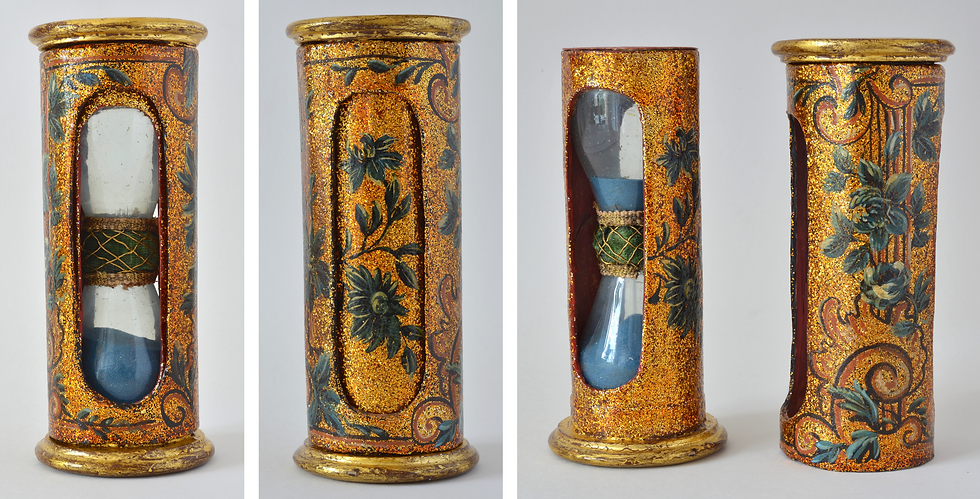
Also dating from the first half of the eighteenth century and presented by the same gallery, this travel hourglass reflects a different approach to portable timekeeping. Its operation relies on a glass ampoule composed of two blown bulbs connected by a narrow calibrated neck and housed within a rotating double-cylinder frame; the operating system is elementary, emphacising material and surface treatment over technical complexity.
The structure, executed in papier-mâché, is entirely coated in vernis Martin, the lacquer technique developed in early eighteenth-century Paris by the Martin family as an European alternative to East Asian lacquer. Applied in successive layers and polished to a high gloss, this technique may incorporate metallic powders, producing a subtly speckled surface, comparable to the optical effect of aventurine, a variety of quartz characterised by mineral inclusions that create a distinctive light-reflecting appearance.
The attribution to Guillaume Martin is consistent with the chronology and use of this specialised lacquer technique, although it remains necessarily cautious in the absence of a signed parallel. While vernis Martin is documented across a range of luxury objects produced in the 1730s and 1740s, its application to a time-measuring instrument of this type appears to be highly unusual.
A further element of distinction is the material contained within the flask. Rather than conventional granular materials such as sand, this hourglass employs particles of lapis lazuli, a complex rock composed primarily of lazurite, with associated calcite and pyrite. As a gemmological material of exceptional cost in the eighteenth century, its use in an hourglass is exceptional and signals an object conceived well beyond purely functional concerns.
This object exemplifies the capacity of eighteenth-century French workshops to elevate a fundamentally modest instrument into an object of remarkable sophistication. It was included for the way it foregrounds material, surface and visual effect, offering a perspective on timekeeping in which mechanical complexity is deliberately secondary.
Louis XV musical cartel clock
Jean Moisy (master 1753; movement); Adrien Dubois (master 1741–1788; case). Paris, c. 1750. Wood, green-dyed horn, gilt bronze, brass, steel, enamel, glass and textiles. H. 109 × W. 55 × D. 21 cm. Presented by Galerie Léage.

This Louis XV musical cartel clock reasserts the centrality of complex horological mechanisms, combining an elaborate movement with a musical train while exemplifying the collaboration of distinct crafts—horology, cabinetmaking and bronze work—within mid-eighteenth-century Parisian manufacture. Conceived as a wall-mounted timepiece, the cartel typology emerges during the Régence period and reaches full development under Louis XV (1715–1774), characterised by a vertically structured composition with a pronounced lower extension recalling the pedestal of earlier table clocks.
The case is covered in green-dyed horn, a relatively rare material, applied by the ébéniste through specialised techniques, while the moulded, chased and gilt bronze mounts are conceived, cast and finished by the bronzier, making explicit the division of labour between these domains. The asymmetrical, violin-shaped silhouette, together with an repertoire of scrolls, shells and foliate ornament, corresponds to the rocaille idiom.
A central glazed aperture reveals the pendulum, while a quadrilobed hinged door in the lower section provides access to the musical train. Openwork panels lined with textile facilitate the diffusion of sound. Stamped “A. DUBOIS” and “JME”, the latter indicating compliance with the regulations of the Jurande des Menuisiers Ébénistes, this work may be attributed to Adrien Dubois (master 1741–1788), whose activity is closely associated with the production of clock cases. In this instance, he appears as the coordinating figure responsible for the ensemble, commissioning its constituent elements from specialised workshops. The identity of the bronzier remains unknown, as is frequently the case.
The dial, signed “Moisy à Paris”, and the movement, also signed and numbered (N.° 316), attest to the work of horloger Jean Moisy (master in 1753). The musical device, housed in the lower section, operates by means of a pinned cylinder activating eighteen hammers striking nine gongs.
This object belongs to a small group of closely related musical cartel clocks sharing comparable bronze mounts and overall composition, while differing in the materials employed, including Boulle marquetry, tortoiseshell, red lacquer or dyed horn. Movements in these related works are associated with several prominent Parisian clockmakers, including Jean-Baptiste III Albert Baillon (1698–1772), Étienne II Le Noir (1699–1778) and Augustin Fortin père (active mid-eighteenth century). The present piece may be associated with this group and is notable as the only known example bearing the stamp of Adrien Dubois, allowing the design of this series to be attributed to his workshop.
This piece constitutes a coherent example within this group, combining a signed and numbered movement with an identified cabinetmaker. It was included for the way it exemplifies the collaborative structure of Parisian luxury manufacture, in which distinct specialists—ébénistes, fondeurs-ciseleurs, bronziers and horlogers—contribute elaborate components to a unified ensemble, while incorporating a musical function extending beyond timekeeping into the domain of performance.
Skeleton Clock with Planetarium and Engraved Glass Celestial Globe
Unidentified Parisian maker (movement, case and mounts); attributed to Ursin Barbay (1750–1824; glass globe). Paris, c. 1785. White marble, brass, steel, enamel, gilt and patinated bronze and glass. H. 51 × D. 31.5 cm. Presented by Galerie Kugel.

The exhibition at Galerie Kugel, founded in the nineteenth century and long recognised for its specialisation in European decorative arts of the highest calibre, is located at the very entrance of the fair. It is therefore fitting that among the first timepieces encountered was this skeleton clock with planetarium: an object that draws the eye, inviting curiosity and a growing sense of wonder.
It is as if one is first offered a vision of time in its most expansive dimension, before turning to the instruments that measure it in all their variety, at increasingly minute scales and levels of technical refinement. Through its visual presence, encouraging scientific enquiry, it sets the tone for the exploration of timekeeping instruments across the fair.
The present clock is conceived as an integrated astronomical instrument, in which timekeeping and the representation of celestial motion are brought into direct correspondence.
The architectural base, in white marble and gilt bronze mountings, is articulated as a tripod of atlantes in patinated bronze with gilt draperies, functioning as structural supports and symbolic carriers of the celestial sphere above. Within this structure, the movement is fully exposed and conceived as a skeletonised construction, defined by a pair of slender gilt-brass uprights that reduce the conventional plates to a minimum and hold the mechanism in open space. At the base, the barrels of the going and striking trains remain visible, the latter operating a bell mounted in the lower section, while the pendulum regulates the movement in direct view. The gear train rises through the structure in a clear vertical progression.
The planetary system is not autonomous but driven directly by the movement through a kinematic derivation of the going train, which converts civil time into the differential motion of the celestial bodies. Conceived as a heliocentric orrery, it presents seven revolving spheres arranged around a fixed central sun—Mercury, Venus, the Earth, the Moon, Mars, Jupiter and Saturn—reflecting the pre-modern convention whereby the Moon was regarded as a planet. The absence of Uranus, despite the attribution to circa 1785, is consistent with contemporary mechanical practice, as the integration of the newly discovered planet into horological and astronomical devices occurs only gradually following its identification by William Herschel in 1781. It operates at a non-realistic scale, with approximated yet hierarchised relative velocities, functioning as a demonstrative model rather than a precision instrument.

The engraved glass globe is finely inscribed with the principal celestial reference circles, together with constellations and zodiacal signs, forming a comprehensive astronomical scheme. Such globes are exceedingly rare, with only a small number of comparable examples recorded. The present globe is attributed to Ursin Barbay (1750–1824), a master glassmaker active in Montmirail (Sarthe), who devoted sustained effort to producing perfectly formed glass spheres, a technical challenge that had remained largely unresolved for centuries.
Within this arrangement, the dials assume a secondary role. Positioned on the front, their open centres reveal the underlying gearwork. The principal dial, set lower, is of white enamel with Arabic numerals and indicates the hours and minutes. Above it, a smaller subsidiary dial, likewise in white enamel, displays the date on a circular scale, indicated by a single hand. This configuration establishes a correspondence between measured time and cosmological time, articulated across three coexisting registers: hourly time, indicated on the dial; calendrical time, through the date; and astronomical time, expressed in the planetary revolutions.
Time is thus not only measured but staged, assuming the character of a mechanical theatre in which scientific knowledge, technical ingenuity and visual display converge. As such, the clock participates in the culture of Enlightenment instruments and in the dissemination of astronomical knowledge, while asserting itself as an object of intellectual prestige.
Regulators and the Culture of Precision Timekeeping
Also presented by Mentink & Roest, three regulators offer a concise insight into the development of French precision timekeeping between the late eighteenth and mid-nineteenth centuries. Differing in scale and construction, they are united by a shared function as instruments of accuracy and control, reflecting the close relationship between horology and scientific practice.
Table Regulator
Jean-Antoine Lépine (1720–1814) (regulator); Claude Monginot (act. 1784–1797) (mainspring). Paris, c. 1786. Duration: 1 week. H. 47,5 × W. 28 × D. 21 cm. Presented by Mentink & Roest.
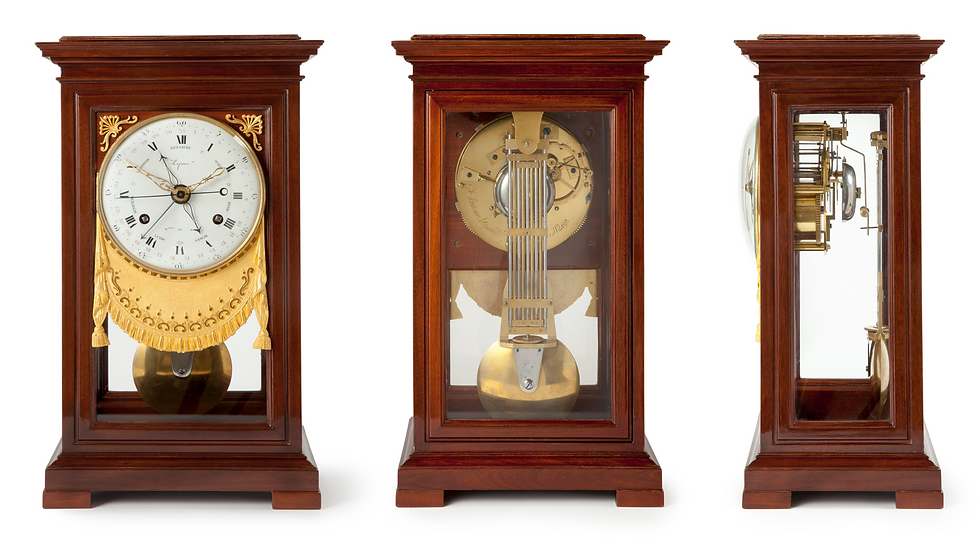
The dial, signed “Lépine / H.GER DU ROI”, and the backplate, engraved “J. Antoine Lépine h.ger du Roi A Paris Nº 4498”, attest to its maker's position as horloger du Roi under Louis XVI and later Napoleon I (Tardy 1972, 386). His name remains inseparable from the calibre that bears it, and he stands among the most consequential figures in the history of horology. This regulator is chronologically anchored by a mainspring barrel inscribed “Janvier 1786 Monginot” (Mentink & Roest 2021, 36–37), linking it to the Parisian spring-maker Claude Monginot (Tardy 1972, 470).
The brass movement employs a pin-wheel escapement with a temperature-compensated pendulum of the gridiron type, incorporating central seconds and date indications. A count-wheel striking train sounds the hours and half-hours on a bell, with going and striking trains driven by separate barrels.
The white enamel dial is organised in concentric chapter rings indicating minutes, days of the month, hours and days of the week, the latter accompanied by planetary symbols. Pierced gilt hands indicate hours and minutes, while blued steel hands serve calendar and seconds indications.
The mahogany case, glazed on all sides and above, reveals the pendulum and movement. Its structural sobriety is set against a finely chased gilt-brass lambrequin beneath the dial, introducing a textile-derived ornamental vocabulary within an otherwise technical object.
It has been slected for the way in which precision timekeeping is paired with a measured decorative vocabulary, in which scientific ambition and ornamental refinement remain intertwined.
Longcase Regulator

Jean-Joseph Robin (1781–1856) (regulator); Étienne Gobin Dubuisson (1731–after 1820) (dial). France, 1819. Duration: 1 month. H. 209 × W. 51 × D. 30 cm. Presented by Mentink & Roest.
The dial and back plate, signed “Robin / Hger du Roi et de Madame / An 1819”, identify the maker as Jean-Joseph Robin, son of Robert Robin (1742–1799) and heir to a major late eighteenth century workshop. The counter-enamel signature of Étienne Gobin, known as Dubuisson, attests to the involvement of a leading Parisian enameller, while the mainspring is attributed to Peupin Frères (act. 1812–1820) (Mentink & Roest 2025, 16–19; Tardy 1972, 515).
The movement integrates a five-second remontoir with a deadbeat escapement, a configuration associated with enhanced rate stability. The substantial gridiron pendulum, comprising nine rods of alternating steel and brass, suspended on a knife-edge, is complemented by temperature and beat adjustment scales. A separate striking train governs the hour, half-hour and quarter strikes on two bells.
The white enamel dial is arranged in concentric registers, with hours marked by Roman numerals on the chapter ring, and minutes and seconds read against inner and outer scales. Two sets of hands articulate the display: a pair of gilt-brass hands with a solar motif, and two blued steel hands, including a sweep seconds hand with counterpoise. Below, partially visible, a revolving annual calendar ring is inscribed with months, dates and zodiac symbols, read against a fixed pointer.

The mahogany case, fully glazed to the front and sides, provides an architectural framework for the regulating system, its overhanging cornice and dentilled frieze establishing clear structural articulation.
This regulator is chosen for the complexity of its mechanical solutions, but above all for the clarity with which it renders visible the principles of precision timekeeping, making legible the relationship between regulation, compensation and control.
Table Regulator
Paul Garnier (1801–1869). France, c. 1845. Duration: 1 month. H. 50 × W. 17 × D. 13,5 cm. Presented by Mentink & Roest.

This regulator is distinguished by a restrained aesthetic, defined by geometric clarity and contrast of materials, combined with technical refinement. Signed on the dial and back plate—“N.º 2718 / Paul Garnier / Hger de la Marine / Paris”—it identifies its maker as a famous official clockmaker to the French Navy, situating the object within the institutional framework of nineteenth-century precision timekeeping. The present example belongs to a small group of regulators produced between the 1840s and 1870s (Mentink & Roest 2025, 30–31), conceived for exacting chronometric performance.

The spring-driven movement employs a pin-wheel escapement with a compensation pendulum of the Mahler type. This three-rod construction, with adjustable horizontal weights, responds to temperature variation by altering the pendulum's effective length, thereby stabilising the rate. The winding square is positioned beneath the dial.
The enamel dial privileges the measurement of seconds, both in scale and legibility. A large outer chapter ring, marked at ten-second intervals, is read by a central blued steel seconds hand, while hours and minutes are relegated to a subsidiary dial below the centre, indicated by blued steel Breguet hands.
The movement is mounted on a black marble column articulated with gilt-brass mouldings, forming a vertical support for the regulating system. At the rear, a calibrated scale records the amplitude of the pendulum, reinforcing its function as an instrument of observation.
It was included for the clarity of its design, in which visual restraint and technical function coincide, reflecting a shift towards an increasingly analytical and instrument-based conception of timekeeping.
Together, these three regulators articulate a progressive refinement of precision timekeeping across nearly a century. From the late eighteenth-century synthesis of ornamental language and scientific ambition in Lépine, through the technical elaboration of Robin’s system, to the nineteenth-century emphasis on legibility and institutional application in Garnier, they reflect successive reconfigurations in the conception and regulation of time. Considered in sequence, they offer a clear insight into the gradual redefinition of horology as a discipline increasingly aligned with precision and scientific instrumentation.
Japanese & Chinese Clocks
Japan and China, Edo and Qing periods, c. 1750–1850. Presented by Mentink & Roest.
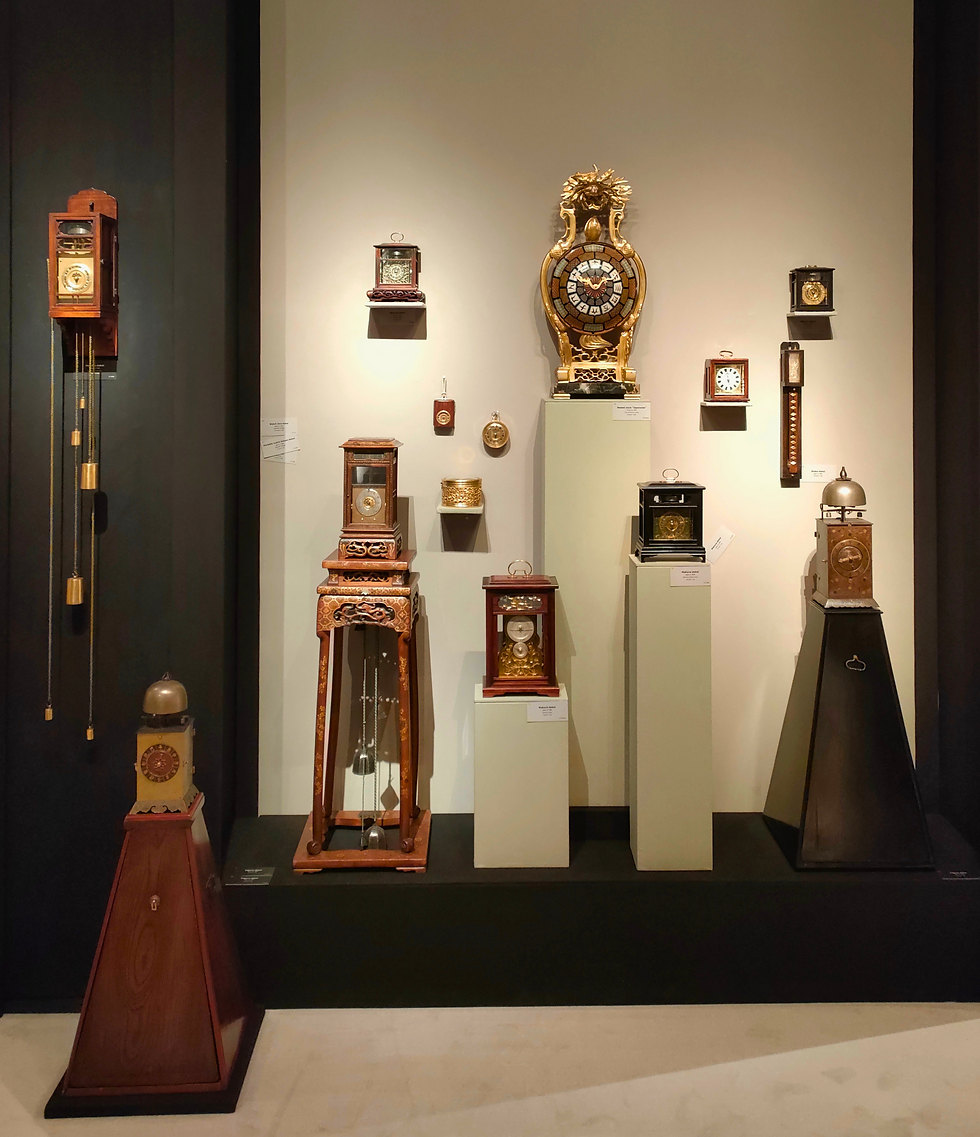
Within the presentation of Mentink & Roest, a group of Chinese and Japanese clocks, dating broadly from the eighteenth to the nineteenth century, was displayed on a single wall. The selection included a Japanese pillar clock (shaku-dokei), a wall-mounted hashira-dokei, table formats such as yagura-dokei and makura-dokei, and smaller portable forms such as a keisan-dokei. These were presented alongside Chinese drum clocks, including an example with a silvered dial and travelling case.
Standing before this ensemble, what becomes apparent is the articulation of different mechanical and temporal systems within a shared visual field. These objects encompass weight-driven and spring-driven movements, indicating distinct approaches to the storage and regulation of energy. The mechanical solutions adopted correspond to different ways of structuring time. Several Japanese clocks are associated with systems in which the division of the day does not rely on fixed and equal hours, but on units that vary in relation to the changing length of day and night, a principle reflected in their scales and displays. By contrast, other pieces—such as the Chinese drum clocks—present time through more regularised circular dials, sometimes incorporating cyclical systems structured around zodiacal sequences. While such formats reflect local conventions of time reckoning, they also exist within a broader context of exchange, in which European mechanical principles and exported movements are adapted to different visual and cultural frameworks.
The diversity of formats reinforces these distinctions. The vertical register of the pillar and wall clocks contrasts with the compact construction of the table clocks and the reduced scale of the portable pieces. The group as a whole reflects patterns of circulation and adaptation between China and Japan, while pointing to broader networks of exchange with Europe, in which mechanical principles, formats and symbolic systems are transmitted and reinterpreted across different cultural frameworks. Installed as a single ensemble, the wall functions as a condensed field of observation, in which differences in the mechanics and the conceptualisation of time become legible through direct comparison.
Anthropomorphic snuff box converted into a table clock
Neuburger & Cie. (act. 1835–1880). Paris, c. 1835–1840. Duration: 1 day. Corozo, brass, steel and enamel. H. 9,5 cm. Presented by Galerie Delalande.
This example has not been selected for its material value, artistic refinement or mechanical complexity. It nevertheless stands among the most curious and whimsical objects encountered.

Originally conceived as a snuff box, the figure—carved as a male character wearing a broad-brimmed hat and long coat—retains the structural logic of a container. A hinged panel at the back provides access to the interior cavity, originally intended to hold snuff. The material, corozo—a vegetal substance derived from palm seeds—is worked to a high polish, resembling horn or tortoiseshell, yet remains characteristic of more accessible forms of production. The simplified sculptural treatment of the figure, emphasising a recognisable type rather than portraiture, further situates it within a popular sphere of production.
At a later stage, the object is adapted to incorporate a timekeeping mechanism. Such transformations are documented in Europe from the eighteenth century onwards, becoming more frequent in the nineteenth century, following the miniaturisation of movements and the proliferation of novelty objects. The rear compartment now accommodates a compact brass movement, mounted on a transverse support signed “NEUBURGER / PARIS”, identifying Neuburger & Cie. (act. 1835–1880) (Tardy 1972, 486). The enamel dial, likewise signed, is set into the abdomen of the figure and is driven by a one-day movement regulated by a front balance with tic-tac escapement.
The object does not fully resolve the tension between its original function and its later adaptation, allowing both identities to remain legible. This unexpected and subtly humorous transformation lends the piece a distinctly endearing quality.
Figural Clock Garniture with Conical Pendulum
Eugène Farcot (1830–1896) (movement); Eugène Cornu (1831–1891) (design and assembly); Société des Marbres Onyx d’Algérie (active from c. 1850s) (onyx marble elements); after a model by Albert-Ernest Carrier-Belleuse (1824–1887) (figure). Paris, c. 1860. Onyx marble, gilt and silvered bronze, champlevé enamel, brass, steel and glass. H. 116 × W. 48 × D. 29 cm (clock); H. 80 × W. 40 × D. 40 cm (candelabra). Duration: 8 days. Presented by Adrian Alan.

This garniture, comprising a mantel clock and a pair of ten-light candelabra, brings together several of the most accomplished Parisian makers active in the mid-nineteenth century. Conceived as a unified ensemble, it integrates sculpture, metalwork, ornamental stone and horological mechanism within a coordinated decorative programme.
Eugène Cornu (1831–1891), active in Paris as a bronzier-éditeur, is responsible for the ornamental conception and assembly, here produced for the Société des Marbres Onyx d’Algérie. Active from the 1850s, following the rediscovery of these deposits in Oran, this company plays a central role in disseminating this material within the decorative arts of the Second Empire.
At the centre of the garniture, the clock is surmounted by a large silvered bronze allegorical female figure, commonly identified as Urania, muse of astronomy in Greek mythology, defining its iconographic framework. One of her attributes, the celestial globe, is here reinterpreted and suspended as a pendulum from her raised arm. The figure derives from a model by Albert-Ernest Carrier-Belleuse (1824–1887), whose sculptural language exerts a wide influence across mid-nineteenth-century decorative arts.
The base, formed as an architectural entablature in onyx marble, is enriched with champlevé enamel plaques of scrolling geometric design. The gilt bronze dial, set within this structure, allows its open centre to reveal the underlying mechanism, situating the object within a broader category of nineteenth-century “mystery” clocks.
The movement is entrusted to Eugène Farcot (1830–1896) and signed with his “EF” monogram. His work on conical pendulum systems, developed from the early 1860s and patented in 1872, places him among the most inventive clockmakers of his generation (Tardy 1972, 220). The eight-day movement, with twin barrels, drives both timekeeping and rack striking of the hours and half-hours on a bell.
At its core lies the conical pendulum, in which the regulator describes a continuous circular motion rather than a lateral oscillation. Suspended from the raised arm of Urania, the pendulum terminates in a rotating celestial orb, its motion maintained through a Cardan suspension. In this configuration, the regulating system is not concealed but fully externalised, becoming the visual centre of the composition. The astronomical attribute thus assumes an active mechanical role, establishing a direct correspondence between allegory and function.
This piece stands apart for its material, technical and formal qualities, but also for the effect it produces in motion. The continuous rotation of the pendulum produces a compelling visual experience, rendering the passage of time entrancing. The rotating celestial orb holds the gaze with persistence, transforming the measurement of time into a quietly absorbing spectacle.
A Fabergé Imperial clock
Carl Fabergé (1846–1920); Johann Viktor Aarne (1863–1934; Chief Workmaster). St. Petersburg, 1896–1902. H. 25 × W. 15,7 cm. Presented by Wartski.

This object stands apart from the preceding examples not only in form but in category. It is best understood as an objet de vertu, situated at the intersection of horology, jewellery and the decorative arts, in which the timekeeping function is integrated into a broader artistic conception.
Centred within a richly figured birch panel, the dial is set against a rectangular enamel plaque, protected by domed glass and framed by a rope-twist bezel. It displays Arabic numerals painted in blue, with gold minute markers and openwork gold hands. The surrounding wooden structure adopts a simplified architectural form, supported by a hinged rear strut.
The technical focus lies in the enamel. The narcissi are formed from fine gold cloisons filled with translucent and opaque enamels, their petals rendered in relief through a technique inspired by Japanese moriage, set against a graduated ground of warm yellows and oranges. Closely associated with Johann Viktor Aarne (1863–1934), this demanding method results, as noted by Kieran McCarthy (FSA, Co-Managing Director, Wartski), in “a tour de force of enamelling”, particularly in combination with the unusual use of wood as a primary structural material.

The compact movement, housed behind the dial, remains integral but is subordinated to the overall conception, in keeping with Fabergé’s production, where horology forms part of a broader system of specialised crafts.
The provenance situates the object within an imperial context, associated with Grand Duchess Maria Georgievna (1876–1940), Princess of Greece and Denmark, and recorded in the 1902 exhibition of the Imperial Family’s Fabergé collection in St Petersburg.
It is included here not simply for its technical execution, but for the way it reconfigures the role of horology within the object. Time remains present and legible, yet it no longer dominates; instead, it is embedded within a broader artistic and material programme, demonstrating how, within Fabergé’s production, the clock becomes part of a larger system of craftsmanship rather than an end in itself.
“Fleur d'Hélianthe” Clock
Mathieu Planchon (1842–1921 ; movement), La Compagnie des Cristalleries de Baccarat. France, c. 1900. "Crystal" glass, gilt and patinated bronze, brass and steel. H. 66 × W. 19 × D. 13 cm. Presented by Adrian Alan.
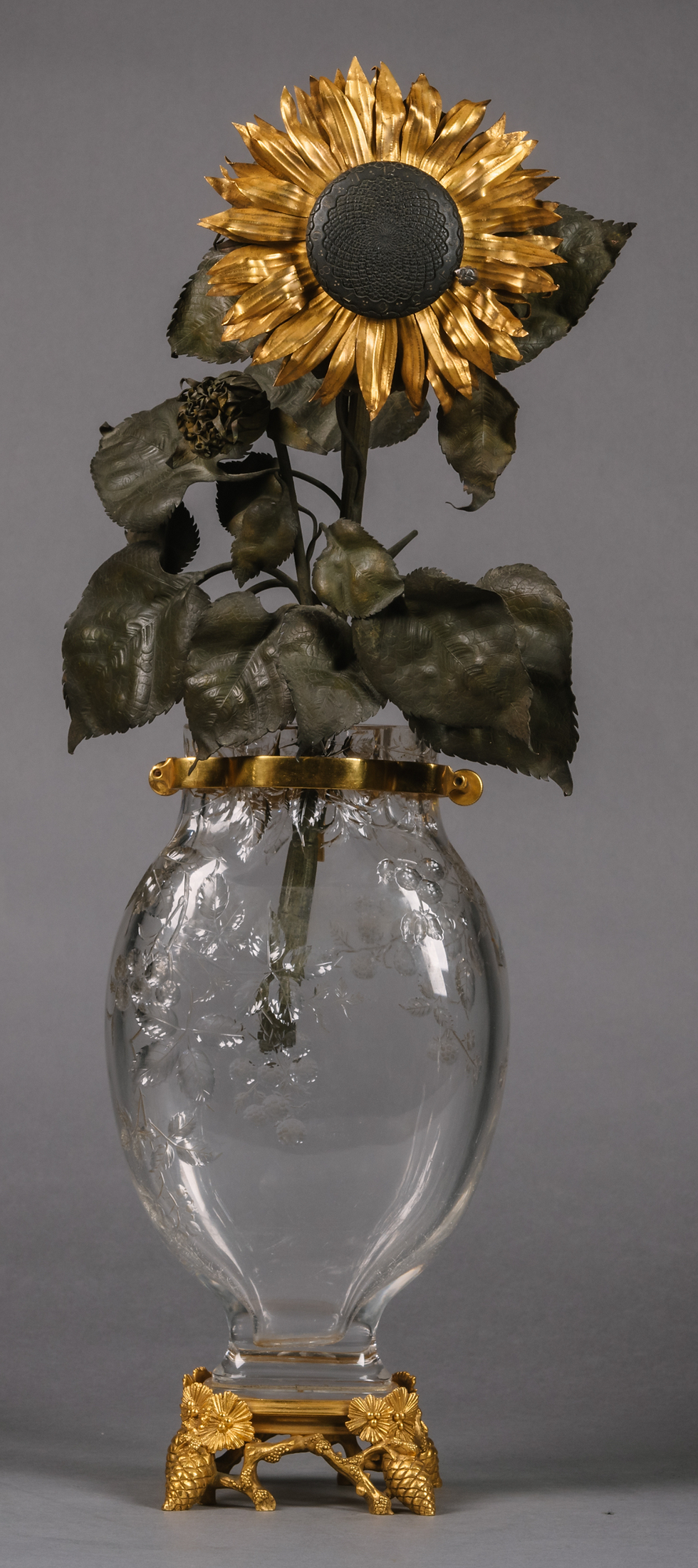
This pendule belongs to a category of late nineteenth- and early twentieth-century objects in which horology is subsumed within a broader decorative and material conception. Conceived as a naturalistic sunflower emerging from a cut-crystal vase, it integrates sculpture, glasswork and mechanism into a unified composition, in which time is embedded within a vegetal structure rather than articulated through a conventional dial.
The ovoid crystal body, finely engraved with berried branches, reflects the technical and aesthetic ambitions of La Compagnie des Cristalleries de Baccarat at the turn of the twentieth century. During this period, the firm produces highly elaborate objets de luxe that combine clarity of material with intricate surface treatment, often within a decorative vocabulary informed by Japonisme.
The horological mechanism is entrusted to Mathieu Planchon (1842–1921; Tardy 1972, 525), a Parisian clockmaker associated with a category of curiosités, in which the display of time is reconfigured. His work is characterised by mechanical ingenuity combined with a taste for visual and conceptual invention. The present clock, signed and numbered, belongs to a small group of pendules based on this sunflower motif.
The most distinctive feature lies in its system of time indication. The dial does not employ conventional hands, but consists of a fixed chapter ring bearing Arabic numerals, arranged around the central boss of the sunflower. Time is indicated by a rotating pointer, integrated into the composition in the form of a beetle at the edge of the flower head. The beetle moves continuously around the circumference, aligning with the numerals to indicate the hours.

The reverse of the sunflower head reveals a compact circular movement housed within a gilt-bronze casing. The mechanism is spring-driven and regulated by a balance system. The going train drives the rotation of the beetle through a modified motion work, replacing the conventional hour hand with a single rotating element.
The stem of the sunflower does not transmit mechanical force; the movement is independent from the "crystal" glass vase, which functions solely as a support. Within the sequence of objects discussed in this article, this pendule represents a further stage in the integration of horology into the decorative arts. Mechanical function persists but is subordinated to material presence, surface and form.
The coherence between the object’s naturalistic conception and its mode of time indication is particularly striking: the rotating beetle moves across the surface of the flower as though it were a living element, momentarily alighting upon it. Time is thus indicated in a naturalistic manner. The illusion of organic form conceals a discrete horological system, requiring the viewer’s attention to recognise the flower as a constructed object, rather than a real sunflower, and to discern the indication of time. In this sense, the object does not simply measure time; it sustains the gaze, revealing its function gradually, through prolonged observation.
Keeping Time at TEFAF: After the Fair Falls Quiet
The 2026 edition of TEFAF offers a clear vantage point from which to consider horology as a field marked by diversity. The objects discussed do not align within a single narrative; instead, they reveal distinct ways of conceiving and materialising time, each rooted in specific historical and cultural conditions.
In retrospect, once the fair has closed and its tempo has receded, these differences become more defined. Considered in sequence, the works make evident that timekeeping is not a stable or uniform practice. In some instances, it is articulated through cosmological frameworks; in others, it is embedded in mechanical refinement or subsumed within broader decorative and material programmes. What emerges is not continuity, but diversity, shaped by context, function and intention.
Direct engagement with the vetting process further sharpens this perspective. In the days preceding the opening, the pace is exacting and sustained. Objects are handled, opened and analysed in close detail; discussions unfold around minute details; decisions are reached through careful negotiation. Within this context, attention is concentrated, technical and often urgent, guided by the need to resolve questions before the fair begins.
With the opening, this mode of attention shifts. The same objects are now encountered within a different rhythm. Crowds gather, slow down, lean in; what has been subjected to technical scrutiny becomes a source of curiosity and, at times, wonder. The clocks continue to function as before, yet their reception changes, as they are no longer only assessed, but experienced.
Within this setting, TEFAF does more than present objects; it establishes the conditions under which they are studied and understood. The selection brought together here reflects that experience, offering a view of horology grounded not in abstraction, but in direct observation and critical assessment.
After the fair falls quiet, and the intensity of analysis and display gives way to distance, the objects remain mind with a different clarity. Removed from the pressures of vetting and the movement of visitors, these instruments no longer present themselves as cases to be resolved or spectacles to be observed, but as testimonies to be (re)considered. Their mechanisms may continue to operate, yet what persists is not their function alone, but the varied ways in which they shape the perception of time. In this quieter register, horology emerges not as a single discipline, but as a succession of encounters, a constellation of worlds unfolding within one another, like seconds within the minute, minutes within the hour, hours within the day and so on…
Acknowledgements
I am grateful to all those who contributed to my participation at TEFAF Maastricht 2025 and 2026. I begin by acknowledging the Medeiros e Almeida Foundation, whose support made this possible and whose recognition of its value—for professional development and the international recognition of the museum and its collection—was essential. Particular thanks are due to the Clocks & Watches Committee—Helmut Crott, Jean Genbrugge, Michael van Gompen, Dominique Mouret and Patrick Rocca—for their generous welcome, as well as for their insight and intellectual generosity. Thanks are also due to the Vetting Organization, and in particular to Claudia Klerkx and Yvonne van den Eerenbeemt, for their guidance throughout the vetting days. I am also indebted to Paul van den Biesen, Rachel Pownall, Delphine de Bokay and, above all, Coco Bannenberg, who encouraged me to apply to assist the vetting committee. I acknowledge my fellow vetting committee assistants, whose conversations and shared experiences shaped this process in many meaningful ways. I also extend my sincere appreciation to the dealers and gallerists who received us with generosity, sharing their expertise and presenting exceptional timepieces throughout the fair. Finally, I wish to record, with particular appreciation, the contribution of Luís Couto Soares, for his close guidance and for his meticulous review of my text. Until the next TEFAF Maastricht!
Bibliography
Adrian Alan. “A Fine Napoleon III Onyx and Enamel Figural Three-Piece Clock Garniture.” Accessed March 25, 2026. https://www.adrianalan.com/product/a-fine-napoleon-iii-onyx-and-enamel-figural-three-piece-clock-garniture/.
Ceretti, Francesco. “Un orologio notturno di Lorenzo De Ruggiero: orologiaio e collezionista napoletano tra il marchese del Carpio e Paolo De Matteis.” Ricche Minere 12, no. 24 (2025): 139–146.
Higton, Hester. Sundials at Greenwich: A Catalogue of the Sundials, Horary Quadrants and Nocturnals in the National Maritime Museum, Greenwich. Oxford: Oxford University Press, 2002. https://www.rmg.co.uk/collections/objects/rmgc-object-69128.
Kollenburg Antiquairs. “German Astronomical Renaissance Türmchenuhr.” Accessed April 2, 2026. https://www.kollenburgantiquairs.com/Clocks/German-Astronomical-Renaissance-Tuermchenuhr.
Kunsthistorisches Museum. “Säulenförmige Tischuhr.” Accessed April 2, 2026. https://www.khm.at/kunstwerke/saeulenfoermige-tischuhr-92845.
Kunsthistorisches Museum. “Säulenförmige Tischuhr.” Accessed April 2, 2026. https://www.khm.at/kunstwerke/saeulenfoermige-tischuhr-92846.
Mentink & Roest. “Excellent Longcase Regulator.” Accessed March 25, 2026. https://www.mentinkenroest.com/collectie/longcase-regulator-robin-h-ger-du-roi-et-de-madame-an-1819-france/.
Mentink & Roest. “Table Regulator.” Accessed March 25, 2026. https://www.mentinkenroest.com/collectie/table-regulator-j-antoine-lepine-h-ger-du-roy-aparis-no-4498-date-on-spring-janvier-1786-monginot-france/.
Mentink & Roest. “Table Regulator.” Accessed March 25, 2026. https://www.mentinkenroest.com/collectie/table-regulator-signed-and-numbered-paul-garnier-h-ger-de-la-marine-no-2718-c.-1845-france-2/.
Mentink & Roest. All in Good Time: The Mentink & Roest Collection. Amersfoort: Wilco, 2021.
Mentink & Roest. Masters of the Past: The Mentink & Roest Collection. Amersfoort: Wilco, 2025.
Mentink & Roest. The Rise of Private Timekeeping: The Mentink & Roest Collection. Amersfoort: Wilco, 2026.
Tardy. Dictionnaire des horlogers français. 2e partie. Paris: Tardy, 1972.
TEFAF. “Art Vetting Process at TEFAF.” YouTube video. Accessed April 2, 2026. https://youtu.be/o1oArQPCmP4.


👏👏👏