
Changing the clocks: how to set your watch back without damaging it

Sunday morning is the best time to set mechanical watches back an hour. Photograph: IPR.
In the early hours of Sunday 25 October, when it reaches 2:00 in mainland Portugal and Madeira, the clocks go back to 1:00; in the Azores, they go from 1:00 back to midnight. Your phone changes by itself. The mechanical watch on your wrist, the pendulum clock in the living room and the cuckoo clock in the kitchen are waiting for you — and some of them will not forgive a turn of the crown at the wrong time.
A 25-hour Sunday
Throughout the European Union, summer time ends at 1:00 Coordinated Universal Time (UTC) on the last Sunday of October. That is why the change happens at the same instant across Portugal, even though the Azores keep a different local time. In practice, the hour between 1:00 and 2:00 is lived twice, and Sunday lasts 25 hours.
We have already explained who sets the world's time. This time the subject is practical: what to do with each clock and watch in the house.

The Ohio Clock in the United States Capitol being put forward on 31 March 1918, when daylight saving time came into force in the country for the first time.
Before you start: is it day or night?
From the hands alone, a watch cannot tell 10 a.m. from 10 p.m.; it is the date mechanism that knows the difference. The date changes around midnight. If the watch is set twelve hours out, the date will change at noon instead.
To find out, turn the hands forward until you see the date change. At that moment the watch is at midnight, and from there you simply advance to the correct time.
The danger zone: 9 p.m. to 3 a.m.
In most mechanical watches with a date, the date change is not instantaneous. The wheels that drive it start to engage hours before midnight and only disengage well afterwards. Seiko and Grand Seiko manuals ask owners not to set the date between 9 p.m. and 3 a.m.; Omega gives the window as 8 p.m. to 2 a.m.
Using the quick-set date during that period forces a mechanism that is already in motion. At best, the date fails to change the following midnight; at worst, teeth break.
If in doubt, move the hands to 6:00 first. Only then touch the date.
The same care applies to turning the hands backwards. Inside this zone, setting the time back can force the date mechanism to run in reverse. Outside it, on most wristwatches, going back an hour causes no problem.
Going back an hour, step by step
The best time is Sunday morning, after 9 a.m., well away from the danger zone. On a wristwatch with hours, minutes, seconds and date:
If the crown screws down, unscrew it first.
Pull the crown out to the time-setting position, usually the last one. On many watches the seconds hand stops.
Turn the hands back one hour, slowly.
Push the crown in and, if it screws down, screw it all the way home: the watch's water resistance depends on it.
On watches with a hacking seconds hand there is an alternative: pull out the crown and wait an hour. The watch stands still while time catches up with it, and no hand ever moves backwards. If you have an automatic watch that has stopped in a drawer, wind it before setting it.

A wristwatch movement with its stem and crown, used to wind the watch and set the time and date. Photograph by Rama, Wikimedia Commons, licence CC BY-SA 2.0 FR.
Perpetual and annual calendars
These are the most delicate watches, because the mechanism that counts days, months and leap years is linked to the hands. The rules differ from brand to brand.
In IWC's perpetual calendar manuals, the hands must not be turned back from 8 p.m. onwards, nor wound back past 2 a.m. Patek Philippe advises against turning the hands anticlockwise: it does not damage the mechanism, but it may desynchronise the calendar displays. MB&F allows the hands of the LM Perpetual to be turned back at any time, but warns that going back past midnight does not move the calendar back.
With a perpetual calendar, the manual has the final word. If you do not have it, stop the watch for an hour instead of setting it back.
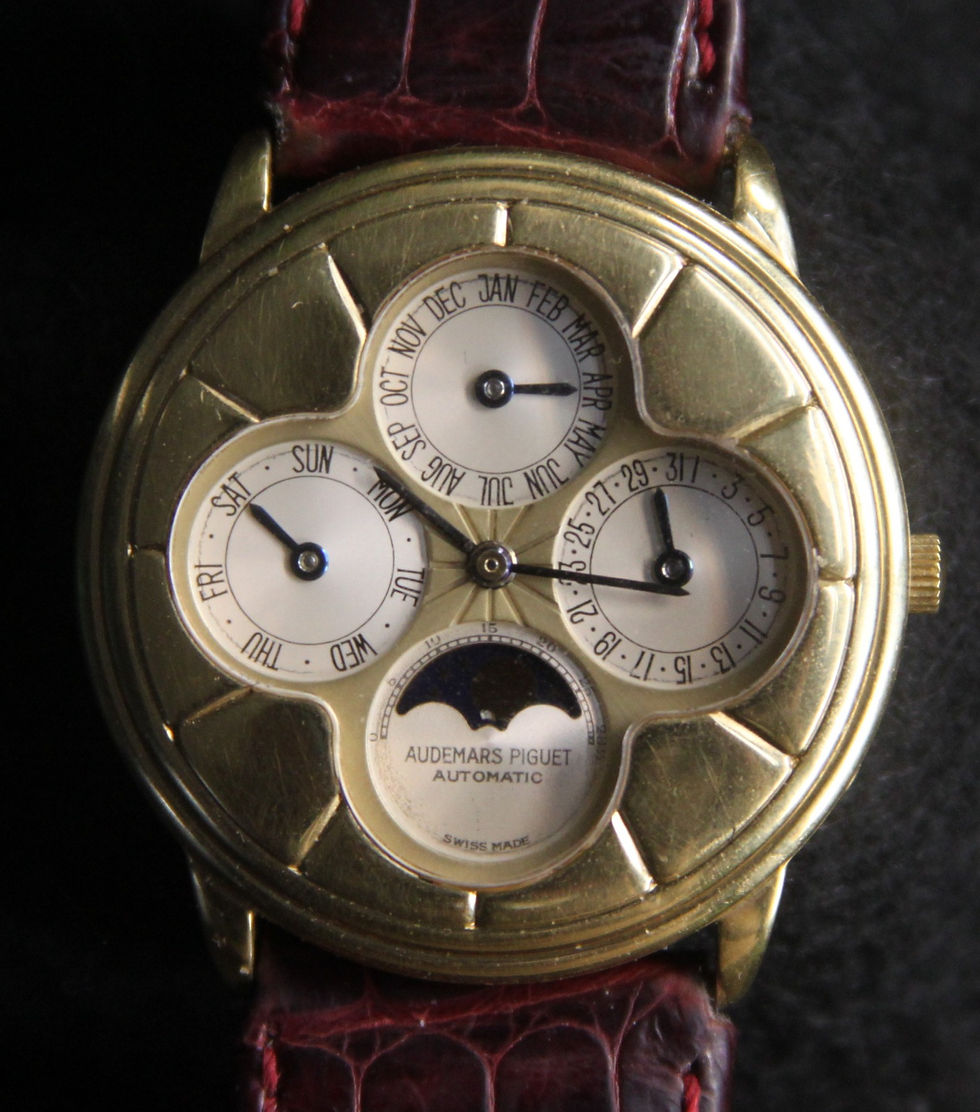
A wristwatch with a perpetual calendar and moon phase. Photograph by jcw, Wikimedia Commons, licence CC BY 3.0.
GMT and world-time watches
On second-time-zone watches designed for travellers, the change is simple. On the Rolex GMT-Master II, for example, the local hour hand jumps hour by hour, forwards or backwards, without disturbing the minutes and seconds and without stopping the watch: just move it back one jump. The 24-hour hand, which shows the reference time, only needs adjusting if that reference is Lisbon time.
On world-time watches, remember that not every country changes its clocks, and those that do do not always change on the same day. The United States, for instance, only sets its clocks back a week later, on 1 November.
Quartz and radio-controlled watches
Many quartz watches with a date share the same danger zone: Grand Seiko also states it in the manuals of its quartz calibres. Radio-controlled watches change by themselves when they receive the signal from the German DCF77 transmitter near Frankfurt. Because Portugal lies at the edge of its range, the change may not happen, in which case they must be set by hand.
Pendulum and wall clocks
On a wall clock or longcase clock that only shows the time, you can turn the minute hand backwards. If the clock strikes the hours, half hours or quarters, it is a different matter: turning the minute hand back can jam the striking mechanism and stop the clock. The safest solution is to stop the pendulum for an hour and set it swinging again when the hands match the correct time.
Never turn the hour hand on its own. The only exception is when the clock strikes a number of blows different from the hour it shows: in that case, move only the hour hand to the number the clock struck, then set the time with the minute hand, always forwards, letting it strike at each half hour and each hour.

Clockmaking class at the IPR. Photograph: IPR.
Cuckoo clocks
For Black Forest cuckoo clocks certified by the VDS, the region's makers' association, the instructions are clear: set the time by turning the minute hand, the longer one, anticlockwise, and never touch the hour hand. If you prefer to turn it clockwise, you must wait for the cuckoo to finish calling at each half hour and each hour before carrying on. Here too, stopping the pendulum for an hour is an alternative.
On battery-powered cuckoo clocks the procedure varies from model to model, and in some cases you remove the battery and turn the minute hand clockwise only. Follow the manual.

Cuckoo clock. Photograph: IPR.
Will this be the last time?
Probably not. The European Commission proposed ending the clock change in 2018, after a public consultation in which 84% of 4.6 million respondents called for it, and the European Parliament approved the proposal in 2019. Since then the process has been stuck in the Council, where member states have not agreed on which time to keep. In October 2025 Spain put the issue back on the table, and the Commission commissioned a new study, due to be completed by the end of 2026.
Meanwhile, the calendar is already fixed. In March 2026 the Commission published in the Official Journal of the European Union the summer-time dates for 2027 to 2031. The next returns to winter time will be on 31 October 2027, 29 October 2028, 28 October 2029, 27 October 2030 and 26 October 2031.
Checklist for Sunday
Set your watches on Sunday morning, after 9 a.m., away from the 9 p.m. to 3 a.m. danger zone.
Simple watch or watch with date: pull out the crown and go back one hour.
Never use the quick-set date between 9 p.m. and 3 a.m.
Perpetual or annual calendar: follow the manual; if in doubt, stop the watch for an hour.
GMT with an independent hour hand: go back one jump.
Screw-down crown: screw it all the way home again.
Striking pendulum clock or cuckoo clock: never touch the hour hand; stop the pendulum for an hour or follow the maker's instructions.
If something goes wrong
A date that has stopped changing, a crown that will not go back in, or a wall clock striking the wrong hours can almost always be fixed. The IPR workshop repairs, services and restores watches and clocks, and estimates are free of charge. Watches are received Monday to Friday, from 10:00 to 12:00 and from 13:30 to 17:00, at Rua Alfredo da Silva, 13B, Lisbon.

At the IPR, in Lisbon. Photograph: IPR.
Sources
Directive 2000/84/EC on summer-time arrangements, and Commission Communication C/2026/1660 of 18 March 2026.
Instruction manuals from Seiko, Grand Seiko, IWC, Patek Philippe and MB&F.
Rolex, GMT-Master II technical data (calibre 3285).
Operating instructions for VDS-certified cuckoo clocks.


Comments