
The clocks and watches of Stranger Things


Stranger Things is a science-fiction series created by Matt and Ross Duffer and produced by Netflix, which premiered on 15 July 2016, with its story set in the fictional town of Hawkins, Indiana, in the 1980s. The series follows a group of children and teenagers confronted with inexplicable phenomena, secret scientific experiments and a parallel dimension known as the Upside Down. The finale has been announced and will be released in Portugal at 1 a.m. on 1 January 2026.
From the first season, the series built an identity of its own, in which references to 1980s popular culture met an increasingly complex mythology. The fourth season premiered in 2022.
Although Stranger Things is not a work about watchmaking or the science of time in any technical sense, time plays a structural role in the narrative. In the early seasons, time appears as everyday time, marked by school timetables, family routines and the ordinary cycles of American suburban life. This “normal” time contrasts with the Upside Down, a space where the passage of time seems suspended or frozen at a moment in the past.
On the other hand, the explanation of the relationship between the Upside Down and the “normal” world draws on the theory of wormholes formulated by Albert Einstein and Nathan Rosen in 1935, known as the Einstein–Rosen bridge, which mathematically describes the possibility of connections between distinct regions of space-time through theoretical shortcuts predicted by general relativity.

In the fourth season, time moves from backdrop to explicit theme. The villain Vecna is directly associated with a grandfather clock, which appears as a sign of imminent danger. This clock does not measure time; it symbolises it as something inevitable, oppressive and bound to traumatic memory. The series’ creators themselves confirmed in interviews that this clock is a central part of the season’s mystery.
Thus, over the course of the series, time evolves from a simple narrative frame into an active force, with a direct impact on the fate of the characters.
There are several meanings behind the appearance of the grandfather clock alongside Vecna’s victims in Stranger Things season 4. One of the first elements of this season to be revealed to the public was precisely the grandfather clock (back in 2020), although nobody had understood what the marketing team meant to convey with its presence in the various teasers. Unfortunately for the people of Hawkins, it turned out to be a kind of signature of Vecna, the new villain of the fourth season.

Vecna is not a monster like the Demogorgon or the Mind Flayer, nor is he interested in Eleven or her powers. He is instead a humanoid, a kind of dark sorcerer, who uses his abilities to build a team, much as the Mind Flayer did in Stranger Things season 2 with the Demodogs. But there is more to know than just that: Vecna does not choose his victims at random, nor does he kill them whenever he pleases. His modus operandi proves meticulously calculated: he begins by attacking people psychologically, then come the visions, before he drags them into his domain.
Vecna first strikes his victims with intense headaches, then come nosebleeds and, finally, visions related to past traumas. In Max’s case, these visions take the form of Billy, who died during the Battle of Starcourt.
Before Vecna claims his victims, the vision of a grandfather clock always appears, serving as a warning that they have less than a day left to live.
Max noticed the time pattern and concluded that Chrissy and Fred (and, later, Patrick) all died within 24 hours of their first vision. This also fits Henry Creel’s obsession with the order of the world and the idea that time — seconds, minutes, hours — is an artificial imposition on nature.
In a way, it was time that fuelled his hatred of humanity.

A recurring theory suggests that the grandfather clock might work as a passage to the Upside Down. In Stranger Things season 4, the clock appears inside the Creel House and even cracks (or breaks apart completely) in the trailers, which suggests a deeper function.
In the fifth season, however, it is not canonically established that the grandfather clock works as a literal passage to the Upside Down. The clock remains a narrative symbol associated with Vecna, trauma and the manipulation of time, but it is not revealed to be a physical portal or an autonomous dimensional mechanism. The idea of the clock as a passage thus remains in the realm of symbolic reading and fan theories, without explicit validation in the final narrative.
The prop master of Stranger Things
In an article published by Hodinkee in 2020, journalist Danny Milton interviewed Lynda Reiss, the Prop Master in charge of props on True Detective and the early seasons of Stranger Things. The conversation reveals how wristwatches, far from being neutral accessories, play a subtle but decisive role in building the characters and the atmosphere of the series.
“As Prop Masters, we help establish a character’s socio-economic place and their emotional state. There is a big difference between telling and showing — and showing is always better. A watch is a perfect example of that. If the camera pans up and the character is wearing an IWC, a Rolex or an Omega, the viewer immediately understands their economic level. If, on the other hand, they are wearing something held together with sticky tape, that tells us something else. That is the kind of layering we have to build.”
According to Reiss, the choice of a watch helps define each character’s social, economic and emotional context. A simple or worn model immediately communicates a different reality from an expensive or showy watch. In Stranger Things, this logic was applied with particular care, since the series is set in the early 1980s and demanded strict chronological consistency.
“The problem comes when an actor has an outside product placement deal. We hear things like ‘I have to wear this watch’, and I reply: ‘Fine, but your character is a broke, unemployed screenwriter — it makes no sense to be walking around with a $10,000 watch’. Sometimes you have to pick your battles.”
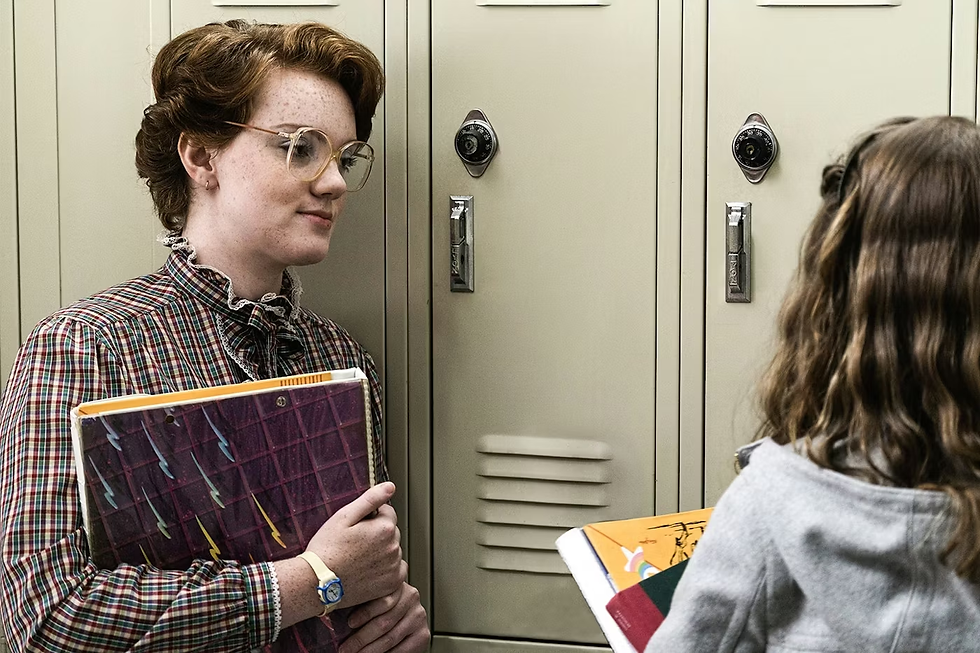
The Prop Master explains that the first season is set in 1981, a period when many watches now associated with the ’80s — such as Swatch or certain digital models — were not yet widely available. For that reason, anachronisms had to be avoided and models consistent with the transition between the 1970s and 1980s were used. Even so, characters such as Barb wore one of the first Swatch watches, justified by a specific narrative construction: an only child, sheltered and with access to the latest youth consumer trends of the time.
The children in the series mostly wore digital and calculator watches, from brands such as Casio or Timex, chosen for their historical plausibility.
Reiss admits, however, that these watches caused practical difficulties during filming, because of alarms and buttons pressed inadvertently, often making it necessary to remove the batteries.
Among the adults, the standout is the Timex Atlantis TW2V51000 worn by Sheriff Hopper, a utilitarian watch with a built-in compass, in keeping with the character’s pragmatic and practical nature.
The article stresses that, in Stranger Things, the watches are not there to catch the viewer’s eye, nor do they serve as product placement. On the contrary, they blend quietly into the narrative, reinforcing the credibility of the fictional universe and helping to tell the story without words.
Special-edition watches for Stranger Things
Beyond the watches that appear on screen, the Stranger Things universe has given rise to licensed special-edition watches, released later by mass-market brands. As a rule, these models do not correspond to the watches worn by the characters, but present themselves as contemporary interpretations of the series’ aesthetic and of the material culture of the 1980s.
In June 2022, Timex unveiled a capsule collection in collaboration with Stranger Things, explicitly embracing the 1980s aesthetic and imagery that define the Netflix series. The partnership comes across as a natural exercise in nostalgia, at a time when contemporary watchmaking frequently revisits its own past.
Timex Atlantis (ref. TW2V51000)
Set, as we have seen, in the ’80s, Stranger Things has become a visual reference for that decade, blending science fiction, horror and youth culture, with a cinematic language that evokes E.T. and The Goonies. It is precisely this universe that Timex brings to this collection, reviving three historic models from its ’80s catalogue: the Timex Camper, the Timex T80 and the Timex Atlantis.

According to Shari Fabiani, senior vice-president of Brand Marketing at Timex, this collaboration brings together two cult brands in a capsule deeply connected to the current cultural moment, thereby reviving one of the most expressive decades of the 20th century through timeless design and visual storytelling.
The three watches incorporate graphics and visual references from the series, including details associated with the Upside Down. The Timex Camper, a military-inspired analogue model worn by the character Lucas Sinclair, features INDIGLO® illumination with a hidden image. The digital models T80 and Atlantis, both originally launched in the early 1980s, feature a custom alarm playing the Stranger Things theme.

For its part, Casio presented themed editions based on classic models from its Vintage line, such as the DW-5600 and the AQ-800, adapted with graphic details and inscriptions referring to Stranger Things. These watches retain the full technical architecture of the original models, standing apart only through their visual language and special packaging.
The Timex × Stranger Things collection was launched in three versions in 2022 — Camper (40 mm), T80 (34 mm) and Atlantis (40 mm) — all priced at 89 dollars, positioning it as an affordable, commemorative edition clearly aimed at fans of the series and of retro aesthetics.


Comments